Tuesday, March 29, 2022

109) Dead of Night (1945) - The More Horror There Is...


Directors
Basil Dearden - The wraparound story at the farmhouse, and "The Hearse Driver."
Alberto Cavalcanti - "The Christmas Party" and "The Ventriloquist's Dummy"
Robert Hamer - "The Haunted Mirror"
Charles Crichton - "The Golfer's Story"

Cast
Mervyn Jones - Walter Craig
Frederick Valk - Dr. van Straatan
Roland Culver - Eliot Foley

"The Hearse Driver"
Anthony Baird - Hugh Grainger 
Judy Kelly - Joyce Grainger
Miles Malleson - the hearse driver/ bus conductor

"The Christmas Party"
Sally Ann Howes - Sally O'Hara
Michael Allen - Jimmy Watson

"The Haunted Mirror"
Ralph Michael - Peter Cortland
Googie Withers - Joan Cortland
Esmé Percy - The antiques dealer

"The Golfer's Story"
Basil Radford - George Parratt
Naunton Wayne - Larry Potter
Peggy Bryan - Mary Lee

"The Ventriloquist's Dummy"
Hartley Power - Sylvester Kee
Michael Redgrave - Maxwell Frere


Gary Gerani writes about the importance of the anthology film "Dead of Night" within the horror genre in his book "Top 100 Horror Movies." 

"Anthology style movies have had an uneven history at the box office. Audiences tend to prefer a single plot, theme and set of characters into which they can invest their emotions for ninety some-odd minutes. But of all the popular film genres, horror seems best suited to the fractured, multi-tale format, with or without a unifying 'host.' And undoubtedly the best of these episodic fright films is one of the first ever made, Dead of Night." (p.148)

Incidentally, Gerani places "Dead of Night" at number 20 in his top 100 horror movies. I think that's fair. This British horror film from 1945 deserves recognition for not only being an early horror anthology, but for its unique overall unique story line that portrays the hazy line separating reality and delusion. 
The film opens as architect Walter Craig (Mervyn Johns) is driving out to a country house to discuss renovations with a guy named Elliot Foley (Roland Culver). 
When Craig arrives, a handful of guests are sitting in the living room. 
He's rather dumbfounded when he enters because even though he's never met the people inside, he knows them for a reoccurring dream. He's also so familiar with the situation, thanks to his dream, that he's able to predict events that will occur around the house. He then predicts something terrible is going to happen before he leaves. 
A psychologist named Dr. van Straatan is one of the guests present. He tries to convince Craig that his fears are only in his head. The others, however, take an interest in Craig's insight and start telling each other about strange experiences they've personally had. These are where the stories begin. 

The Hearse Driver
This segment is based on a story by E.F. Benson.  
Hugh Grainger (Antony Baird) races cars for a living. One particular racing accident lands him in the hospital. 
One sleepless night, as his health has vastly improved, he notices the clock in his room stops. 
He gets up and happens to look out of his hospital window. A horse-drawn hearse is sitting underneath his window on the street below. The driver (Miles Malleson) looks up at Grainer and says in a Cockney British accent, "just room for one inside, sir." 
This, of course, freaks out Grainger. Soon after the experience, he's discharged from the hospital. 
He waits to catch a bus. And when it arrives, the bus conductor is the same man he saw driving the hearse. 
"Just room for one, inside," he tells Grainger.
Dumbfounded, Grainger doesn't board. The bus pulls away. And what happens next leaves Grainger thankful he listened to his instinct. 

The Christmas Party
Based on a story by Angus MacPhail, "The Christmas Party" this segment centers on teenager, Sally O' Hara (Sally Ann Howes). Sally tells of her experience encountering the ghost of a child during a Christmas party held inside a huge mansion. 
All the young guests start a game of hide-and-seek.  
Sally runs up a few flight of stairs and hides behind window curtains. 
A boy named Jimmy finds her, and then hides with Sally. 
Jimmy tells her about a murder that happened in the mansion years ago. Sally doesn't let the tale scare her, though.
They decide to hide up near the attic. Sally finds a door that leads to a nursery. She walks in and finds a little boy crying all by himself. 
She tries to console him, and then tucks him into bed. He says his name is Francis Kent. 
Afterwards, she heads back downstairs with all the other party goers. 
She inquires about the little boy upstairs she claims to have seen. Sally tells one of the adults about him and says his name is Francis. When its explained who Francis is, she nearly collapses with dred. 
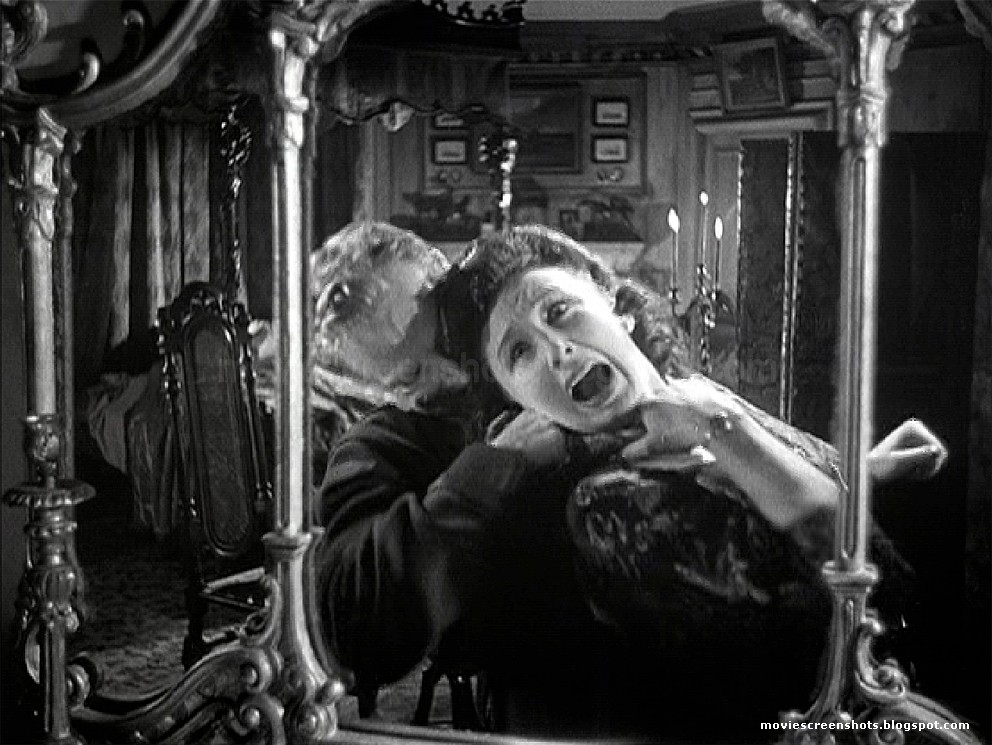

Ralph Michael and Googie Withers in 
the story "The Haunted Mirror."
The Haunted Mirror
After Sally tells her story, a wife named Joan Cartland (Googie Withers) talks about an antique mirror she gave her husband, Peter (Ralph Michael), as a birthday gift. 
At first Peter loves the mirror. It fits in their apartment well. 
But he starts seeing his reflection in an unfamiliar room whenever he looks in the mirror.
He thinks he's loosing his mind. Even when looking in the mirror with Joan, he can see the unfamiliar room, but can't see Joan's reflection. Joan says she doesn't see what her husband claims to be seeing.
Concerned, Joan looks into the mirror's history and who the previous owner was. 
The antique dealer who sold her the mirror tells Joan it belonged to a Francis Etherington who had murdered his wife after thinking she was having an affair. 
When Joan returns home after visiting the antique dealer, she finds Peter sitting alone in the dark facing the mirror. He's not himself at all, and accuses her of cheating on him. 
Things become violent fast, until Joan is forced to take care of the situation with her husband and the mirror herself. 


Golfer's Story
Based on the short story, "The Tale of the Inexperienced Ghost" by H.G. Wells, this segment is the comic relief of the movie. 
Golf buddies, George Parratt (Basil Radford) and Larry Potter (Naunton Wayne), fall in love with the same woman, Mary Lee (Peggy Bryan). 
To figure out which one of them will pursue Mary's affection, they agree to let a game of golf figure that out for them. The winner will have Mary's hand. The loser will not interfere in any way, and will disappear forever. 
Parratt ends up winning by cheating. Defeated, Potter walks into a nearby lake and drowns himself. 
Soon, his ghost appears to Parratt demanding he gives Mary up. If he doesn't he has to haunt him for the rest of his life. 
Of course, he doesn't. Potter's ghost, meanwhile, forgets how to make himself disappear. 
This becomes a major problem on Parratt's wedding night.


Michael Redgrave (right) and Hugo in
the story "The Ventriloquist's Dummy."
The Ventriloquist's Dummy
Dr. van Straaten tells his own tale about an interview he conducted with a ventriloquist named Maxwell Frere (Michael Redgrave). 
Frere is famous for his performances with his dummy, Hugo. He appears at various nightclubs and other venues. Frere is an English gentleman while Hugo is insulting and quick with his biting remarks.
An American ventriloquist, Sylvester Kee (Hartley Power) travels to England to meet Frere and his dummy. 
Hugo, who seems cognizant and tends to speak for himself, evidently wants to leave the act with Frere and join with Kee. 
During an act, Hugo seems to get out of hand, and Frere tries to silence him. Hugo then bites his hand which draws blood. 
After that show, Kee meets with Frere and Hugo in Frere's hotel room to talk business. 
The next morning, Frere finds Hugo in Kees' room, and accuses him of trying to steal his dummy. He ends up shooting Kees and is, of course, arrested. 
This is where Dr. van Straaten gets involved. He meets with Frere in his jail cell, and then has Hugo brought to the cell.
He watches as Frere has an argument with Hugo, and attempts to suffocate the dummy with a pillow before smashing its head in with his foot.  
When Kee, who survives being shot, visits Frere in the hospital, he finds that Frere isn't himself anymore.
This is the creepiest story, thanks in large part to Hugo. It's also a story that obscures what's real and what's pure delusion, which is done really well. Nothing is obvious in this segment.
In the final act back inside the house, Craig's horrific prediction comes true. He murders Dr. van Straaten. During this tragic event, he starts seeing himself within each of the stories he has heard throughout the course of the movie. 
Soon, he wakes up at the sound of the phone ringing, and tells his wife he had a terrible nightmare. The caller is Eliot Foley, inviting him to his country home to discuss renovations.
As the credits start rolling, we see Craig driving down the same country road from the beginning of the movie. He then stops at the same country house and is greeted by Eliot Foley. 
"Dead of Night" is a well-made psychological film with a theme (or so it seems to me) of human reaction to death and eternity. 
The first story seems to portray the looming reality of death. This leads to other stories surrounding individuals facing or confronting death in various manners. 
The reality of death is told in various unique ways. The movie doesn't completely rely on grotesque images and monsters to frighten the audience. Reality and mental delusion are obscure. 
It ends with Craig in an eternal loop. Is he in some kind of hell for his deed? Insanity is doing the same thing over and over again, and expecting a different result. 
"Dead of Night" feels a little ahead of its time as a psychological thriller and an anthology. Or, perhaps its more better to say the movie is foundational in the horror genre. 
I may have to re-watch this movie to gain some clarity about the entire premise.  
I thought I had "Dead of Night" figured out within the first 30 minutes. I anticipated that all the people in the room were dead and it would later be revealed they were all living some sort of hell. That's not quite the case. 
The movie slows down right before the last act. There's a slight but distinct foreboding feeling that wafts from story to story. It's interrupted in "The Golfer's Story."
That segment is intentionally silly, and ends with an uncomfortable situation. On Mary and Parratt's wedding night, Mary obviously wants Parratt to take her to the bedroom so they can consummate their marriage. 
Mervyn Jones as Walter Craig in "Dead of Night."
But Potter is forced to haunt him as he forgot how to make himself vanish. So, when they go into the bedroom, the idea is that Potter is going to be forced to watch them. 
Of course, it doesn't get that far as Parratt accidentally makes himself vanish leaving the ghost of Potter to...umm...fill in for him. No pun intended.
It would have been so much better if this story were depicted with the same trepidatious tone as the other stories. I haven't read Wells' story this is based on. I don't know if his short story is meant to be comedic or not. Either way, the comedy feels out of place in this movie. 
In "The Golfer's Story", Basil Radford, who plays George Parratt, and Naunton Wayne, who plays Larry Potter both starred as a double act in Alfred Hitchcock's 1938 movie "The Lady Vanishes" where they played Caldicott and Charters. They were popular enough that their characters in "Dead of Night" are derived from Caldicott and Charters.   
Though the movie doesn't rely on hideous creepy things that generally scare audiences (or did in 1945), it packs in a lot of frightful elements surrounding premonitions of death, spirits, cognizant (maybe?) ventriloquist dummies, unrequited love, and insanity. 
After the credits rolled, I couldn't wait to start writing. The story has been lingering in my head since I watched it.
I recognize Welsh actor Mervyn Johns from his later role as Bob Cratchit in the 1951 British film "Scrooge." English actor Miles Malleson, who plays the hearse driver in this movie, also appears as "Old Joe" in "Scrooge." 
But most recognizable of all is the young Sally Ann Howes who is well known for playing "Truly Scrumptious" in the 1968 film "Chitty Chitty Bang Bang."
I previously reviewed another horror movie that stars Howes - 1980's "Death Ship."
"Dead of Night" is like a long episode of "The Twilight Zone." It if were a Twilight Zone tale, it would surely be a classic episode worth remembering. 
I have yet to find another horror anthology film so well structured with a story well told in a multi-tale format without a singular host to tell it. It's a beautiful foundation to anthology horror films. "Dead of Night" doesn't begin inside a haunted house, or with a hideous monster telling us how we're going to be scared. It begins with a bad dream and a group of ordinary people sitting in a living room telling each other what weird experiences they've had. The uneasy grows from there. Well done! 

Monday, March 21, 2022

108) Drive-In Massacre (1976)

Stu Segall

Cast
John Goff - Det. Mike Leary
Bruce Kimball - Det. John Koch
Robert E. Pearson - Austin Johnson
Douglas Gudbye - Germy
Norman Sheridan - Orville Ingleson


I'm back in deep schlock territory with the 1976 B-slasher flick "Drive-In Massacre." 
This movie was made in, and is intended for, the era of drive-in movies. That's clear not just from the title. This was before drive-ins became seemingly antiquated Americana pieces that you might still find in random towns few and far between for mostly nostalgic purposes.
I've always wanted to watch a movie at a drive-in. I have yet to experience what that's like.
This movie tries relatively hard to turn the experience of watching a movie in your car into a potential life or death situation. Of course, at drive-ins, there's more going on than eating junk food and watching movies like "Drive-in Massacre."
The movie starts with a title card indicating that on "August 10th, at a rural California drive-in, the horror began."
We then see a young attractive couple sitting in their car as couples at drive-ins generally do. 
The horror wastes no time as the story starts off. Just as they're getting warm and cozy, the dude decides he actually wants to listen to the movie. He struggles (of course) reaching out the car window to grab the speaker. 
An unseen killer comes out of nowhere and slices the guy's head off with a single swipe of a sword. The girl also "gets it" through her neck. 
Detectives Mike Leary (John F. Goff) and John Koch (Bruce Kimball) investigate the murders. One of their fellow investigators advises them to speak with the theater's manager, Austin Johnson (Robert E. Pearson).
"I talked to the manager of the drive in," this other officer says. "His name is Austin Johnson, and you're really gonna like him. He's what you'd call your perfect asshole." There's really no clearer way to describe Johnson.
When they go to question Johnson, he's more upset that the theater owner disappeared and left him the undesirable task of running the place than he is over the fact two people were brutally murdered the night before. 
"So, a couple horny kids got themselves chopped up by some kook! So, what?" Johnson says. 
They also speak with the theater's custodian, Germy (Douglas Gudbye), who's much more helpful than Johnson. He tells the cops that a guy comes in every night to peep on the couples making out in their cars. They instruct him to write his license plate down next time he sees him at the drive-in.  
Johnson, by the way, treats Germy terribly and refers to him as a "miserable piece of vomit."
During the next night's show, the killer murders two other young lovers while they're...*ahem...making memories during the movie. 
This time, the killer leaves his sword behind. 
Previously, Germy told investigators the missing owner has a collection of swords. So, they bring Germy to the station to see if he can identify it as part of the owners private collection. Unfortunately, it's not. But Germy gives police the peeping tom's license plate number.
It belongs to a loner named Orville who admits upon questioning why he goes to the drive-in each night. 
Robert E. Pearson (Center) playing "the perfect asshole"
in "Drive-In Massacre."
During the investigation, police search Orville's car where they find clothing stained with blood. 
He tries to escape on foot, but they catch up and place him under arrest. 
But they have to let him go soon after because Orville insists the blood is from a dog he accidentally ran over with his car. The police confirm this claim with an analysis of the blood.
Orville insists his innocence, and also promises never to go back to the drive-in. 
The next night, Leary and Koch are at the drive-in disguised as a couple. 
They see Orville at the drive-in, despite his promise to never return. 
During the movie, a young guy tries to make out with the girl he's with. However, she's more interested in actually watching the movie. Frustrated, he storms off for a bit while she stays in the car.
When he returns, he finds his girlfriend without her head. 
Right away, the investigators think Orville is the killer. But when they approach his car, he's throat is slit. 
They were three cars away from the killings. And they were supposed to be looking out. How they completely missed everything happening is simply thanks to lousy story execution. 
The investigators take Austin and Germy in for more questioning. 
Austin is being his usual dick-headed self. Police want to close the theater down, but Austin refuses unless they obtain a court order. He then fires Germy. 
The next night, police get a call about a lunatic with a machete who just killed two people, fled to a warehouse, and is holding a young girl hostage.
Leary and Koch chase this guy down, and think this is their drive-in killer. Spoiler - it's not their guy.
Later, Germy goes to collect his things at the theater and have a word with Austin. 
The investigators see Germy walk into the projection booth. Then, a silhouette of Austin getting beheaded is visible on the movie screen.
The investigators rush in. What they find isn't what they expected. The movie ends abruptly with a disclaimer. 
The overall film reminds me of a homemade movie made by rather knowledgeable student filmmakers for their final project. It would earn them a solid "B+" for sure. I'd have to take points off for moments of poor writing and one or two instances of bad direction. Still, I would commend them for the amount of effort that went into their production. 
The horror element comes in strong in the opening, and then tapers off as the movie becomes a crime thriller rather than a slasher. 
The killer using a sword as his weapon makes the scenario seem that much more maniacal and insane. 
There's little happening after the gore in the beginning, except for investigating on top of investigating. 
The story seems to remember at times that it's supposed to be a slasher horror film, and tries to live up to slasher movie expectations with a horror scene here and there. 
The entire scene with Leary and Koch chasing the killer in the warehouse with the young hostage is one of the most awkward scenes in a B-film I've seen. 
The girl escapes his grasp, and never says a thing other than pleading for him not to kill her. 
When the investigators arrive, there's a cat and mouse chase through the warehouse before they finally shoot him.
The girl runs into frame, with hardly any emotion. 
"Did you have to kill him? He's my father," she says nonchalantly. 
I wonder why she couldn't have run out or shouted "Please don't shoot him. He's my dad."
The entire scene is awkward and terribly executed. I understand what the writers are trying to do with it. They're trying to set up a false conclusion to bolster up the audience's sense of dread. It's hilarious - unintentionally, no doubt. 
The trepidatious soundtrack reminds me of something you'd hear on a video game from an Atari, or whatever video game console people played in 1976. 
The ending is a cheap attempt to give the audience a lasting sense of uneasiness after the credits roll.
When the investigators break into the projection booth, they find the mutilated bodies of Johnson and Germy. 
Rather than show the audience who the killer is, a voice booms over the speakers at the theater.
"Ladies and gentlemen, this is the manager. Do not panic. There is a murderer loose in the theater. I repeat, do not panic. The police are on the way."
The movie then ends with a disclaimer on another title card.
"The killer could strike again. Anywhere...Anytime...Who will be next?" 
The beginning is enough to pull audiences in. But once they're in, it's like being tricked into listening to an insurance seminar or a time share sales pitch. Disappointing! There's something to build up to, but we're left with no satisfying conclusion. 
"Drive-In Massacre" wants audiences who probably first saw this movie at a drive-in to keep that uncomfortable "what if" feeling in the back of their minds as they drive back home.
I admit I had a little fun watching "Drive-In Massacre" primarily because of its B-Horror cult status, and the nostalgia of it all. 
The highlight of this movie is its writer, George Buck Flower. Flower is best known as "the bum" in "Back to the Future" and "Back to the Future II." 
He also stars in other well known films such as "They Live", "Escape from New York" and "Pumpkinhead" to name a few titles. I didn't realize it at the time, but he plays the maniac in the warehouse in this movie. Crazy drunk pedestrian! 
Though the movie starts off strong as a horror picture, if fizzles out to an underwhelming, haphazard story. But oddly enough, this one is kind of growing on me, all things considered.

Monday, February 21, 2022

107) Tales from the Darkside: The Movie (1990) - The More Horror There Is...

Director
John Harrison

Cast
Deborah Harry - Betty
Matthew Lawrence - Timmy

Lot 249
Christian Slater - Andy
Steve Buscemi - Bellingham
Julianne Moore - Susan

Cat from Hell
William Hickey - Drogan
David Johansen - Halston

Lover's Vow
James Remar - Preston
Rae Dawn Chong - Carola
Robert Klein - Wyatt

The television anthology series "Tales from the Darkside" is worth remembering. The show comes from the mind of horror legend George Romero and aired some campy but otherwise good episodes during its run.
I've mentioned the series before when I wrote about obscure movies and shows based on the works of Stephen King.
"Tales from the Darkside" ran from 1984 to 1988 on CBS. After the weekly horror series ended, the show's producer, Richard Rubinstein, went on to produce another horror anthology show called "Monsters." I've also mentioned this series in my list of Stephen King movies. "Monsters" ran from 1988 to 1991 and is a series I'd like to look into more. The only episode I've seen of "Monsters" is titled "The Moving Finger," based on a short story by King.
Both shows featured celebrity appearances similar to another horror series of tales I just wrote about that aired on HBO.
"Tales from the Darkside" somehow managed to earn itself a movie in 1990 called "Tales from the Darkside: The Movie." How original. And, like its source material, it has quite a list of celebrity actors in its three tales of terror. The stories come from the minds of Michael McDowell, Sir Arthur Conan Doyle, and... surprise... Stephen King.
The film begins with a wraparound segment starring rock singer Deborah Harry as a modern ghoulish witch named Betty, who's keeping a young boy, Timmy (Matthew Lawrence, "Mrs. Doubtfire"), locked in a cell. She feeds him cookies in the hopes of fattening him up because she's planning a dinner party, and Timmy is the main course.
Timmy tries to stall the witch by reading tales from a book she left in the cell with him—her favorite book when she was a child.

Lot 249
Screenwriter Michael McDowell starts the storytelling off with Sir Arthur Conan Doyle's short story "Lot No. 249."
In this tale, Steve Buscemi plays graduate student Edward Bellingham, who's a lover of antiquities and has been framed by two fellow students, Susan (Julianne Moore) and her boyfriend, Lee (Robert Sedgwick).
They stole a valuable museum piece and planted it in Bellingham's dorm room.
With the university breathing down his neck, as they think he's guilty of the theft, this betrayal will ruin his opportunity to obtain a scholarship.
Bellingham obtains an ancient mummy that he is able to reanimate by reciting words found on a parchment buried with the mummy.
As the mummy is under his control, he uses the corpse to murder both Lee and Susan in the same ancient Egyptian way it was preserved centuries ago. Back then, according to the film, Egyptians would extract the deceased's brains through its nose with a metal hook. Its insides were then removed and replaced with flowers and spices.
Susan's brother, Andy (Christian Slater), quickly figures out what is taking place behind Susan and Lee's murders.
He knocks Bellingham out and ties him up in a chair. Andy's plan is to get Bellingham to summon the mummy so he can destroy it. After that, he'll set Bellingham on fire.
Andy is able to destroy the mummy. But when he gets to the killing part of his plan, he can't bring himself to do it.
Later, Bellingham brings Susan and Lee back to life to obtain revenge on Andy.
McDowell's screenwriting credits include work on the TV series as well as on "Monsters," "Tales from the Crypt," "Amazing Stories," and "Beetlejuice." He's also a novelist and an all-around talented writer.
The story itself is a bit bland, and I say that with all respect to Arthur Conan Doyle. Though the premise certainly has the feel of classic horror, it's the lackluster performances in this segment that make it lackluster.
As the students are all upper-class, preppy '90s kids, they're all played without much personality or emotion. Julianne Moore screaming is the only time anyone in the story emotes.
This segment feels like a palate cleanser.
The horror is grotesque right away and continues through the film. The horrific imagery is what stands out most about "Tales from the Darkside: The Movie."

David Johansen in Tales from the Darkside: The Movie
Cat From Hell
George Romero takes this short story from Stephen King and includes it as the second tale.
It's both the most humorous story and the most disturbing as far as disgusting imagery is concerned. Spoilers ahead... because I have to mention the ending.
A wealthy old businessman named Drogan (William Hickey) hires a killer, Halston (David Johansen), to take out a simple house cat.
Drogan informs Halston that he owned a pharmaceutical company that used cats as test subjects for new drugs. This testing resulted in the deaths of thousands of felines. So, Drogan believes this cat, which suddenly appeared on the doorstep one day, intends to gain revenge on the entire household.
Drogan relates how the cat is responsible for killing his two sisters, Amanda (Dolores Sutton) and Carolyn (Alice Drummond, "Ghostbusters"). It also took out their family butler, Richard (Mark Margolis). Now, Drogan is next.
Halston, of course, thinks Drogan is out of his mind. But since he's paying big money, he accepts the job to simply kill a cat.
Drogan leaves him while Halston gets to work.
As he tries to take the cat out, Halston discovers it's his most difficult job yet.
When Drogan returns, he finds Halston's dead body on the floor.
The cat had leapt onto his face, forced its way into his mouth, crawled down his throat, and into his body. And the audience sees the entire thing happen.
As Drogan stares at Halston's body, the cat comes back out of Halston's mouth and leaps onto Drogan's lap. The shock leads to Drogan having a heart attack.
It's a predictable story, but Johansen certainly has fun with the role. He gives a lot of energy, infuriatingly yelling at this cat that's getting the better of him.
Evidently, this story was intended to appear in the 1987 horror anthology movie "Creepshow 2" but was ultimately scrapped.
The segment has the feel of a tale to be told in the "Creepshow" franchise, with its awkward angles, many of which are from the cat's point of view, and comic-book-esque flashback sequences shot with a blue filter.
Seeing a cat crawl in and crawl out of Johansen through his mouth is a well-done effect and a truly unforgettable scene.

James Remar as "Preston" in the story Lover's Vow.
Lover's Vow
Michael McDowell writes the final story in the film. And this is the most terrifying one. More spoilers are ahead.
A struggling artist, Preston (James Remar), lives alone in a studio apartment. A stone gargoyle on an adjacent building happens to face into his apartment through the skylight. His agent, Wyatt (Robert Klein), calls, asking to meet at a bar near Preston's apartment.
When Preston finally arrives, Wyatt doesn't beat around the bush. He tells Preston that his artwork isn't selling and that he's dropping him as a client.
Feeling demoralized, Preston stays at the bar and drinks a few more.
Before he knows it, it's closing time. The bartender offers to get him home, as he's too plastered to take himself home.
As the two exit into the alley, Preston takes a moment to relieve himself. Meanwhile, the bartender sees a winged gargoyle standing right there in the alley. So, he starts shooting.
The creature tears the bartender's hand off and then rips off his head.
It then turns its attention to Preston, who begs the creature to spare his life.
"Your life in exchange for a promise," the creature says.
Of course, Preston agrees.
"If I let you go, you must swear you'll never say you saw me, never say you heard me speak, never tell anyone how I look, never repeat what I've said. A promise... forever," it says.
He hesitates a bit, until the gargoyle raises its hand to strike. Then he promises.
"Cross your heart," the gargoyle says as it claws Preston's chest with three long slashes. And then it flies off.
Later in the night, trying to sober up while comprehending what he just witnessed, Preston runs into a young woman named Carola (Rae Dawn Chong) while she's trying to get home.
He stops her, warning her that it's dangerous on the streets.
Carola claims to be lost and wants to get a taxi. Preston encourages her to call a taxi from his apartment, promising she'll be safe.
After a while, the two fall in love, get married, and have a couple of kids.
In the ten years proceeding, Preston is burdened by the events he witnessed the same night he met Carola. He's never been able to forget. But his life as an artist has improved considerably, thanks in large part to connections Carola has in the art world.
That promise, though, chews at his mind incessantly. Holding in this experience has been difficult.
On their 10th anniversary, Preston decides to tell Carola about the gargoyle he saw the night he met her and how it killed the bartender.
He thought after ten years that his promise would have been forgotten. But it wasn't. And he broke it.
I find this story the scariest segment, with its depiction of a man's burden of being forced to hold onto a secret. How would someone cope with witnessing the existence of gargoyles but being forced to never tell? In Preston's case, demon-like gargoyles exist and kill people. And when he does tell someone, he's forced to watch all he holds dear succumb to that otherworldly reality.

Matthew Lawrence as "Timmy."
"Tales from the Darkside: The Movie" relies more on its horror and imagery, which, to the movie's credit, is unforgettable. The stories get better as they progress.
I recall seeing this in my younger days. Scenes from each story stuck with me for 30 years.
Too much of it initially comes across as flat and, at times, rushed.
After the third tale is told, young Timmy makes a quick getaway. He kills the witch and makes a cute remark to the camera, breaking the fourth wall, saying, "Don't you just love happy endings?" And then the credits roll.
This horror movie is a fun scare but doesn't exceed beyond that.
Still, it's a movie that has received a bit of a following and hasn't been lost to obscurity. With names such as Sir Arthur Conan Doyle, George Romero, and Stephen King, that's certainly no surprise.

Tuesday, February 15, 2022

106) NEW HORROR RELEASES - Shut In (2022)


Director
D.J. Caruso

Cast
Rainey Qualley - Jessica Nash
Luciana VanDette - Lainey Nash
Jake Horowitz - Rob
Vincent Gallo - Sammy


I've sat through probably too much of the mindless, tasteless drivel the horror genre has produced over the decades. But I've also watched, and re-watched, some of the most sublime and magnificent horror films made. "Frankenstein" (1931) remains one of my favorite movies in the genre.
On February 10, the conservative news site, The Daily Wire, released its first original horror movie "Shut In." I was taken in by the fact a relatively new news agency is producing its own horror film. I had to see what this would be like. So, I managed to catch the premier.
Often horror movies elevate the monster into a hero of sorts. Torture and murder become the homeruns audiences cheer for. Often do horror fans prefer to see the monster slaughter the innocent young girls. The more kills, the better. That's where schlock comes from. Sure, a lot of it is freaky and frightening.   Freaky and frightening is what attracts audiences and horror fans. But with such schlocky horror movies, that's all there is to take away at the end.
In an episode of "Siskel and Ebert at the Movies," film critics Gene Siskel and Roger Ebert narrowed in on this aspect of horror films which they claimed is often mixed with misogyny.
In that episode, Ebert says, "I think a lot of people have the wrong idea. They identify these films with earlier thrillers like 'Psycho' or even a more recent film like 'Halloween', which we both liked. These films aren’t in the same category. These films hate women, and, unfortunately, the audiences that go to them don’t seem to like women much either. To sit there [in a theater] surrounded by people who are identifying, not with the victim but with the attacker, the killer – cheering these killers on, it’s a very scary experience.” 
"Shut In" offers a relatable, frightening tale about a woman. Jessica Nash (Rainey Qualley) is a former meth addict who's now focused on keeping her life clean as she raises two young children. 
She lives in an inherited old farm house that belonged to her grandmother. Her plan is to sell the house, which is surrounded by apple trees, so she can move to a new location and start a fresh life.
While packing up belongings, Jessica accidentally gets locked in the kitchen pantry. While she's in there, her drug addicted violent ex-husband Rob (Jake Horowitz) shows up to the house with his drug addict buddy, Sammy (Vincent Gallo). Jessica is weary of Sammy as he's been previously accused of pedophilia. 
Rob lets her out of the pantry. As the two guys are clearly high and looking for cash, Rob locks Jessica back in the pantry in a fit of anger. He nails it shut as a form of "punishment" stemming from his own jealousy towards her undergoing drug rehabilitation. He also intentionally kicks a small bag of cocaine under the pantry door so she can fall back into her old habit. Rob insists she's not better than he is.
The two guys leave. Jessica now has to make sure her daughter, Lainey, is able to help take care of her son, Mason, while she's lock in the pantry. Mason is still a toddler, and Lainey is about four-years old. Sammy returns to the house alone several hours later. Jessica quickly has to find a way to stop him from harming her children. 
And she must quickly find a way to get out of the pantry. 
Amidst all her worries and fears, Jessica's period of darkness in the pantry forces her to face her urges to fall back into her cocaine habit, think about her relationship with God, and come to terms about being a mother despite feelings of inadequacy to be a good mom.
How will she come out of this darkness? 
Qualley's performance is magnificent as she so easily conveys Jessica's emotions and turmoil through simple inflections and body language. It's almost flawless. 
Rainey Qualley as Jessica Nash in "Shut In."

For a thriller, Shut In focuses a lot more on the moral of the story rather than the trepidation and sense of danger within the scenario. 
Initially, I anticipated the movie would focus more on the kids being in a place of danger while their mother is locked in the pantry and wicked men take advantage of the situation. 
As the film progresses, this isn't quite the case.
While some moments build up tension, they're quickly relieved. That doesn't necessarily make it a bad film. It simply wasn't as thrilling as I anticipated after watching the trailers. 
Monsters looming over us in dark places don't necessarily have to be evil demons, or machete yielding killers in hockey masks. They can simply be those small things we fight every day that bring us down, such as a small bag of cocaine, our own sense of failure, or bad company. Those worst case scenarios can be truly frightening to watch. 
Daily Wire co-founder Jeremy Boreing endorses this film as an artistic one.  
In his "Letter to Artists" Pope John Paul II writes, "Even when they explore the darkest depths of the soul or the most unsettling aspects of evil, artists give voice in a way to the universal desire for redemption." 
Suffering, inner-turmoil, and the desire to be rescued are themes running throughout the movie. "Shut In" accomplishes what it sets out to do without being preachy or hammering its themes over the heads of the audiences. 
The audience can easily put themselves in the main characters place. And not only are they in the pantry with her, they can reflect on their own struggles while she struggles with her own situation. They can realize the same truths as she does. There's always a way out. We just have to be willing to get a few scrapes and scars in the process.
I've always been of the opinion that horror should act as a sort of "how to" guide when it comes to facing our fears. Horror movies like this one can encourage us to overcome, rather than succumb. 
Though a bit underwhelming in its thrills, "Shut In" is truly one of the best thriller films I have seen in a while. The horror is certainly more psychological than bloody.
The simple, relatable, yet frightening scenario reminds me of something Stephen King would produce where the protagonist finds themselves stuck in some agonizing situation that could happen to anyone. Donna Trenton finds herself stuck in her Ford Pinto with her son Tad, fighting against the threat of dehydration and heat stroke as the ravenous St. Bernard dog, Cujo, waits to attack them outside their car. 
The only way out will require some sort of sacrifice, perhaps for the better. The protagonist will find their freedom. That much is certainly obvious. The cost of freedom isn't so obvious. 
Their exit from the darkness will leave a scar. And that scar will always be there. For Jessica, the freedom and the life waiting for her on the other end of the darkness within the pantry is much more sweeter. She's a mother, and that's worth any sacrifice.  
In his book "Danse Macabre", King says, "Horror movies do not love death, as some have suggested; they love life. They do not celebrate deformity, but by dwelling on deformity they sing of health and energy. By showing us the miseries of the damned they help us rediscover the smaller joys of our own lives. They are the barber’s leeches of the psyche, drawing not bad blood but anxiety … for a little while anyway." 
It's certainly not a ground-breaking film in the horror genre. It's a story similar to films such as "Panic Room" (2002) and "Don't Breath" (2016) but with a bit more emphasis on its themes. Still, I'm glad I saw it.

Sunday, February 13, 2022

105) Munchies (1987)


Director
Bettina Hirsch

Cast
Harvey Korman - Cecil Watterman/ Simon Watterman
Charles Stratton - Paul Watterman
Nadine Van der Velde - Cindy
Alix Elias - Melvis

I've heard claims, most likely false ones, that horror flicks such as Ghoulies (1985) and Critters (1986) are rip-offs of the 1984 movie Gremlins. I argue that that's not the case. Ghoulies began production in 1984 - the year Gremlins was released. And Critters is certainly its own thing. 
I can't vouch for the 1988 creature feature, Hobgoblins. Once I watch it, then I'll let you all know. 
But one creature feature that really struck me as taking some inspiration from Gremlins is the 1987 cult creature feature, Munchies. 
These little monsters originate from another country, they multiply, have anti-social attitudes, and make life hell for people by wreaking havoc where ever they end up. 
The stories for both films are a little similar which doesn't surprise me as Munchies is directed by Bettina Hirsch who previously worked as film editor for Gremlins. 
Franceso Borseti interviews Hirsch in his book It Came from the 80s!. There, she claims that Roger Corman had wanted to make a film similar to Gremlins as it was a profitable franchise at the time.
"Coincidentally, he had recently asked the heads of companies that made lower-budget movies, what their most profitable projects were," Hirsch says. "All of them mentioned making money from Gremlins rip-offs. He was in the process of getting a creature script. I had cut Gremlins, so it would be a perfect fit." 
Harvey Korman kicks this mess off as space archeologist, Simon Watterman, exploring a cave in Peru with his son, Paul (Charles Stratton). 
Paul's ambition, by the way, is to be a comedian. But his dad constantly reminds him that he's not funny. And he's right.
During his search inside some ancient ruins, he finds a dormant alien-looking creature. He somehow reanimates it and brings it back to the states. 
He thinks this creature will be the greatest alien discovery.
When they get back home, he leaves it with Paul and his girlfriend, Cindy (Nadine Van der Velde) while he goes out to prepare for...something...I don't know?
They name it Arnold, although Cindy calls it "Munchie" since it loves snack foods.
Since they're home alone with Arnold, or Munchie, Paul gives the creature a porn magazine to keep it occupied while he and Cindy go upstairs to have sex.
Simon's evil twin brother, Cecil (played also by Harvey Korman) lives right next door. Cecil works in the snack foods industry, and often spies and eavesdrops on what's going on inside Simon's house.   
He lives with an adopted dork of a son whom he cares nothing about. And he has an Elvis-obsessed wife as well who shows up later in the movie.
When the coast is clear, Cecil sneaks over with his adopted son to try and kidnap Arnold. 
As they chase the creature around, they end up hurting it. 
This makes Arnold turn very aggressive and attack.
Cecil's son tries to kill it by chopping it into pieces.
Little does he know that this is how these creatures multiply. Each body part becomes a whole new "Munchie." 
The small gang of alien creatures escape, and can suddenly talk. For some reason, they talk like thugs off the streets of Brooklyn. 
They love women, drink a lot of beer, attack innocent people, and gorge themselves with junk food.
And the rest of the movie is just repetitive cat and mouse chasing, with over-the-top gags and humor in between.
Arnold initially sounds like Gizmo from Gremlins. 
Speaking of voices and sounds, the talents of Fred Newman and Frank Welker provide Munchie's voice.
Several small nods to other horror movies like Halloween III: Season of the Witch and Evil Dead are sprinkled throughout. And there's a small E.T. gag that made me roll my eyes. 
Harvey Korman is a legendary comedian. He was hilarious during his days on the Carol Burnett Show.
It's unfortunate that all he has to go with here is his bad wig and fake mustache while playing Cecil. Korman isn't given much else to work with. He bolsters his appearances up for humor because his lines aren't funny. Korman isn't given much else. 
A cameo from Robert Picardo, dressed as an ice cream man, is a surprise. 
Also, Ellen Albertini Dow (The Wedding Singer, Patch Adams) plays an outlandish old lady who's ready to take on these Munchies for attacking her while she's driving down a road. 
This creature feature is light on the gore. In fact, there's really nothing to it. 
The jokes are just silly humor. There are a lot of caricatures, and lame cracks. Only one scene made me laugh. That's not an exaggeration. Even "stupid humor" can still, sometimes, make me laugh. This movie resorts to the lowest denominator with making the creatures vulgar and disgusting. There's no reasoning or explanations.
At times, the sound is inconsistent between shifts in the camera angles. 
Otherwise, this movie is dull and repetitive. The music soundtrack constantly makes it seem like something important is happening. Nothing ever does.
Many of these actors go into their roles like their performing as a favor to the director. Some of it is way too over-the-top such as the performances from Cecil's son and wife. The others are apparently dull and lackluster.
The plot involves people chasing the creatures, then finding them, then chasing them, and then finding them again, and then chasing them, and then finding them, only to chase them again. It's more of a low-budget puppet show - one where nobody tries very hard - than it is a true creature feature. The only elements worth remember are the names attached to this movie - Wendy Shaal, Robert Picardo, Frank Welker, Paul Bartel, Ellen Albertini Dow, and obviously Harvey Korman.
Corman can, and has, made some sublime low-budget bad flicks. Munchies isn't one of them. It's bad all around. 
If Gremlins is the name brand, Munchies isn't even the store brand. It's more like the "Save-On" version found beneath the generic store brand. 

Ellen Albertini Dow in Munchies.


Friday, January 28, 2022

104) Tales from the Crypt (1989-1996) - The More Horror There Is...

I started this post back in 2019. I'm finishing it now. And it's timed perfectly as I meander through horror anthologies in posts I've been calling "The more horror there is." 
I thought it would be worthwhile to list what I think are the best episodes from the classic HBO series Tales from the Crypt. I never watched the show while it originally aired from 1989 to 1996, save for a few instances when I caught at episode or two at friend's houses. 
Part of that was due to its sexual content, graphic violence, nudity, and profanity. You know, typical HBO stuff. 
The other half of that was because my family didn't subscribe to HBO, which was a wise decision in hindsight. 
In 2019, I found the entire series on DVD for a very reasonable price. 
I've read a lot of the EC horror comics in my adult years. Even non-horror fans probably heard of some EC titles such as The Vault of Horror, The Haunt of Fear, Shock SuspenStories, and Two-Fisted Tales.
The more popular comic in that EC lineage of horror and schlock is Tales From the Crypt, created by Bill Gaines and Al Feldstein. No doubt its popularity is primarily due to the HBO series of the same name.
Just like the comic, the show was hosted by the "Crypt Keeper." With his decayed flesh, piercing sky-blue eyes, sarcastic and horrific pun-filled humor, he introduced each new chilling story to us "boils and ghouls" in every episode.
The comics also feature an "old witch" and a "vault keeper" who tell some of these ghoulish stories within the pages. 
These issues are still a novel treat to flip through. 
And while the series makes these same stories its own through the medium of television, they're just as fun to watch. Behind the campiness of some of these segments, the series doesn't hold back in the gore and terror. That, of course, was thanks to its airing on the unscrupulous HBO.
Tales from the Crypt is by far one of the best comic adaptation TV series in the history of comic adaptation TV series. 
While much of the horror is blood and gore, a fairly equal amount is psychological. I call that sort of fear "did I remember to lock my car door" horror, but intensified. 
The series captured the voice and the style of the comic book, each issue having different horror and thriller stories. 
Some episodes stand out above the rest thanks in part to the celebrity appearances. Practically every episode has a well known guest star - Demi Moore, Tom Hanks, Arnold Schwarzenegger, Christopher Reeve, that kid from Indiana Jones and the Temple of Doom, Don Rickles, Dan Aykroyd, Michael J. Fox, Iggy Pop, and Joe Pesci just to drop a few names. Several episodes are also directed by great directors such as Robert Zemeckis, Richard Donner, William Friedkin, and Bob Gale. I get a sense that back then, being a celebrity guest or featured director on the show was a badge of honor. 
Even some celebrities, such as Michael J. Fox, Tom Hanks, Bob Hoskins, and Arnold Schwarzenegger sit in the director's chair for an episode or two.
Some episodes are over-the-top just like the comics. Others have a more serious tone, yet are still horrific to some degree or another..  
I was fortunate enough to find a complete series collection on DVD for under $30. So, as I watched the entire series from beginning to end, I've picked out my personal favorite episodes.
Many of the stories told in the HBO series are taken from the other EC horror comics I mentioned earlier.

Season one


"Jonas" from the segment Collection Completed, which
aired on June 28, 1989.
Tales from the Crypt starts off with a lot of eagerness, energy and gusto. It's like the writers already knew what they wanted, and couldn't wait to get it rolling. 
It's heavy on the fun clichés and bargain-basement horror elements like old creepy houses, voodoo, and maniacal killers on the loose.
And All through the House, the second episode in the initial season, tells a story that's also depicted in the 1972 film Tales from the Crypt. This segment stars Mary Ellen Trainor (Goonies, Lethal Weapon, Ghostbusters II) as a greedy housewife who murders her husband for insurance money on Christmas Eve. Her young daughter is asleep upstairs, eagerly awaiting the arrival of Santa. 
Meanwhile, a homicidal killer escapes from a mental hospital and is now the loose, dressed as Santa. As she tries to get rid of her husband's corpse, he pays her a little visit. 
It's the quintessential Tales from the Crypt story, and told with more disgusting imagery than the 1972 movie. Horror icon Larry Drake plays the homicidal Santa Claus. It's a nice little slasher story told in 30 minutes.

Collection Completed is definitely one the series' more cheesy episodes, and I like it for that reason. 
It tells the tale of an older man named Jonas (M. Emmet Walsh) who's forced into retirement thanks to his wife's out-of-control habit of adopting animals. He grows so sick of her habitual adoptions that he decides to turn them into a hobby of his own. 
It's certainly over-the-top horror, which makes it a fun segment. And it captures the same tone and feel of the comic. 

Season two


Jon Clair (left) and Moses Gunn in the segment, Fitting Punishment.
The next season carries the energy of the first season well. 
Cutting Cards is, in my opinion, one of the more iconic episodes in the entire series. It takes a more serious tone than previous episodes. 
Two gamblers, who passionately hate each other, square off in unfriendly challenges. The ultimate loser must leave town for good. 
The stakes are violent and brutal. And the more they carry on, the more violent they get just so each can see the other in pain. But neither want to give their rival that satisfaction. 
The segment stars Lance Henriksen and Kevin Tighe, both of whom put so much character and energy into their respective roles. It's an intense episode as the two rivals go at it with as much hatred for each other as they can muster. 

The Ventriloquist's Dummy is another segment that's pure EC style horror as it relies on pure cringe to shock the audience. 
This episode is one among many directed by Richard Donner. Comedian Bobcat Goldthwait plays Bill Goldman- an up and coming ventriloquist who wants to master the craft. He approaches his icon, Mr. Ingles (Don Rickles) for tips. 
But Billy gets more than he bargained for when he finds out his idol's deepest, darkest secret- who's behind the dummy.

Fitting Punishment is a gruesome revenge tale that makes my skin crawl even as I think of it. The segment stars Moses Gunn (The NeverEnding Story) as an overly religious funeral home director. 
After a tragic car accident, he's forced to care for his teenage nephew, Bobby (Jon Clair). 
He grows abusive towards Bobby, while making him his apprentice mortician as payment for room and board.
Bobby immediately takes a disliking towards his uncle. Their unstable relationship finally meets a boiling point that leads to a truly terrible accident.
Moses Gunn puts a ton of emotion and seriousness into this one role. He is truly an actor's actor. 

Season three


Kirk Douglas as Gen. Calthrob in the segment "Yellow" 
which aired Aug. 28, 1991 on Tales from the Crypt.
By season three, Tales from the Crypt feels truly established.  
Carrion Death is a brilliant "what if" type of story.
Kyle MacLachlan plays murderer, Earl Raymond Diggs, who escapes from jail. He crosses the desert trying to make it to the Mexican border before the state trooper pursuing him catches up.
When he does catch up, and slaps handcuffs on him, the trooper swallows the key - literally. 
Diggs kills him, and now has to trek across the desert cuffed to the dead body of this state trooper.
It's a story that wants the audience to put themselves in the main characters place, and ask themselves what would they do. The ending is loaded with such cheesy stupidity, it's fantastic.

Yellow is the only full hour episode in Tales from the Crypt. This segment is more of a psychological horror, although drama is a better word to use. 
The story is set during World War I. Lt. Martin Calthrob (Eric Douglas), who's the son of an Army General (Kirk Douglas), is court-martialed for cowardly failing to warn men under his command that German troops were approaching while they attempt to fix a broken communication line. As he runs for his life, those same men are killed. 
Before dying, Sgt. Ripper reveals to the general what Lt. Calthrob failed to do, calling him "yellow."
Calthrob is sentenced to death by firing squad. 
His father tries to save his son's life by swapping the bullets with blanks. His son just needs to face death with bravery and dignity.
Lance Henriksen returns to the series as Sgt. Ripper.
The story is taken from Shock SuspenStories number one, though initially I assumed it was published in Frontline Combat - an anthology war comic also published from EC Comics. 
It's definitely one of the better stories in the show. I'll admit I didn't see the ending coming until moments before.
Kirk Douglas and his true son, Eric Douglas, star in this segment along with Dan Aykroyd. 

Season four


Christopher Reeve and Bess Armstrong in
the Segment "What's Cooking."
This season certainly has some of the funniest and most insane episodes. 
What's Cooking stars the late, great Christopher Reeve along with Judd Nelson, and the late, great Meat Loaf.
Husband and wife Fred and Erma (Reeve and Bess Armstrong) are struggling to maintain their failing diner. The problem is they only serve squid dishes. 
Their luck changes after their janitor, Gaston (Judd Nelson - The Breakfast Club), gives them some delicious steaks to try. 
The couple put these steaks on the menu, only to find out the meat came from Gaston's landlord, Chumley (Meat Loaf). Actually, the steaks are Chumley himself.
As shocking as it is, still...the steaks are a hit with customers. Business quickly begins to boom. 
Superman himself, Christopher Reeve, in this role is such a trip to watch. 

King of the Road is a story with a pretty good the twist.
Brad Pitt plays a typical street racing punk kid named Billy who's confronted by a Sherriff named Joe Garrett (Raymond J. Barry).
Billy recognizes that Garrett is a legendary former street racer once known as "Iceman." So, he does the obvious. HE challenges him to a race. 
To ensure Iceman accepts his challenge, Billy kidnaps his daughter.
So, he's forced to accept in order to save his daughter's life.
This segment was originally filmed for the pilot episode of a spin-off series Two-Fisted Tales which was going to air on the Fox Network. But Fox passed on it, and it aired on Tales from the Crypt instead, along with the segments Yellow and Showdown (season four, episode eight). 

Split Personality Joe Pesci can be both intimidating on screen, or funny should the role he's playing demand it. And no, I won't make any references to Goodfellas after using "Joe Pesci" and "funny" in the same sentence.
This is one episode I can recall from childhood after watching it at a sleep-over back in my elementary school days. 
Pesci plays a con man named Vic Stetson who goes in for a big con after his car breaks down in front of a mansion.
The home owners, two gorgeous twins named April and June Blair (Jacqueline Alexandra Citron and Kristen Amber Citron) let him come inside to use their phone.
He quickly learns these twins are worth $2 billion. 
Wanting to get his hands on their fortune, Vic convinces them that he also has a twin in order to fool them into marriage.
What Vic doesn't realize is that he doesn't know the twins as well as he thought he did. The final scene is burned in my memory, probably forever. 
This episode also stars Burt Young - Paulie from the Rocky movies.

Season five


Tim Curry as Winona Brackett.
By now, the series seems more saturated with campy stories. Of course, the previous seasons have their share of schlocky tales as well. 
Death of Some Salesman is absolutely unforgettable as it stars Tim Curry in three roles. Fan-bloody-tastic!
I haven't seen any Tim Curry performance I didn't like. 
The story involves sleazy door-to-door salesman, Judd Campbell (Ed Begley, Jr.) who tries to swindle other people's money by selling them over-priced burial plots for fake graveyards.
He calls on a hillbilly family (ma, pa, and Winona Brackett - all played by Tim Curry) who have a load of money stashed away in their house. 
Little does Campbell know they have already been cheated once too many times. 
Curry as Winona Brackett is one of the creepiest and unforgettable performances I have ever seen him in. By the way, Curry also stars in the 2002 Tales from the Crypt film, Ritual. I'll have to check that one out later.

Food for Thought stars Ghostbuster, Ernie Hudson in a villainous role. 
He plays "the Great Zambini" who's a mind reader performing in a circus. He tries reading his wife Connie's (Joan Chen) mind.
When he successfully does, she happens to be in the middle of a passionate affair with the fire-eater. So, Zambini goes insane with jealousy. 
Hudson seems like a gentle, friendly, cordial person. His role in this episode is just the opposite. Well done, Ernie. Well done!

People Who Live in Brass Hearses is a story about an ice cream man, and is another pure cheese tale at its best.
Billy DeLuca (Bill Paxton) is just released from prison after serving a two-year stint for embezzlement. He gets his mentally challenged brother, Virgil, (Brad Dourif) to help him gain revenge on the ice cream man who ratted him out to the police. Virgil, however, messes up at every step of the plan. 
This story is one of the more "so dumb, it's good" segments. I have to include it among my favorites. 

Season six


John Lithgow and Humphrey Bogart starring
in the segment You, Murderer.
This is where the series begins to feel lackluster, tired and, at times, forced. 
It's like the writers are starting to lose steam in their imagination and will power to produce episodes that could leave the audience horrified. That is, until the last episode of the season.
You, Murderer is the most unique story in the entire series. 
It's narrated by the deceased Lou Spinelli whose a former criminal turned businessman. He undergoes plastic surgery to resemble Humphrey Bogart. And he's portrayed by Bogart himself, though Bogart passed away in 1957. 
Throughout the story, Spinelli tells of the greed, sex, and murder that lead up to his death. The entire segment is told from his point of view. We occasionally see his face, which is the face of Bogart himself. 
I'm willing to bet that in the wake of the 1994 film Forest Gump, which brought back several notable dead people to star in the film, Tales from the Crypt producers wanted to do something similar.
This episode has the feel of a film noir. It goes to show that dead celebrities staring in films and, in this case, television shows is nothing new. 

Season seven


A scene from The Third Pig, the final episode of
 Tales from the Crypt which aired July 19, 1996,

The last season is certainly hit or miss. Some episodes are either boring, uncomfortable, or merely alright at best. By this point, the series needed to end.
There's one episode that left me unsure whether I liked it or not. I'll throw it in for the sake of mentioning it. The rest just didn't grab my attention, or were ridiculously underwhelming, such as the episode Cold War with Jane Horrocks, Colin Salmon, and a young Ewan McGregor.
This is also when the series moved from Los Angeles to England to film episodes. 
To the producers credit, it was something new and different for the show. The U.K. offers more opportunities to shoot in castles and large estates. It offers a different atmosphere. 
Recognizable names from that side of the pond also make their way into season seven episodes, such as Bob Hoskins, Steve Coogan, Daniel Craig, and veteran actor Roy Dotrice. 
Though some horrific elements remain to some degree or another, the majority of these episodes feel like I'm watching a PBS series. It sticks to the motif of bad people getting what's coming to them.

Horror in the Night is one of this season's more gory episodes thanks to a few disturbing scenes of horror and psychological turmoil.
Nick Marvin (James Wilby) is a jewel thief who is purposely deceived by his partner, "T" (Ronan Vibert).
After a shoot-out between the two, Marvin hides in a cheap hotel. While inside, horrific images and psychological turmoil torment him. 
He's also visited by a strange yet gorgeous woman named Laura (Elizabeth McGovern). 
He quickly learns only he can see Laura, whose motives quickly change as the night progresses.
One particular scene during a dream sequence is especially morbid and disturbing.

The Kidnapper is the episode in which I wasn't sure what to make of it. It's uncomfortable to watch in the sense that I couldn't help put myself in the shoes of one of the main characters. 
In this episode, Steve Coogan plays a simple-minded pawn shop proprietor named Danny. 
When a homeless pregnant girl named Teresa (Julia Sawalha) enters the shop, Danny takes pity on her and offers to let her stay with him. 
It doesn't take long before Danny develops feelings for Teresa. She, however, doesn't share the same romantic feelings, though she is very grateful for his generosity and kindness. Teresa just sees him as a true friend. 
Time goes by, and her baby is now apart of both their lives. The baby takes up most of her attention, as babies often do. Danny grows envious, and wishes the baby were out of the picture.
He hires a kidnapper to steal the child, hoping his absence will lead to a romantic involvement between the two. Rather, it only leads to Teresa's emotional break-down. 
Regretful of what he's done, Danny sets out to retrieve her baby. As I write out this synopsis, the episode now leans more towards the side of ludicrous than it did while I watched it. 
The ending though left me feeling chillingly uncomfortable, which is what this series is supposed to do. I've included it here because it's an episode that left me thinking afterwards. 

The Third Pig ends the entire series with a magnanimous bang, and an animated one at that. This is the only animated episode in the series. 
This segment retells the story of the three little pigs, narrated by the Crypt Keeper. 
The Big Bad Wolf (voiced hilariously by Bobcat Goldthwait) attempts to devour the three pigs, Drinky (Brad Garrett), Smokey (Charlie Adler), and Dudley (Cam Clarke). Drinky builds his house out of an old alcohol barrel. Smokey builds his out of  match sticks and cigarettes. And Dudley builds his home out of bricks. 
As Smokey and Drinky loose their homes to the wolf's huffing and puffing, they bunk in with Dudley, and soon begin bossing him around. 
One day, as Dudley goes to the store to buy them beer and smokes, the wolf pays them a visit. 
He eats them, and leaves a mess of carnage inside. 
Dudley is accused of the murders and is thrown in the clink by a judge and jury composed of wolves. The ghosts of Smokey and Drinky show up to help break him out. He then plots revenge against the wolf who killed hills brothers. 
It's story that's original to the show as it's not pulled from the comics as far as I know.
Being animated allows for some truly grotesque, ghoulish horror scenes. It's a fantastic send-off for the series.

It goes without saying Tales from the Crypt has left an indelible mark on pop culture, and the horror genre specifically. I would love to see this series rebooted. The Crypt Keeper is, without a doubt, one of the best show hosts in show hosting history. He's truly iconic.
The series spawned a trio of films, Demon Knight (1995), Bordello of Blood (1996), and Ritual (2002).
There was also a Saturday morning cartoon, Tales from the Cryptkeeper which ran for two season from 1993 to 1994. Though I watched Saturday morning cartoons religiously back then, I have no recollection of this show.
Looking up the premise of the cartoon, I read that the Old Witch and the Vault Keeper, pulled straight from the comics, were regular characters on the show. Evidentially, a third season called New Tales from the Cryptkeeper aired in 1999, teaching kids some morals and lessons with the Crypt Keeper in a more active role than just storyteller. Weird, but...whatever.
As far as the HBO series goes, it's a fun venture that maintains the atmosphere and feel of the comic anthology so well, even though it's a different medium. That's quite an accomplishment. These are tales meant to chill, and they do precisely that - all jolting tales told in the EC tradition.