Showing posts with label Not Reviews Necessarily. Show all posts

Monday, July 27, 2026

Not a Review Necessarily - My 'Carrie' trailer reaction

Summer H. Howell as Carrie White in the upcoming miniseries "Carrie." 

Horror writer Stephen King's first novel, "Carrie," published in 1974, is getting a new movie. I don't know what to write that would best convey how unenthused I am. It's been done already. More than once. 
Well, it's not just a movie. It's a miniseries. And the trailer for this new adaptation of King's story dropped July 25th. 
I have to add that it seems Stephen King miniseries are more often terrible or mediocre at best. I think I can count on the fingers of one hand those that are actually good on the fingers of one hand. 
"Salem's Lot" from 1979 is one of the best vampire movies I've seen. "The Stand" from 1994 is also pretty good. And "11/22/63" is certainly worth checking out. My wife even liked that one, and she's no Stephen King fan. "Welcome to Derry" which is based on characters from King's "It" was alright. Not mind blowing but I tuned in to finish the whole series. I'll throw in the series "Castle Rock" which is based on multiple stories by King just to give the good list a solid five titles. The second season was better than the first. 
But it's easier to remember the awful ones - "The Tommyknockers" (1993), "The Langoliers" (1995), "The Shining" (1997). That's "The Shining" with Steven Weber and Rebecca De Mornay. It was certainly underwhelming. And "Rose Red" (2002) was, as I recall, boring. 
"Carrie" is about a 16-year-old high school girl named Carrie White, living in Chamberlain, Maine, who has the power of telekinesis. She's mocked and ridiculed at school. And she lives with her overly zealous religious mother who thinks everything about her own daughter is an abomination before God. Fast forward to the infamous prom scene where some bullies dump pigs' blood on her, and all hell breaks out. Audiences have seen it over and over again, even if they didn't read the book. 
The first adaptation of King's novel, and the most well known in the horror genre, is director Brian De Palma's 1976 movie of the same name starring Sissy Spacek as Carrie. and Piper Laurie as her fanatical mother. John Travolta also stars in a supporting role along with William Katt.
In 1999, "The Rage: Carrie 2" was released as a direct sequel to De Palma's movie. Directed Katt Shea, the sequel stars Emily Bergl as Rachel Lang who is the younger half-sister of Carrie. Like her older half-sis, Rachel also possesses telekinesis. It was released in theaters and panned by critics. 
In 2002, a made-for-TV version of "Carrie" was released and premiered on NBC. It stars Angela Bettis in the lead role along with Patricia Clarkson as Carrie's mom. Like most other Stephen King made-for-TV stuff, it bombed. 
And then in 2013, a third adaptation was released starring Chloë Grace Moretz and Julianna Moore. I saw this in theaters when it was released. Despite the good acting, I found it poorly cast. Chloë Grace Moretz does not strike me as an unpopular girl at school. She has all the characteristics of being the kind of high school teen other students would be fumbling over themselves to vote for as prom queen. She doesn't seem like the kind of teenage girl who would have any trouble finding a date to the prom, neither. But she was cast as Carrie. Though her acting was great, the role didn't fit her. 
This new adaptation of "Carrie" is directed by Mike Flanagan and starring Summer H. Howell in the title role alongside Samantha Sloyan as her mother.
While the trailer looks like it'll be more of the same, all I really can say is that it better add something new to the prom, the likes of which hasn't been seen in previous adaptations. 
Maybe the acting will be phenomenal. Maybe as a miniseries, "Carrie" will be an edge-of-your-seat thriller. Still, based on the trailer, I'm not holding out for anything even partially mind-blowing. I don't know anything about Summer H. Howell, but I will say she does seem to fit the part of Carrie White. She certainly does way more so than Chloë Grace Moretz. 
Director Mike Flanagan is, I'll say, a decent director. He directed "The Haunting of Hill House" (2018) which I enjoyed. He also directed the Stephen King movie, "Doctor Sleep" in 2019 which is based on King's novel sequel to "The Shining." And I thought it was a well done! It's also not the only other King IP that Flanagan directed. He did "Gerald's Game" in 2017 which I watched but I don't remember much about it except the ending. 
And speaking of Flanagan's horror movies, he did the movie "Oculus" also in 2017. That was a pretty well put-together film. So, maybe "Carrie" will be a great series. I'm still not waiting with shaking anticipation to see it. Why? Well, it looks like more of the same.  
Too often, Hollywood producers, who are often too stupid to realize how out-of-touch they are, often mistake familiarity for demand. Just because audiences recognize the title and maybe have a nostalgic love for an IP like "Carrie" doesn't mean they're asking for another version of the exact same story again and again. But, as I said, Hollywood is painfully out-of-touch.  
Maybe I'll watch it should someone else recommend it.
The series is scheduled to premier October 7, 2026 on Amazon Prime. I'll probably be tuning in to something else. 

Tuesday, June 25, 2024

Not a Review Necessarily - My Nosferatu trailer reaction

The 1922 silent German expressionist vampire film "Nosferatu," directed by F.W. Murnau and starring Max Schreck as Count Orlock, opened the horror genre to vampire movies. 
Count Orlock was the vampire before Bela Lugosi established the quintessential vampire through his depiction of Count Dracula in 1931 with his sleek black hair, alluring Central European/ Romanian accent, debonair appeal, and mysterious and sinister darkness.
Count Orlock is a demon of a vampire both inside and out.
He has an otherworldly appearance, piercing glare, emotionless and unsympathetic demeanor, and his shadow is just as menacing as his person. 
I happened to watch the original "Nosferatu" a month ago and wrote some commentary about which I'll post in October. 
A trailer for "Nosferatu," a remake set to be released Christmas of this year, dropped on Monday. 
It's the second remake of Murnau's brilliant and truly horrific foundational film. The gothic horror movie "Nosferatu the Vampyre" was released in 1979 starring Klaus Kinski as "Count Dracula." He's called that rather than "Orlock" in the movie.
In 2000, the film "Shadow of the Vampire" was released which tells the backstage story about the filming of "Nosferatu." It portrays the suspicions that the film crew had about Max Schreck based on how seriously he took his performance as the vampire. Willem Dafoe plays Schreck in that initial remake.
Willem Dafoe in the upcoming movie, "Nosferatu."
I see "Nosferatu," and maybe Dracula in general, as an allegory for the deadly sin of lust - an enticing powerful emotion that kills love and the soul in the end. It's a vice that makes slaves out of those who give into its seductive allurement, and in most instances struggle all their lives to escape it. 
What person who indulges in lust can stand the sight of a crucifix? The guilt of what the lustful person does in the cover of darkness and secrecy is heavy. The fear of being found out and their secrets being brought out and exposed outside of that darkness is a nagging feeling. But the enticement of lust is too strong and appealing to resist. 
Only the unrepentant soul will cringe at the thought of being exposed, ultimately running away from God. On the other side, the repentant will glorify God for His infinite mercy. 
I worry this remake will get it backwards and glorify the demonic and the seductive while demonizing repentance and the religious which is what the vampire fears. 
It's much too common in Hollywood these days. Perhaps that won't be the case, but I'm not holding my breath. Too many remade stories and the morals they express are often flipped upside down by the progressive minds that run Hollywood. Regressive is more like it. 
"Nosferatu" is directed by Robert Eggers who directed "The Witch" in 2015. That movie does just that. The ending depicts gleeful women being elevated above the trees by demonic forces, no longer bound by the so-called patriarchal repressive powers of the Puritan society the movie takes place in. All the modern articles of the leftwing creed are there (patriarchy and oppression and hatred for religion). His movie "The Witch" is unashamed of depicting evil as a "savior" and good as an enslaver. 
To be fair, Eggers also directed two major hits after "The Witch." That is, "Lighthouse" and "Northman." I saw "Lighthouse" and enjoyed it, though I think I need to see it again because I'm sure I missed something. 
Looking at the trailer for "Nosferatu" I recognize the same storyline from the silent movie. I think the new film will follow that storyline at least. Still, as trailers can be deceiving, I hope the new movie respects the source material - namely the 1922 movie, and Bram Stoker's novel. 
Bill Skarsgård plays Count Orlock in this new remake which isn't a bad casting choice. 
In fact, I predict this will be a winning performance from Skarsgård. He killed it (no pun intended) as Pennywise the Clown in "It" and "It: Chapter 2" directed by Andy Muschietti and based on Stephen King's novel. His performance in both of these movies elevated Skarsgård to the lofty ranks of frightening and memorable movie monsters. His Pennywise will surely stick around for decades alongside Boris Karloff as Frankenstein's Monster, Bela Lugosi as Dracula, Linda Blair as Regan MacNeil, and Robert Englund's Freddy Krueger. With his boyish face and intense stare that fit Pennywise so well, I think he'll give Count Orlock that same staying power. In other words, he'll raise this vampire back into pop culture territory. I can see Skarsgård making Orlock his own.
Willem Dafoe also stars in this movie as Prof. Albin Eberhart Von Franz. He's a decent enough actor with a number of entertaining performances.
Nicholas Hoult will play Thomas Hutter - the Renfield of the story. Honestly, I haven't seen a Hoult performance that I found impressive. He was decent... just decent... in "Tolkien." He was well cast in "The Menu." He was boring as Renfield in "Renfield" (speaking of vampires). Basically, he's a mediocre actor from what I've seen of him so far, which includes his performances in the Marvel movies. Mediocre! So, fingers crossed he brings a decent performance.
The original "Nosferatu" is a nightmarish movie. Will this remake be scary? Maybe. There's no way it'll capture the brilliance and imagination of Murnau's film. But if modern ideologies can be left out, maybe this'll be a worthwhile remake. I can see Skarsgård carrying this entire thing on his shoulders.
I'll hold out a spark of hope that the movie will be a faithful retelling of the story. 
I get that impression from the trailer. So, I'm curious enough to see a new retelling. And stay tuned for my commentary of the silent movie this October... among another set of reviews for the Halloween season!

Saturday, May 25, 2024

Not a Review Necessarily - My Beetlejuice, Beetlejuice trailer reaction

I have mixed feelings about Tim Burton's 1988 supernatural comedy, "Beetlejuice." 
Michael Keaton's performance as the titular character is one of my favorite performances of his. It's pure Michael Keaton all the way. He's a natural born comedian who's immensely likeable. He brings that likeability to this comically sinister "bioexorcist" character. 
Keaton is so at ease as Beetlejuice, with his class clown kind of humor and mannerisms. 
In my head, "Beetlejuice" is the most Tim Burton-y movie of Tim Burton movies. It's certainly one of a kind. I can't compare it to any other movie I've seen or know about. 
Some of the jokes in the movie work, and the gimmicky concept of the afterlife as being one big corporate system operated by the dead who appear just as they did when they died is hilarious. 
The set design is unique and unforgettable. It's like a dark ride version of Tim Burton's 1985 movie "Pee-Wee's Big Adventure." 
Beetlejuice, though, is more of a side character in his own movie. The story is really about the small town couple, Barbara (Geena Davis) and Adam Maitland (Alec Baldwin) who pass away and are stuck in their  house as ghosts. 
They have to get use to "life" in the afterlife while attempting to scare away the upscale eccentric Deetz family who move in from New York City. 
What makes Beetlejuice stand out, aside from his unkept hair, molding face, dark eyes, and cartoonish behavior, is how he contrasts with the story around him. 
Outside of the titular character, the movie has a somber tone within a surreal atmosphere. It's a weird mixture of small-town country style side by side with Tim Burton's dark and dreary ambiance sprinkled with awful looking gaudy kitsch artwork. That's part of the comedy, though. 
And Keaton's Beetlejuice contrasts with it all with his slapstick comedy. It's a movie that seems intended to a specific audience. Who that audience is, I have no idea. 
It's Keaton's likeability that surely kept Beetlejuice a pop culture staple ever since his 1988 debut. Though the movie is really aimed at adults, with its adult humor, it still managed to gain the attention and affection of kids. It even managed to get a Saturday morning cartoon that ran for four seasons between 1989 to 1991. I never missed an episode each Saturday morning.  
Thirty-six years later, in this cinematic era when long-awaited sequels come to fruition, a new Beetlejuice movie is coming out in September called "Beetlejuice, Beetlejuice." Rumors abounded for years of another Beetlejuice movie in the works. Now, it's a thing. 
Michael Keaton reprises his role as Beetlejuice 36 years
after playing the character in Tim Burton's 1988 movie, "Beetlejuice."
I think a sequel is manageable for the story. Afterall, Beetlejuice is dead, so he's not going anywhere. 
I'm curious enough to wonder what became of the oddball Deetz family. Has this upscale eccentric New York City family managed to adapt to country life in the rural town of Winter River, Connecticut? What became of the ghosts of Adam and Barbara Maitland? My guess is their number was finally called, and they moved onto the great beyond past the afterlife waiting room. 
Above all, what else is there to explore in the afterlife?
I don't get the impression, based on this trailer, that Keaton still has the same comedic energy he did 36 years ago. Then again, it has been a long time. How long is too long? Evidently, it doesn't matter since, again, this is the age of sequels intended to pump new life and interest (money) into older movies past their prime.
The heart of the original movie is the satirical treatment of the afterlife and all the weird dark spiritualism unfortunately associated with it, at least among people who think they know all about the unknown. 
"Beetlejuice" is a ghost story told from the ghosts point of view. The Maitlands are not only thrust into a completely unfamiliar domain that doesn't meet their expectations, they also have to figure out how to haunt their house. It's a clever scenario that's perfect for a comedy setup. There's a lot to do with a scenario like that. Hence, a sequel. 
So, now where does it go?
I bet "Beetlejuice, Beetlejuice" will explore the "other side" a little more. It looks as though since the happenings of the first movie, Beetlejuice has started working at a job inside the corporate processes of the afterlife. 
I think the inclusion of Jenna Ortega as "Astrid," who must be Lydia Deetz's (Winona Ryder reprises her role) daughter is a great casting choice. 
Ortega is masterful as Wednesday Addams in Burton's mystery series "Wednesday" based on the "Addams Family" series." I expect she'll be fantastic in this movie! 
Catherine O'Hara also returns as Lydia's mother, Delia Deetz. Again, based on this trailer, she seems to bring a more reserved demeanor with a sense of true sophistication. In the first movie, she's an impulsive and self-absorbed character. Surely that aspect of the character will carry on. I am really intrigued, based on the trailer, what Catherine O'Hara will do with an older Delia who's a grandmother. 
Above all, I truly appreciate Burton utilizing stop motion animation just as he did for the first movie. 
Despite the mixed feelings I have towards the first "Beetlejuice," I'm curious enough to see where Burton will take everything.
Most sequels that have come out years and years after the initial film are really just attempts to rehash old franchises and allow old timers to relive their old movie experiences. This, I'm sure, is following that trend.
There are a few callbacks seen in the trailer which is expected. I anticipate it'll be another attempt to capture the feel of the first flick. That's probably a no-brainer. 
By the way, I have to say, for a dead guy, Beetlejuice has certainly aged considerably. 

Tuesday, November 14, 2023

Not a Review Necessarily - My Ghostbusters: Frozen Empire trailer reaction

T
he 2021 film "Ghostbusters: Afterlife" was a decent third installment to the 1984 horror comedy "Ghostbusters" and it's 1989 sequel "Ghostbusters II." I wrote about my thoughts of "Ghostbusters: Afterlife" in the local newspaper, noting that it "works as a tribute to the original film." I even gave it 3.5 out of five stars. 
Now a fourth Ghostbusters movie is on the horizon, titled "Ghostbusters: Frozen Empire." And the trailer for it dropped November 8th. 
Based on the trailer, this new Ghostbusters movie looks like something unlike the other movies, save for the Ghostbusters squaring off with the paranormal. Where "Ghostbusters Afterlife" is a retread of the 1984 film, namely to restart the franchise with new characters, part four looks like something all on its own. 
The trailer starts off lighthearted as "Cruel Summer" by Bananarama appropriately plays on top scenes of beach goers enjoying the New York City summer. Of course that's interrupted as an ominous sky begins to loom over the city, coming in off the beach and engulfing everything with ice. 
It looks like New York City is under a bit of a frozen spell in the middle of summer. Patton Oswalt's character voices over the trailer, stating "for the first time in New York history, people froze to death in the middle of July." That's a lot of death and destruction!
"Ghostbusters: Frozen Empire" looks darker and more sinister than before.
My fear, however, is that the plot of a frozen Manhattan is a setup for a preachy flick about climate change. We've had too many of those, and they're pretty much all crappy movies. 
Thankfully, the official synopsis of Frozen Empire gives me some reassurance. 
It reads, "The Spengler family returns to where it all started - the iconic NYC firehouse - to team up with the original Ghostbusters, who've developed a top-secret research lab to take busting ghosts to the next level. But when the discovery of an ancient artifact unleashes an evil force, Ghostbusters new and old must join forces to protect their home and save the world from a second ice age." 
James Acaster in "Ghostbusters: Frozen Empire."
But a recent article in "Rolling Stone Magazine" speculates a plot about climate change.
I want a paranormal story with the Ghostbusters, no matter how old they are, doing what they do best - telling jokes and busting ghosts. 
I don't want to spend money on admission just to be lectured again about climate change and saving the planet, yada yada yada. I want to escape for an hour and half, and just be entertained. 
That was my big gripe over the 2019 movie "Godzilla: King of the Monsters." It's a preachy flick about that same topic. I've heard it all before.
The trailer offers some images that, like so many other fans, has me anxious and excited to see this new movie. 
For instance, the characters from "Afterlife" dawn red winter coats that are a new part of the Ghostbusters uniform. 
One new character, played by James Acaster, is also sporting this red winter coat along with a name patch similar to those on the Ghostbusters coveralls. Some on social media speculate this might be baby Oscar from "Ghostbusters II" all grown up. Others think the name on his coat looks like it reads "Melnitz" which may indicate he's related to the Ghostbuster's receptionist, Janine Melnitz, played by Annie Potts in parts one, two, and in Afterlife. 
I even read that this mysterious character might be related to EPA agent Walter Peck, played by William Atherton in "Ghostbusters."
Incidentally, Atherton is supposed to reprise his role in this new movie. 
As for the new specter tormenting New York City, it's appearance is really intriguing. It show's up twice in the trailer. 
In the first brief glimpse, the monster looks like its attaching horns into its head. 
A fellow Ghosthead I chatted with on Facebook seemed certain this new ghost is "Garaka" which he surmised thanks to some leaked concept art. 


"Ghostbusters: Frozen Empire" concept art.

I couldn't find anything online to confirm this except for a blurb on the Ghostbusters wiki page about a character called "Hob Anagarak" - a monster that appeared in the episode "Cold Cash and Hot Water" from season two of the animated series "The Real Ghostbusters." However, they're clearly not the same two characters as Hob Anagarak is a fire deity who "has the ability to breathe and control fire, has incredible strength, and can teleport away from danger. It was said Hob Anagarak could have reduced whole cities to charcoal." 
The horns on that thing, which you can barely see in the blurred shot of it walking into the firehouse, makes me think of Bullwinkle J. Moose
Still, the Ghostbusters News website has an article that claims "Frozen Empire" is said to have taken inspiration from "The Real Ghostbusters." 
Actor Kumail Nanjiani, who appears in the trailer, posted the following on X - formerly Twitter; "Also I am a huge fan of The Real Ghostbusters (the animated series) and that show was a point of reference for this movie. The filmmakers wanted to make a long episode of the animated series. So if you love that show as I do, be excited." 
I guess the animated series has content that's worth pulling inspiration from in order to make an entertaining live-action movie with the original Ghostbusters along with the new characters. I hope there's more originality thrown into the new movie rather than ideas recycled from the cartoon. 
Whoever this big scare is, I appreciate something new and original for the franchise rather than rehashing old characters from before. 
Even so, I think it would be great to see Rick Moranis return, even if briefly, as Louis Tully from parts one and two. Still, I doubt his return as he's very selective about the roles he's offered nowadays.
Gil Kenan, who worked as a writer for Afterlife, sits in the director's chair this time after Jason Reitman directed the previous movie. Kenan directed the 2006 animated horror comedy "Monster House" which isn't a bad film. I enjoyed it, as did my kids.
He also directed the 2015 "Poltergeist" remake. The less said about that flop, the better! I saw it when it was released, and don't remember anything about it. He also directed the Christmas movie "A Boy Called Christmas," which is also a decent enough picture. So, being a decent enough director, I think Kenan's presence adds a little promise to this next Ghostbusters movie. We'll see, of course. 
There's a spectacular shot of Ecto 1 blaring down the streets of New York City in the trailer! And it's restored. I'm excited to see her in action again.
Plus, Dan Aykroyd, Ernie Hudson, and Bill Murray return. That's always a welcomed sight, especially for Murray who seemed reluctant to do any more Ghostbuster movies after the second film. 
Though I can't help but have my doubts that part four will be any good as the original film's success is true lighting in a bottle, and both part two and "Afterlife" are hit and miss, I'm still anxious and curious to see where "Ghostbusters: Frozen Empire" takes the franchise. As of now, "Ghostbusters: Frozen Empire" is set for release on March 29, 2024. 

Monday, August 24, 2020

Not a Review Necessarily: The Haunting of Everything and Everyone, Everywhere (and some horror history)

For anyone whose ever wondered how someone can be a "horror movie fan," John Carpenter, director of some great movies in the genre such as In The Mouth of Madness, The Thing, The Fog and especially Halloween, summed up a wonderful answer.

"Everyone's afraid of something and we're all afraid of something together. It binds us as people," he said. 

While I was attending the horror movie convention, Crypticon, in St. Joseph, Mo., back in 2018, I asked the head of the Kansas City Horror Club the same question. His response was that horror movies act as a "how-to" guide as we face our fears. 
I can buy that. Maybe we won't ever be chased down by a machete wielding, hockey mask wearing killer. But in the off chance we ever are, and we've seen the Friday the 13th movies, we'll know what to do and what not to do. 

It's true that through the decades, horror movies generally reflect the fears and anxieties of society. This is why I find it curious that paranormal content is very popular now-a-days in horror films and TV. 

The social climate of the times also plays a role in a movie's storyline, and the its significance within the corridors of film titles. It's easily overlooked with general audiences. After all, people are people, and Friday and Saturday nights are a time to turn the lights low and give the mind a break. 

But what's with all the ghosts? In movies, there's a long list of movies surrounding haunted people and haunted places - An American Haunting (2006), Paranormal Activity (2007), A Haunting in Connecticut (2009), The Haunting of Molly Hartley (2008), A Haunting in Georgia (2002), The Haunting of Hill House (2018), The Haunting of Whaley House (2012), The Haunting of Fox Hollow Farm (2011), The Haunting of Ellie Rose (2015), The Conjuring (2013), The Haunting of Sharon Tate (2019), The Haunting of Borley Rectory (2019), The Haunting of La Llorona (2019). 

On the Travel Channel alone, there's an even longer list of reality ghost shows (that is, paranormal investigators) along with documentary programs showcasing "real ghostly encounters" - Ghost Adventures, Ghost Asylum, Ghost Nation, Ghost Stories, Ghosts of Morgan City, Ghost Bait, Ghost Brothers, Paranormal 911, Paranormal Caught on Camera, Paranormal Survivor, Paranormal Emergency, Scariest Night of My Life, My Ghost Story, Most Haunted, Most Terrifying Places, My Haunted House, My Paranormal Nightmare, Haunted Hospitals, Haunted Case Files, Haunted Live, Haunted Things, Haunted Towns, Haunted USA, Haunting in the Heartland, Hotel Paranormal, and my personal favorite Fear the Woods

Again, this is just on the Travel Channel. With a list like this, who or what isn't haunted these days?  

I've been intrigued about this ghost trend in horror for several years as, like I said, horror generally reflects the fears and anxiety's of their respective time. 

During the tumultuous era of World War I, and the aftermath felt in Germany in the 1920s, what's referred to as Weimar expressionism - a new way of looking at the world - grew popular and landed heavily into German horror films. 

With meager budgets compared to that of Hollywood, German film makers looked to more simplistic ways to convey emotion, distinct and surreal atmospheres, and uniquely haunting stories in their movies. No lavish costumes, or towering sets, or mind blowing special effects. 
Gothic horror quickly sprung from this new portrayal of reality, looking into darker, sinister characteristics of human behavior and the human mind. 
From this concept, films such as The Cabinet of Dr. Caligari (1920), Nosferatu (1922), Phantom (1922), and The Last Laugh (1922) were produced and continue influencing modern horror movie makers today. 

The styles of movies like these use a lot of light and dark contrast, embrace surreal imagery, and show a great deal of eye shots - close-ups of a character's eyes to arouse fear and suspense in an audience who'll feel what a character is feeling simply by the terror or evil seen through their eyes. 
This is the foundation of horror movies.

As Americans were working to return to normalcy after the first World War, and enjoying the roaring 1920s, they were met with the stock market crash and a great depression. Meanwhile, the world was also facing another world war. The good times of the roaring 1920s roared themselves out, and America found itself  facing a dark era the likes of which hadn't been seen since the Civil War. 

This was also the period of Universal's monster movies. Now considered iconic, these monsters matched our looming fears in that they were out of our control - Dracula, Frankenstein's monster, the Mummy, the Creature from the Black Lagoon, the Wolfman, and my personal favorite, the Invisible Man. They're either monstrosities of man's own creation, like Frankenstein's monster. Or they're creatures of darkness whose origins are foreign to us, who will get us when we least expect it, such as Count Dracula. How do we stop them? 

Americans felt vulnerable just like their victims on screen. These Universal monsters preyed on that vulnerability. But we managed to find a way to defeat them and haven't forgotten how to since.
Monsters like these were the audience's face-off with their own sense of powerlessness. We couldn't get enough of them. Sequels upon sequels were made, with monsters facing off with other monsters on screen. Revenge of the Creature from the Black Lagoon (1955), Frankenstein Meets The Wolfman (1943), The Mummy's Tomb (1942), The Invisible Man's Revenge (1944), Dracula's Daughter (1936), and House of Frankenstein (1944) to name a few titles. 
And when America dropped an atomic bomb on Japan, the "king of the monsters" arouse from the fallout, and brought the atomic age into horror. Godzilla! 

This was the nuclear age in horror/ SciFi. Giant creatures, often radioactive, began devouring our cities on screen. This was also the time when America started looking to space exploration, the final frontier. Who knew what was out there? Aliens from outer space, most of them unfriendly, began to visit us in the movies. It became a mix of radioactive creatures and aliens from space.

These fears and uncertainties - the unknown of space and the fear of nuclear threats thanks in part to the Cuban missal crisis -  nagged at us through the 1950s and 60s. While that was going on, a counter culture was developing in America which changed horror for the 1970s. 

People began noticing how ugly some of our fellow Americans are via racism, and bigotry. Revolutions against traditions and family, and new ways of life were popping up. 
Movies like Night of the Living Dead (1968) brought the zombie genre to the forefront. Old versus new. The dead walk among the living.

Vera Farmiga and Patrick Wilson as
famed ghost hunters Ed and Lorraine Warren in
The Conjuring, released in 2013.
The movie Dawn of the Dead (1978) has an underlying tone of American consumerism. And that counter culture shifting the American family is evident in the movie The Texas Chainsaw Massacre (1974). 

Good versus evil. Godliness, faith and religion versus materialism and atheism became much more real in society. Many saw it as a threat to the American way of life. 
The perfect family, and Americana in general, common in 1950s media, wasn't as prominent now. It was challenged. The time was ripe for unholy films like Rosemary's Baby (1968), The Omen (1976) and The Exorcist (1973) to emerge. Religion was at a cusp not seen in the lifetime of anyone living in this decade. Satan versus God was a serious thought on the forefront of many discussions, especially when major changes in the Catholic Church were being established. I'll include the well done, yet underrated 1976 movie Alice, Sweet Alice here. It's a movie that certainly reflects the religious social climate of the time.

It was also in the late 1950s through the 1970s that Universal monsters began to reemerge thanks to the U.K's Hammer Film Production's remakes - The Mummy, The Brides of Dracula, The Curse of the Werewolf, Dracula: Prince of Darkness, Frankenstein Must Be Destroyed. Classic Hammer Horror films still have a following.

Through the sixties and seventies, free love and the so-call "sexual revolution" blew up. By the dawn of the 1980s, more people looked on it with disdain. A war on drugs ensued - the same drugs young people indulged in, in the seventies. The decade - the Reagan years - more or less ushered in a conservative confidence in the political system (and society in general) severely tarnished by drugs, "sexual liberation" and the Nixon era.

The sins of not-so-innocent baby boomer parents needed to be punished. And their children inherited their sins. So horror movies like A Nightmare on Elm Street (1984), Friday the 13th (1980), and Halloween (1978) depicted teenagers often freely indulging in premarital sex come face to face with unstoppable serial killers with an other-worldly nature. And Freddy Krueger killed the children of Elm Street in their dreams to get back at their parents.

It was blood, guts, and gore. It's thanks to John Carpenter's Halloween movie that the term "slasher" became part of horror lingo. 

Horror in the 90s saw some revisions of past classics, along with some new fears with a more psychological feel to them for audiences to contend with such as Silence of the Lambs (1991). Jacob's Ladder (1990) is a look back at the post-traumatic horror of the Vietnam War. And the movie Misery (1990), based on Stephen King's novel, depicts deranged fandom. 

America had pulled itself through a lot of darkness with horror movies to help them face their fears. The long awaited period of normalcy, as best as could be expected, came about in the 1990s. Sure we still tackled drugs, and crime needed to be cleaned up in a lot of places. Horror revitalized a lot of the old classic tropes. 

And once the 90's were over, and a new millennium was upon us, America was thrown back into darkness and despair on Sept. 11, 2001. We found ourselves face to face with a new enemy - a serious, seemingly crafty, dangerous, and unsympathetic one. Foreign terrorists.
If these terrorists could take down two monumental buildings with two airplanes, strike the Pentagon, and attempt to crash another plane into, maybe, the White House or the Capital Building right under our noses, what else could they do? 

The thought of a virus attack loomed over the nation, and we saw movies like 28 Days Later (2002), and Quarantine (2008) came to be. 

Americans feared that evil was hidden in places we'd never expect to find it. No one was safe. This panic was mirrored in movies such as Wrong Turn (2003), The Devil's Rejects (2005). Turistas (2006), and Hostel (2007).

Now, we come to today.
Aside from all the paranormal content out there, the current trend includea what I dub "family horror" - It Follows (2014), Hereditary (2018), Us (2019), A Quiet Place (2018), and The Babadook (2014)Watching these movies, they clearly depict a break down in the once tight bonds of the American family. 

Families aren't portrayed as strong or close knit in most modern horror movies. Maybe it's because we spend so much time as a society online. Parents are distant. Children are disinterested. We have a lot of ways to talk to each other today, but we really don't have anything say. 
Get Out (2017) and The Witch (2015) specifically convey this scenario. The former deals more with the aspect of white society attempting to form black individuals into what they deem as socially normal. 
Aside from that, modern horror/ thriller is saturated with paranormal films. 

I don't think you can discuss the existence of spirits without going into religion because religious institutions are the front runners in any discussion of an afterlife. So, pardon me if I sound preachy.
It's no revelation that our modern society is a skeptical one, to say the least, when it comes to religion in general, the existence of the human soul, and where a soul goes when it leaves the body. If space is the great unknown, life after death is much more so. 
A scene from 1999's The Sixth Sense depicts spirits appearing as they died.

I personally think the success of 1999's The Sixth Sense has something to do with the current trend in paranormal entertainment. And The Exorcism of Emily Rose (2005) resurrected the exorcism trend also prevalent in today's horror. The two subgenres (hauntings and exorcisms) go hand in hand. Still, there's something deeper.

There's an extensive amount of animosity when it comes to religion these days. There's also a lot of doubt. I mean, there has always been animosity and doubt. But today, it's written into many laws and spoken of like it's an animosity understood by all.

Matthew 16:4 says a "wicked and adulterous generation seeketh a sign." 
A sign is what all these self-proclaimed "paranormal research experts" ask for on TV. To be fair, who doesn't want to know the absolute truth about whether ghosts exist or not? And if somehow their existence was suddenly confirmed without a shadow of a doubt, there'd be so many more questions. 
Society is largely skeptical, or unbelieving, when it comes to the spiritual. Still, there's something underneath the surface that's plaguing a lot of consciences. What if the soul does exist? What if there is a heaven and a hell? What if there is an eternity? What if? 

In our society, where science is deemed unquestionable, paranormal investigators on television attempt to present supposed scientific proof of ghosts using a ton of gadgetry. Meanwhile, other TV programs offer alleged personal encounters. What makes these ghost hunters "experts" is beyond me considering nothing is more mysterious than what happens after we die. It's a concept science cannot answer because science doesn't deal in the spiritual. Regardless, many of these ghost hunters on TV will tell you otherwise as they show off their ghost finding gadgets and recorders. Who decided they're experts is unclear. My guess is these TV ghost hosts declared themselves as such. They offer resolutions and answers as fact though it's all based on their own speculations and opinions. And it seems like every 

Spirits are as old as time. Ghost stories, especially those handed down from generation to generation, demand at least some reverence. They come from the aisles of history - our family history, our society's history, our country's history. 

Places we revere are often said to be inhabited by ghosts. And many spirits we've heard about are often people we honor and respect whether we knew them or not. Or, they were people who deserve our sympathy - the bride who died on her wedding day, the child who lost his mother for all eternity, the soldier who never made it home. 

Their memory can turn into tales, and then into legend. They can be accounts of President Lincoln haunting his old bedroom in the White House, inmates still wandering the cells of Alcatraz Island, or the ghost of a faceless woman that a friend of mine said haunted his old house somewhere in the hills of Oakland, California. It's all intriguing whether we believe it or not. When it comes to ghosts, as John Carpenter said, we're afraid together. Whether we believe in them and in an afterlife or not, this trend in today's horror movies leaves us facing the question, "what if?" 

Wednesday, August 5, 2020

Not a Review Necessarily: Did Tom Six and Rob Zombie Take Horror Too Far?

Sheri Moon Zombie, Sid Haig, and Bill Moseley.
The Human Centipede and The Devil's Rejects are both movies that found me needing to pause in order to regain myself while watching them. 
These two are the most jarring movies I've ever seen. 
I didn't know what sort of movie I was getting into when I rented the 2009 Dutch horror film The Human Centipede, directed by Tom Six, some time ago. 
I finished it convinced there can be a fate worse than dropping dead.
Before I saw Rob Zombie's 2005 sequel The Devil's Rejects, I watched James Rolfe's Cinemassacre review on it so I knew what I was getting into. It didn't make it any less disturbing, though.
It's the second movie in a trilogy. The preceding film House of 1,000 Corpses and the most recent and final film of this series, 3 From Hell, though disturbing and scary in their own way, don't quite cross the line as much as Rejects. At least not in the same way.
All three movies follow the twisted, sadistic, backwoods Firefly family.  
The first is its own, demented, dark ride. It's a revolting Halloween house-of-horror style movie. Blood, guts, gore, and grotesqueries are what pass for scary these days. But it does go a little above and beyond that. 
3 From Hell is more focused on its story line since audiences were already introduced to the family, especially in the second movie. It's really a follow-up movie to show them in prison, escaping prison, and fleeing to Mexico, and all the "misdeeds" they're up to along the way.
I can tell there's some influence taken from the classic The Texas Chainsaw Massacre as far as the Firefly family goes. And all that is in House of 1,000 Corpses. It's shocking in that Rob Zombie pure hell style of horror. 
I definitely would not recommend this movie because of its realistic violent nature that begins even before the credits are done, and gains intensity until the end.
I have to admire the way it does what it sets out to do - shock and scare. It's certainly not a fun scare, though. 
While the characters are all terrifying and played well - Sid Haig as Captain Spaulding, Sherri Moon Zombie as Baby, and Bill Moseley as Otis Driftwood - it's Moseley who terrifies me the most. 
He has a presence on screen that's more terrifying and intimidating than Linda Blair possessed by the devil himself.
Watching interviews with Moseley, and even following him on Twitter, he seems like a person who loves his fans, is down-to-earth, and just an all-around nice guy. In an interview - I think on Adam Green's Scary Sleepover on YouTube - Moseley mentioned he's generally not into horror movies. That's kind of funny because he's appeared in quite a few such as Army of Darkness, The Texas Chainsaw Massacre II, and the 1990 remake of Night of the Living Dead.   
But his portrayal of Otis is absolutely beyond chilling and, again, intimidating. His character's coldness and hardness is evident in just the way he talks. He is soullessness personified.
No doubt there are people in the world as cruel and soulless as Otis is in the movie, and heaven help us if we ever stumble upon those individuals. But in the end, they are just people...only the kind you don't want to run into anywhere. And that's how Moseley portrays him. Just a cold man who's callous, unsympathetic, and vengeful towards all of society for no clear reason. 
With Moseley, the acting is not only in his voice and appearance, it's in his eyes and demeanor. It seems natural on screen. To make a character as cruel as Otis Driftwood - a character who easily makes audiences feel fear just by watching him - shows a truly talented actor. 
In the first act of the movie, Baby pretends to be passed out in the middle of a road as a good Samaritan lady in a waitress uniform pulls over to help her. As the driver gets out to see if Baby is alright, Otis sneaks up behind her, kills her, and steals her car. Right away, we want to see him pay for his crime. We want him to pay for making us fear him.
They drive to a run-down motel to hide out for while, and call Baby's dad, Captain Spaulding (Sid Haig), who poses as a clown, to meet them there. 
Meanwhile Otis and Baby hold a travelling family hostage at gunpoint in their motel room. They humiliate them in the worst possible ways.  
Otis takes one of the family's companions and one of the family members out to a secluded area. He ultimately kills them after he tells the companion, "I am the devil. And I've come to do the devil's work." 
When Otis returns to the motel, he brings back the severed face of the family member and continues to torment the family. They carry on in such a sadistic and evil way. It's one of the most horrific scenes I've ever watched. I felt guilty that I even allowed myself to sit through it. 
There's two ways to look at a movie like this. It's either a horror movie in the most truest sense of the word, challenging you to get through it (I had to pause it a couple times because I felt yucky watching it. That's the best word I can use. "Yucky"). Or, you can watch this for the sake its meant to be watched. It's not a good time, despite some humor in the story. But the way Rob Zombie and the actors, especially Moseley, mold the horror genre into something that's so honest and maybe even masterful to the genre's namesake is impressive. It's horror! The Devil's Rejects is brutal and honest. It's portrayals are awful because such violent acts in reality are awful. 
The movie has been criticized by some who believe it wants the audience to cheer for the Firefly family. I don't see it that way, but I can understand that point of view. It's like audiences taking a liking to Dr. Hannibal "the Cannibal" Lecter in Silence of the Lambs and the sequel, Hannibal. I chalk up that affinity to Anthony Hopkins' talent as an actor to make a sadistic cannibal murderer into an otherwise likable person regardless of his sick nature. 
A movie can make a catastrophic auto collision look fantastic. In reality, the same auto collision would be cringe worthy, terrible and absolutely devastating to someone only hearing about it. That's The Devil's Rejects. 
T
he Human Centipede has become well known in pop culture regardless of who has or hasn't seen it. Even South Park had an entire satirical episode based on the movie. The reputation of The Human Centipede definitely precedes it. 
I'll get the gory details out of the way. 
It centers around Dr. Heiter (Dieter Laser), a true mad scientist, who kidnaps three tourists and...*this detail is really disgusting* sews them together mouth to anus. The digestive track is surgically connected so food is passed from the first victim until it passes through the last victim. I know. It's a storyline that's more than disgusting.
I reluctantly have to give this film credit in that it went beyond the standard norms of SciFi horror films which take grisly scenarios and water them down as far as content goes. Teens are generally the target audience so there has to be a line drawn somewhere, even among slasher flicks. Movie makers can depict a head being severed, or a naked woman being sawed in half, but some lines still can't be crossed. I don't know what those lines are exactly. And quite possibly, neither do movie makers.
The entire purpose behind The Human Centipede seems only to cross lines - to elevate the horror genre to something even more unspeakable than before.  
There are some film enthusiasts who might appreciate that. Most other people, even fans of slasher flicks may find a movie like The Human Centipede challenging to watch. With the most unfortunate trend of internet shock videos, and the challenge people set on others to watch them (I won't bother naming a single one), a movie like Human Centipede certainly follows that dark, sick fad.       
It certainly takes horror to somewhere grotesque that horror formerly went only in underground films and comic books, and now viral shock videos. Somehow, it still maintains that fictional element. It's hard to watch, and leaves you wondering "could that really happen?" But horror can only continue to shock audiences more and more. 
In a 2019 interview with bloody-disgusting.com, which called the movie a "game changer in the world of body horror" Tom Six said, "I am all about creating original work and pushing boundaries of art/film. I hate mediocre shit. It's great to have raised the bar but not just to shock for the shock. I'm the guy that travels the seven seas while others stay safely on shore." 
Six directed the following two sequels to The Human Centipede as well. And he connected each film. Where the first movie ends, the second movie begins. And where the second movie ends, the third movie begins. It's kind of like a movie-centipede. Clever! 
But (no pun intended) I see this movie as an experiment. It's not meant to entertain and frighten like a slasher or alien movie. 
It uses realism, simplicity, and of course shock to pull this off. Audiences still squirm at the sight of, say, Art the Clown sawing through someone's neck and then pulling off their head. They'll rub their own neck and try to look away as all the stage blood gushes out of that hole where a head used to be. But surgically attaching someone to another person, anus to mouth - nope! This movie pushed the envelope for sure, and helped bring the genre (what a movie can or can't do) to someplace new. 
As critic Roger Ebert asks, is The Human Centipede true to the genre?
"[It] scores high on the scale," he said in his review. 
Sid Haig as Captain Spaulding in The Devil's Rejects.
Meanwhile, The Devil's Rejects is sadly like a conglomeration of news articles we read in papers more often then should be reported. Where news platforms leave out a lot of gory details, Rob Zombie keeps them in.  
His wife, Sheri, once said Rob doesn't cater to teens when it comes to horror. His movie is very confident in itself. And what separates it from House of 1,000 Corpses is that the audience gets an in-depth look at the characters in the second film, and how lost they are. Still, it's not a pleasant ride along, nor is it meant to be, thanks for the talented actors. 
The point isn't to tell a good story or make a good movie. If it's a bad movie, it doesn't matter. Horror always tries to outdo itself. Once, the shower became a terrifying place to go thanks to Alfred Hitchock's Pyscho. Now, there's just about no place safe to go. Horror producers still manege to find places audiences haven't been to and been scared at the same time. Otherwise, we have to go to familiar scenarios, like abduction, and see what horrific possibilities may come about. Horror, afterall, is a "how-to" guide in facing our fears. 

Sunday, July 26, 2020

Not a Review Necessarily: I've just wanted to write about Doctor Sleep since the day I saw it!

Last year, while audiences (especially myself) were anxiously awaiting the release of It: Chapter 2, after the success of It: Chapter 1 based on the novel by Stephen King, another King movie sequel came out of nowhere to the surprise of horror fans. 
The movie Doctor Sleep, a direct sequel to Stanley Kubrick's 1980 movie The Shining, is based on King's 2013 book of the same name - a sequel to his book.
It was a great movie to tide audiences (and me) over during the summer of 2019 until the release of It which came out in theaters last September. 
I've wanted to write about this particular movie for sometime, but held back due to my personal rule to review only (more or less) obscure horror titles. But then I figured...what the hell? I just won't include it in my "official" count of 1,000 horror movies. 
When Doctor Sleep was released, I don't think a lot of people were aware this was even being produced. I know I didn't. A trailer just suddenly popped up one day and, "oh...they're making a movie of Doctor Sleep." 
Social media circles were abuzz with anticipation as to whether Stephen King would give his own seal  of approval, so to say, since it's well known he's no fan of Kubrick's The Shining.
This dislike is a large reason why King wrote the 1997 miniseries The Shining, which is generally panned by many critics. However, the series is more faithful to the source material, while Kubrick's movie is considered a true horror movie classic. 
With Doctor Sleep, which is not only a sequel to The Shining, it's a sequel to Kubrick's Shining, King is one of the writers for the movie. Obviously he would approve. He didn't work on Kubrick's movie back in 1980. So, when he gave his thumbs-up for Doctor Sleep, King fans were overjoyed. But why wouldn't he give a thumbs up to something he wrote?
And his thumb prints are definitely on this movie. It has the look of Kubrick but the scenes are Stephen King, with action and King-esque creepy, scary, and uncomfortable elements. 
Kubrick tends to draw out the suspense and horror. It gradually intensifies. King shows you what's happening. He wants you to see the horror, the abnormality that hinders a character's normal life. He wants it to bother you, and make you imagine yourself in that predicament. 
King's style of horror is like discovering a jar filled with whatever rancid stuff makes you gag and heave. Your life would be so much better without knowing that jar didn't exist. 
Anyways, there's a lot I like about Doctor Sleep
The story sees a grown Danny Torrence (Ewan McGregor) who, like his father before him, has hit the bottle hard while the ghosts of the Overlook Hotel still pursue him. 
As a boy shortly after the events of The Shining, he was visited by the spirit of Dick Hallorann, the former head chef of the Overlook Hotel, who gave him instructions on how to lock the ghosts up who are still apart of his life. He explains to Danny that the spirits are hungry now that the Overlook is abandoned, and they want to feed on his "shine." Danny has kept them locked up in his subconscious all his life. And he's hidden his gift well into his adulthood.
Meanwhile, a group of individuals calling themselves "the True Knot" caravan throughout the country looking to feed off those who shine as well. The stronger a person shines, the more steam, or essence, they possess. And the only way for the True Knot to obtain a person's steam is to slowly kill them. 
They're like vampires, attracted to those that shine through psychic sensory and clairvoyant tactics, sucking the essence, or "steam," out of their shining victims. The steam extends their life span considerably, and the less they obtain, the hungrier they get. If they go to long without steam, they'll die.  
The group is lead by a woman called "Rose the Hat", played incredibly well by Rebecca Ferguson, who's worried about the steam supply running low. People who shine are becoming scarce. And while Danny has locked away his gift, he's unaware of the existence of the True Knot.
Meanwhile, a young girl named Abra discovers she has an immense gift of shining - stronger than anyone. She can telepathically sense the horrible things the True Knot are doing to others. At first she keeps herself hidden from their ability to sense her out. But that changes. Abra also begins mentally communicating with Danny like a newly found pen-pal though the two have never met. They interact through a chalk board in Danny's apartment.
Rose the Hat eventually picks up on Alba's incredible amount of  shining, and quickly goes after her. The amount of shine Abra possesses is too enticing, and the True Knot are growing hungrier. But Alba is much stronger in her ability to shine than Rose or anyone else in the True Knot.
The group doesn't hesitate to go clear across the country to find Abra. 
First off, I appreciate the cast of new actors playing the characters as seen in Kubrick's movie. Since the original movie is nearly 40 years old, recasting the same actors was out of the question. Rather than resorting to the synthetic media platform, or what is commonly referred to as "deep-fake" video (replacing someone's likeness with previously recorded footage), different actors took on the roles.  
While Shelley Duvall and Jack Nicholson played Wendy and Jack Torrence in the original film, Alex Essoe and Henry Thomas (E.T.) fill the roles for Doctor Sleep. Scatman Crothers played Dick Hallorann in the original. In the sequel, he's played by Carl Lumbly. It helps make Doctor Sleep its own movie with its own style separate enough from Kubrick's film. It works out fine that way. 
Essoe, by the way, plays Wendy impressively. Though her scenes are few, she still has Wendy's mannerisms and exasperated voice similar to Shelley Duvall's performance. It's really well done.
Her performance reminds me of Lizzy Caplan playing Annie Wilkes in season two of Castle Rock on Hulu.
Wilke's is the main antagonist in King's novel Misery. She was played by Kathy Bates in the 1990 movie - a role which Bates deservedly won an Academy Award for best actress. In the Castle Rock series, Caplan nails her portrayal of a younger Annie Wilkes using of Bates's mannerisms and inflections from Misery. 
But the best performance in Doctor Sleep goes to Rebecca Ferguson. Her portrayal of Rose the Hat is superb. If an actor can make an audience rightly despise a character, and real feel that tension and discomfort by their depiction of an antagonist lacking empathy for their suffering victims, then I think that's a performance well played. That's precisely what she does. You just want to see her get what's coming to her at the end. You love to hate her. 
Her appearance is ordinary and innocent. Nothing stands out except the fact she always wears a hat. She looks like the cute neighbor girl from across the street you grew up with. But she's willing to kill a person for their essence so she can continue living. 
The one scene that really shows how far and how evil the True Knot, and Rose specifically, are involves their sensing the shine in a young boy named Bradley (Jacob Trembley) whom they abduct just after his little league game.
What follows is one of the most uncomfortable scenes in any genre I have ever seen. They torture him to obtain his steam. And the audience has to sit through the entire ordeal. 
All I can say is kudos to young Trembley for pulling off one serious,  tormenting scene involving a child. What he as an actor must have done to prepare for that scene deserves an award in itself. It was intense and too real.
Director Mike Flanagan had a really difficult task on his hands with Doctor Sleep. He had to appease both fans of Kubrick's movie as well as Stephen King fans. Since I mentioned King is no fan of Kubrick's film, I'm willing to bet there's a lot of King fans who feel the same way about Kubrick's movie. It deviates quite a bit from the source material. To me, that's not necessarily a big deal. But to others, it is. 
And on top of that, like any director should, Flanagan had to make the movie/ story his own. I think, for all practical purposes, he managed to pull it off so nicely.
The movie doesn't feel like a Kubrick movie, though there are some similarities in camera work, primarily with extended steadicam shots and aerial footage.
The pace of the story is fantastic. As soon as the movie begins, the audience is glued for the entire two and a half hours. It just keeps going, with hardly a pause in its stride. And Kubrick's movie doesn't really pop out until the final act at the abandoned Overlook. When the looming, dilapidated hotel appears on screen, with the famous theme music similar to the Dies Irae melody playing, my little fanboy heart jumped. 
When it comes to movies in general, the first factor I consider in whether or not a movie is good is its entertainment value. Did this entertain me? Then I go from there. There's no doubt in my mind that Doctor Sleep fits itself nicely among my top favorite Stephen King movies along with, of course, The Shining as well as The Green Mile, The Shawshank Redemption, Stand By Me, It: Chapter One, and Misery.  


Tuesday, February 4, 2020

Not a Review Necessarily: Is the Exorcist Still the Scariest Movie Ever?

Linda Blair as Regan MacNeil in The Exorcist (1973).
I believe it's a safe assumption that movie audiences, whether horror fans or not, know to some degree that director William Friedkin's 1973 movie The Exorcist was and still is an impactful movie. That's putting it in simple terms, but it's true.
The movie is about a young girl named Regan MacNeil (Linda Blair) who's possessed by the devil. Her very non-religious mom (played by Ellen Burstyn) has no idea what is happening to her daughter. With all avenues of medical help exhausted, she finally turns to a Catholic priest for help.
The whole demonic possession motif is so common in the horror genre these days. By "demonic possession," I mean the idea that someone can somehow be taken over by evil spirits, and the remedy is the intervention of a priest or religious person to exorcise that malevolent spirit. I'm not referring to supernatural horror movies about haunted houses or possessed dolls, or the like.
Before 1973, there was no movie The Exorcist could really be compared to. It was a new kind of horror subject for the big screen - a subject as old as Christianity, and older. To see a Catholic exorcism reenacted was brand new and terrifying. But audiences get used anything the more they see it.
A lot of inspiration springs from this one movie.
After the release of The Exorcist, the theme was repeated in movies such as Abby (1974), Beyond the Door (1974), The Entity (1982), Burnt Offerings (1976), Prince of Darkness (1987) and of course the sequels to The Exorcist to name a few. 
The cultural impact of the movie is intense.
Though horror movies centered on exorcism and the demonic have lingered on through the 1970s, 1980s, and the 1990s, the 2005 movie The Exorcism of Emily Rose brought the horror sub-genre back into a more prominent place not seen since audiences watched Linda Blair be taken over by the devil.
What these two movies have in common is what makes them stand out above the rest. They're both based on true events.
The Exorcist is based on the Catholic exorcism of a 13-year old boy back in the 1940s outside Washington D.C.
The Exorcism of Emily Rose is based on the Catholic exorcism of a German woman named Anneliese Michel back in the mid-1970s.
Both movies also have a documentary style about them, especially Emily Rose which focuses around a court case.
Friedkin comes from a documentary background. His previous film, The French Connection, has a similar feel to it. That's why author William Peter Blatty, whose book this movie is based on, picked him to film the movie.
That style adds to the frightening nature of each movie. It's an emphasis on the idea of "what if it really is true."
There's a ton of movies centering around possession and exorcisms released in the last 10 years alone - The Last Exorcism (2010), The Rite (2011), The Possession (2012), The Last Exorcism II (2013), Deliver Us From Evil (2014), The Exorcism of Molly Hartley (2015), The Possession Experiment (2016), The Crucifixion (2017), The Possession of Hannah Grace (2018), The Prodigy (2019) and more possession-based movies slated to come out in 2020. There's at least one for every year of the last decade! Demons are all the rage now.
To be honest, I find these kinds of movies repetitive and dull. They rely mostly on jump scares and grotesquaries to frighten audiences - contorted bodies, eyeballs rolled back into the head, scars and lesions, and a lot of vomit! Occasionally there's a good movie, but they don't hold a candle to both The Exorcist  and The Exorcism of Emily Rose. 
I first saw Friedkin's movie back in the mid-1990s when I was a teenager. I grew up in a Catholic household as my late father was a devout Roman Catholic. He attended the old rite of mass said in Latin every Sunday. He was never without a rosary in his pocket. And he owned quite a library of books on various religious topics including demonic possession.
I've read a few of these books on actual exorcism cases - Hostage to the Devil by Fr. Malachi Martin S.J., Begone Satan by Carl Vogl- an account of demonic possession involving a girl back in the 1920s in Erling, Iowa which lasted nearly a month - and An Exorcist Tells His Story by the Vatican's Chief Exorcist, Fr. Gabriele Amorth, to name a few. I found all these books to be very compelling. And of course there's accounts of possession and exorcism recorded in Scripture. So, being raised Catholic meant a belief that these things can and have happened.
And with that belief about exorcism, I was initially scared to watch The Exorcist. But that was me.
For others, it boils down to personal religious beliefs. Are demons real? Is there an eternal Hell where the souls of unrepentant sinners go? And can demons possess the living?
There's a lot to be said about the intense reactions audiences had when The Exorcist first came out. Some people vomited and passed out in theaters. Others ran out crying. Some non-Catholics ran straight to Catholic confessionals. What other horror/thriller movie had such an impact before 1973?
But audiences are used to seeing the sub-genre portrayed over and over again. For the most part, audiences have become desensitized to exorcism movies.
It's that documentary style in The Exorcist  that still holds up and helps set the movie apart from other such films. What also stands out is the focus within the movie of how the events surrounding Regan are effecting the two priests performing the exorcism makes the movie work. One of the priests is in the middle of a battle against doubt regarding his faith. The other priest is suffering from a heart condition. And now they both have to take on the devil himself.
It's not just a scary movie. There's a lot more to the story. There is so, so much for audiences to take away from The Exorcist.
Exorcism has effected real people beyond those who are supposedly possessed by demons. This movie addresses that, and that depiction is a scary thing in itself.
As Friedkin said in an interview, "It's not a movie about Dracula. It's not a film about the alien. It's a film about a real street in a real town, and upstairs on the third floor of this house is a real little girl who happens to possessed by a demon."
Meanwhile, other exorcism movies lean towards being monster movies. Despite my general dislike, there have been some good ones. Hereditary (2018) definitely pops into mind as a memorable and truly scary possession movie. But even that movie is more of a monster movie than The Exorcist. That's not necessarily a bad thing, though. Movies like that, and most other exorcism movies, are meant to scare the audience more than make them ponder the reality behind the phenomenon. The Exorcist and The Exorcism of Emily Rose have a much more educational undertone than most other sub-genre films.
But perceptions have certainly shifted over time. Compared to recent horror films not necessarily centered on exorcism but with scary visuals and such, maybe The Exorcist is a product of its day. However,  with the reality of the movie, along with knowledge that many religions (Catholicism particularly) deal with problems like this in real life, other possession horror movies just don't compare story-wise.
Maybe for non-religious individuals, the movie may lack in scariness. I've heard one non-religious person claim the scary aspect for them was how the mother in the film, Chris MacNeil, who isn't religious at all in the movie, and thinks her daughter is literally loosing her mind, finally has to appeal to a Catholic priest out of desperation because no medical expert could tell her what's wrong with her daughter. She places her trust in an institution (the Catholic Church) which she is completely unfamiliar with. Otherwise, for religious folks (Christians especially) it still holds true that it's the scariest movie ever. Demons and the possibility (though rare) of possession is a very real part of Abrahamic religions.

Wednesday, November 6, 2019

Not Reviews Necessarily: Gateways Into Horror - MORE Personal Favorites in the Genre

The Grudge (2004) - I know the American version of The Grudge has had a lot of poor reviews, I find its use of terror seen in the eyes of various characters as a tool to arouse fear in the audience very clever.
Simply seeing emotions on someone's face can cause that same emotion in another person.
This movie pulls that off rather well with long shots on character's faces when something dark and terrifying is about to show itself. It's all in the eyes.
Despite poor reviews, I enjoyed this movie.


The Invisible Man (1933) - There's so much written about this monster movie. As the Invisible Man is considered a Universal Monster, like Dracula, Frankenstein's monster, and Gillman (aka The Creature from the Black Lagoon) I've often wondered why he's considered a monster based on the mere fact that he's invisible. The answer lies in his intentions.
For this era of movie making, the special effects are well done. This movie is dark and grim, sometimes humorous. Claude Rains as Dr. Jack Griffin (the chemist who discovers invisibility) is superb.
His monstrous nature arises from his desire to conquer the world, and do so by any means possible, leading to widespread of terror.


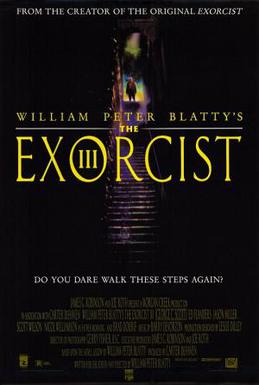
The Exorcist 3 (1990) - A lot has been said about The Exorcist (1973). When it comes to the sequels and its one prequel, the third is the only installment in the franchise that's compelling and scary, thanks primarily to Brad Dourif. He's the man who single-handedly made the third Exorcist movie the only good sequel.
Though the movie does drag a bit, the performances are great. Brad Dourif's performance especially really makes the movie. He puts everything he's got into it. And George C. Scott is great to see in this film. Scott is an actor I sorely miss altogether.
The intense exorcism at the end is perfect, and visually memorable.


Trick 'r Treak (2007) - I haven't found any horror movie yet that really utilizes the lore and traditions of Halloween as we know them today into a story.
The John Carpenter Halloween movies take place around the holiday, but Halloween isn't necessarily an integral part of the film's storyline.
Trick 'r Treat is an anthology movie, with separate tales that are all woven together.
The visuals work well, leaving me with an uneasy feeling. And the use of Halloween to tell each story is great. Just as I watch movies like A Christmas Story and It's a Wonderful Life during the holidays each year, I watch Trick 'r Treat every October 31.


The Stand (1994) - After the TV movie Salem's Lot (1979), I think Stephen King's TV miniseries, The Stand, is second best as it's compelling and entertaining.
Sure, the effects are a bit dated, but that...you know...what are you going to do? It is what it is.
It's long if you watch from beginning to end in one sitting. But it kept me interested right from the start. The characters are memorable. The storyline develops fairly well. And though this aired over several episodes, it doesn't really drag on.


The Witches (1990) - While this movie is a children's movie, it centers on witches so it fits well here. Based on the book by Roald Dahl, it delivers scary visual affects (thanks to magic of Jim Henson) wonderful make-up, great casting, fantastic story telling, and is the best Dahl story adaptation after Willy Wonka and the Chocolate Factory (1971).
Angelica Houston plays the "Grand High Witch" - a role that couldn't have gone to anyone else. She went on to play Morticia Addams the following year in the movie The Addams Family. I wonder if she drew some creepy inspiration from her part in Witches. This movie is original, entertaining and chilling right from the beginning with no dull moments in between.


The Blob (1988) - Seldom are movie remakes both good and memorable. The remake of the 1958 SciFi/Horror movie The Blob is both.
While the original is good despite its B-movie feeling, and stars the legendary Steve McQueen, the remake delivers more in horror and terror.
I loved this movie, turning what could pass as a B-sci fi movie into an entertaining scarefest. It's a fun horror movie. Oh, and great horror effects!
Movie critic Leonard Maltin called it a needless remake. I call it a worthy one!


For more recommendations, click here: Personal Favorites in the Genre no.1

My Latest Review!

Not a Review Necessarily - My 'Carrie' trailer reaction