Showing posts with label Halloween 2024's spectacular and not random vampire movie reviews extravaganza!. Show all posts

Thursday, October 31, 2024

206) Let the Right One In (2006)

Son of Halloween 2024's spectacular and not random vampire movie review extravaganza! (Part Ten...the final vampire, for now)

Director
Tomas Alfredson

Cast
Kåre Hedebrant - Oskar
Lina Leandersson - Eli
Per Ragnar - Håkan
Henrik Dahl - Erik
Karin Bergquist - Yvonne
Peter Carlberg - Lacke
Ika Nord - Virginia
Mikael Rahm - Jocke


After two overall terrible vampire movies, despite  some of the good things they both have going for them, I wanted to end this Son of Halloween 2024's spectacular and not random vampire movie review extravaganza with something well made...maybe even sublime. 
The 2006 Swedish horror film "Let the Right One In," based on the 2004 novel of the same title by John Ajvide Lindqvist, is a movie I had in mind to include in this thread since I thought up this year's Halloween movie extravaganza. And as I've mentioned in previous posts, I love saying the word "extravaganza." This movie is a unique story when it comes to vampires. 
The movie, which takes place in the early 1980s in Blackeberg, Stockholm, centers around a young Swedish boy, Oskar (Kåre Hedebrant), who's a bit of a loner. 
He's unmercifully bullied at school by a small clique of boys. He lives in an apartment with his mother, Yvonne, (Karin Bergquist) while his father lives elsewhere. 
Meanwhile, mysterious and brutal murders are occurring around the neighborhood. The person responsible is a man named Håkan (Per Ragnar) who hoists victims upside down by their feet, cuts their throats, and collects their blood. He does this because he lives with a 12-year-old girl vampire named Eli (Lina Leandersson) who needs blood to survive. Håkan and Eli happen to live in the apartment next door to Oskar. 
Kåre Hedebrant and Lina Leandersson in "Let the Right One In."
However, he's unaware of these two until he meets Eli one evening out in the apartment courtyard. 
Oskar spends time alone at night wandering outside pretending to inflict revenge on his tormentors at school. 
One night, Eli sees him alone outside the apartment and talks to him. Oskar takes a bit of an interest in Eli as she appears to be his age. At first, she tells Oskar that she cannot be his friend without giving a reason. 
However, they slowly become friends. He opens up to her about the bullying he endures at school. And she encourages him to defend himself.
So, he enrolls in an after-school fitness class with hopes he can build up some muscle. 
Later, Håkan attempts to murder a passer-by in a secluded area in order to collect blood for Eli one evening but is interrupted by someone else out walking their dog. So, he runs off before getting caught.  He returns home with nothing to bring back to her. 
Eli has to go out into the night and attack someone herself to feed on. She lures a man named Jocke by pretending to be a young child in need and stranded out in the cold. 
When she returns to the apartment, Håkan goes back out to hide Jocke's body by dumping his remains in a frozen river. 
He tries again to collect blood for Eli by tying up a teenage boy after school one night in a locker room long after school hours. 
However, the boy's friends come looking for him and the boy wakes up before Håkan kills him and starts shouting for help. 
He hides elsewhere in the school hoping to avoid detection. In order to prevent being recognized, Håkan pours acid on his face. 
He's soon arrested and taken to a hospital first for treatment. Eli goes to see him that same night. Since he's in custody and will no longer be able to provide for her, Håkan offers his neck to her. She accepts the offer, drinks, and he plummets to his death out of the hospital window. 
Eli goes to see Oskar, while he's in bed. She taps on his window and asks him to invite her in. He asks how she managed to get up to his window as his apartment is several stories off the ground.
She simply says that she flew and them spends the night in his room. 
Now, he's all she has to take care of her. And she's the only friend he has. 
"Let the Right One In" keeps the vampire lore in a realistic style while being its own story unlike other vampire movies out there. 
I've heard it called a "coming of age" story, and I suppose it is for Oskar. Still, it's not the first movie with vampire children. Outside of probably a ton of made-for-children movies with vampire depictions suitable for children, Kirsten Dunst as Claudia in the 1994 movie, "Interview with a Vampire" is the only one that comes to mind right now. 
Kåre Hedebrant's performance makes his character sympathetic and memorable.
He and Lina Leandersson have true chemistry. Kåre's performance supports Lina's role as he needs to give her, as a vampire, a reason to befriend him and have the audience appreciate her doing that. That must have been a challenge. 
Though the movie carries themes of bullying and friendship, I'm torn as to what Eli's true intentions are from the moment she meets Oskar all the way to the end of the story. I couldn't tell if she was deceiving Oskar with her friendship to make him her next servant. Or, if she sincerely wanted friendship just as much as Oskar. Maybe there's a bit of both? 
My suspicions lean more into the side that Eli is really recruiting young Oskar to be a servant for her, whom she'll later command to kill people so that she can feed. 
In the scene when Oskar realizes Eli is a vampire, she admits that she is. She doesn't hide it. Oskar is rightly bothered by her need to kill people so she can feed. Still, he choses to remain a friend, even encouraging her to go steady.
She tells him they are a lot alike. Oskar has a secret desire to kill his bullies, while Eli needs to kill. 
She then tells Oskar, "Be me, for a little while." 
This sentiment gives the movie's title meaning - "Let the Right One In." 
Evil can disguise itself as good, but evil can't be anything other than what it is. 
Eli is the strength Oskar that lacks which is why he gravitates towards her. Or, it could be her vampiric lure to make him her slave. After all, he sees adults, even his divorced mother and father, as not too interested in his problems and situations. His mom is too busy. His father seems to include him because he has to. This certainly works in Eli's favor.   
As a vampire, she personifies the fact that true evil is willing to deceive in any way it can to ultimately drag souls down alongside them. The devil is the father of lies. In which case, perhaps the film is a cautionary tale about becoming comfortable and familiar with evil which ultimately seeks to enslave. 
Despite being a vampire, she never hints at any desire to feed on Oskar. 
In a later scene, Oskar takes her to a hideaway and wants to become blood siblings. He slices his palm and wants her to do the same to her hand. The idea is that they'll shake hands, and mingle their blood. Instead of cutting her hand, she can't hide her insatiable thirst for blood once she sees it as he naively stands in front of her with his hand out dripping blood. Instead of attacking him, she takes to the drops of blood on the floor and tells him to leave. 
The movie also adds a little to the vampire lore in that it shows what happens to a vampire if they enter a house without being verbally invited in. 
"Let the Right One In" got an American remake called "Let Me In" in 2010 with Chloë Grace Moretz, Kodi Smit-McPhee, Richard Jenkins and Elias Koteas. I watched it several years ago shortly after I watched the Swedish film, and I can't remember anything about it. 
Anyways, this is a very unique vampire story that emotes more feelings of sympathy rather than fear, although it does possess some fear and horror elements as is needed in a vampire movie. A lot of the older Dracula movies have a bit of a fairy tale tone to them to some degree or another. This movie maintains a taste of that style, but with much more realism, or real-life style to it. And it's perfectly subtle and thought provoking.


🧛 So, that's another horror movie extravaganza in the bag...or on the blog...or where ever it needs to be. I had a lot of vampire movies I wanted to watch and include. Some I couldn't get my hands on for some reason or another, and others I would have had to pay for which I didn't want to do. 
As for the rest, there's just not enough time to get to all of them. My initial intent was to watch one Dracula/vampire movie from each decade between 1922 to 2024. Well, I made it to 2006, and watched 10 movies which is a number I decided to stick with. So, not bad. Below is a list of other movies I had considered including in this list, or tried to include. I'm certain I'll get to some of these in the future. 


"Vampyr" (1932)
"Vampire Bat" (1933)
"Mark of the Vampire" (1935)
"House of Dracula" (1945)
"The Vampire's Ghost" (1945)
"Abbott and Costello Meet Frankenstein" (1948)
"The Vampire" (1957)
"Kiss of the Vampire" (1963)
"The Fearless Vampire Killers" (1967)
"The Vampire Lovers" (1970)
"Blacula" (1972)
"Son of Dracula" (1974) - This one has Ringo Starr, Harry Nilsson, Peter Frampton and other rock stars! What the heck? 
"Zoltan... Hound of Dracula" (1977)
"Salem's Lot" (1979) 
"Fright Night" (1985)
"Vamp" (1986)
"The Lost Boys" (1987)
"Bram Stoker's Dracula" (1992)
"Interview with the Vampire" (1994)
"Vampire in Brooklyn" (1995) - Eddie Murphy plays a vampire in this movie. 
"From Dusk Till Dawn" (1996)
"Abraham Lincoln: Vampire Hunter" (2012)
"What We Do in the Shadows" (2014) - I regret picking "Dracula: Dead and Loving It" over this comedy. 
"The Last Voyage of the Demeter" (2023)


🎃 Happy Halloween!🦇

Monday, October 28, 2024

205) Dracula: Dead and Loving It (1995)

Son of Halloween 2024's spectacular and not random vampire movie review extravaganza! (Part Nine)

"Children of the night... What a mess they make."

Director
Mel Brooks

Cast
Leslie Nielsen - Count Dracula
Mel Brooks - Professor Van Helsing
Peter MacNicol - Thomas Renfield
Steven Weber - Jonathan Harker
Amy Yasbeck - Mina Seward
Lysette Anthony - Lucy Westenra
Harvey Korman - Dr. Seward
Anne Bancroft - Madame Ouspenskaya, the Gypsy Woman


If you mention Mel Brooks and "horror comedy" in the same sentence to anyone, chances are they'll throw the title "Young Frankenstein" back at you. And rightly so. 
Writer, director, and comedian Mel Brooks has satirized just about every movie genre there is. But he's knocked the horror genre around twice. The second horror satire from Brooks is his 1995 Dracula spoof, "Dracula: Dead and Loving It." 
It doesn't get anywhere near the same attention and appreciation as his 1974 horror comedy classic "Young Frankenstein." 
After checking out more macabre vampire movies, some being sublime and others taking themselves too seriously, I wanted to include something like this. I needed to toss in at least one horror comedy. And what better satirical Dracula movie could their be other than something from Mel Brooks. 
I've heard of this movie, but I've never seen it until now. 
It's a parody of "Dracula" by Bram Stoker with a lot jabs aimed directly at Francis Ford Coppola's 1992 film. "Bram Stoker's Dracula."
The story in "Dracula: Dead and Loving It" is the same Dracula story told again and again. I laid it all out in my review of "Dracula" from 1931 so I'm going to skip the details of the storyline. 
The late comic legend Leslie Nielsen plays Count Dracula alongside Mel Brooks as Prof. Van Helsing. Peter MacNicol stars as Renfield. And the late Anne Brancroft, who was married to Mel Brooks, and is an actress I absolutely love, has a cameo as a Gypsie woman which I got a laugh from.
Steven Weber also stars as Jonathan Harker. And Harvey Korman, who's no stranger to Mel Brook's movies, plays Dr. Jack Seward. So, this movie is certainly well cast with strong comedic talent. 
Leslie Nielsen as Dracula in "Dracula: Dead and Loving It."

And yet the movie lacks comedy. There's not enough of it. Some scenes feel like a joke is building up, and then it doesn't arrive. Disappointing!
As for the rest of the movie, it's the same story of Dracula depicted over and over again in the movies, but with light satire. It doesn't have the comedic punch I would expect from a Mel Brooks movie. No wonder this film doesn't get the same attention as his other films, especially "Young Frankenstein." While that movie is mockery mixed perfectly with a clear reverence for the movie "Frankenstein," and includes unique lines and a memorable performance by Gene Wilder, "Dracula: Dead and Loving It" certainly has a talented cast, but it goes through the motions of the Dracula story. Aside from the cast, nothing else about it stands out. Not even the lines.  
Peter MacNicol is perfectly cast as Renfield. He depicts the character's tics and sporadic mannerisms, as well as Renfield's insanity spot on. 
In fact, MacNicol is an actor who appears to enjoy whatever roles he's in, though I admit the only movies I've seen him in besides this one are "Ghostbusters II," "Addams Family Values," and Mr. Bean's movie, "Bean." He always puts forth everything he has to fine tune his performances. In other words, he never half-asses it. 
Leslie Nielsen as Dracula is exactly that - Leslie Nielsen putting on his best Dracula impression. Behind the Dracula costume and pale face, it's Leslie Nielsen. It seems liker there's potential for some comedic gold in casting Nielsen as Dracula, and then seeing what he does with this character. But it's not his most memorable character. 
This movie has potential. It's the lacking comedy which is disappointing. Only a small handful of scenes got a bit of a laugh out of me. There's little, if anything, that stuck with me after watching this. Otherwise, it's a disappointment.  

Friday, October 25, 2024

204) Vampire in Venice (1988)

Son of Halloween 2024's spectacular and not random vampire movie review extravaganza! (Part Eight)

"Nosferatu is a supreme lord of evil, second only to the devil himself."

Directors
Augusto Caminito
Klaus Kinski

Cast
Klaus Kinski - Nosferatu
Christopher Plummer - Prof. Paris Catalano
Donald Pleasence - Don Alvise
Barbara De Rossi - Helietta Canins
Yorgo Voyagis - Dr. Barneval
Anne Knecht - Maria Canins
Elvire Audray - Uta Barneval
Clara Colosimo - Medium
Maria Cumani Quasimodo - Princess


Decade by decade, the vampire movies become more and more abundant. It's hard to pick just one. 
When it comes to the 1980s, there's a respectable handful of popular vampire movies, "Fright Night," "The Lost Boys," "Near Dark," "Vamp," to drop a few titles. 
For this slot, I wanted to pick something not too common but stands in some way or another. 
I went vampire movie by vampire movie on a few different streaming apps, including one app called "Cinema Box" which has a fantastic list of classic and hard to come by films for free. 
I found the 1988 Italian horror movie "Vampire in Venice" on the Tubi streaming app. 
Also known as "Prince of the Night" and "Nosferatu in Venice" the film definitely has some notable details about it. 
For instance, it stars Acadamy Award-winning actor Christopher Plummer.
In this movie, Plummer plays an Abraham Van Helsing-like character named Prof. Paris Catalano. Incidentally, in the movie "Dracula 2000," Plummer plays Abraham Van Helsing, which is worth mentioning. 
Also, in this movie Klaus Kinski plays a vampire called "Nosferatu." As I previously mentioned elsewhere on this blog, Klaus Kinski plays Nosferatu in the 1979 movie "Nosferatu the Vampyre" - a remake of F. W. Murnau's 1922 silent film which I reviewed earlier this month. 
And Donald Pleasance, who famously plays James Bond villain Blofeld in the 007 movie, "You Only Live Twice" as well as Dr. Loomis in several of the "Halloween" movies, stars in this flick. 
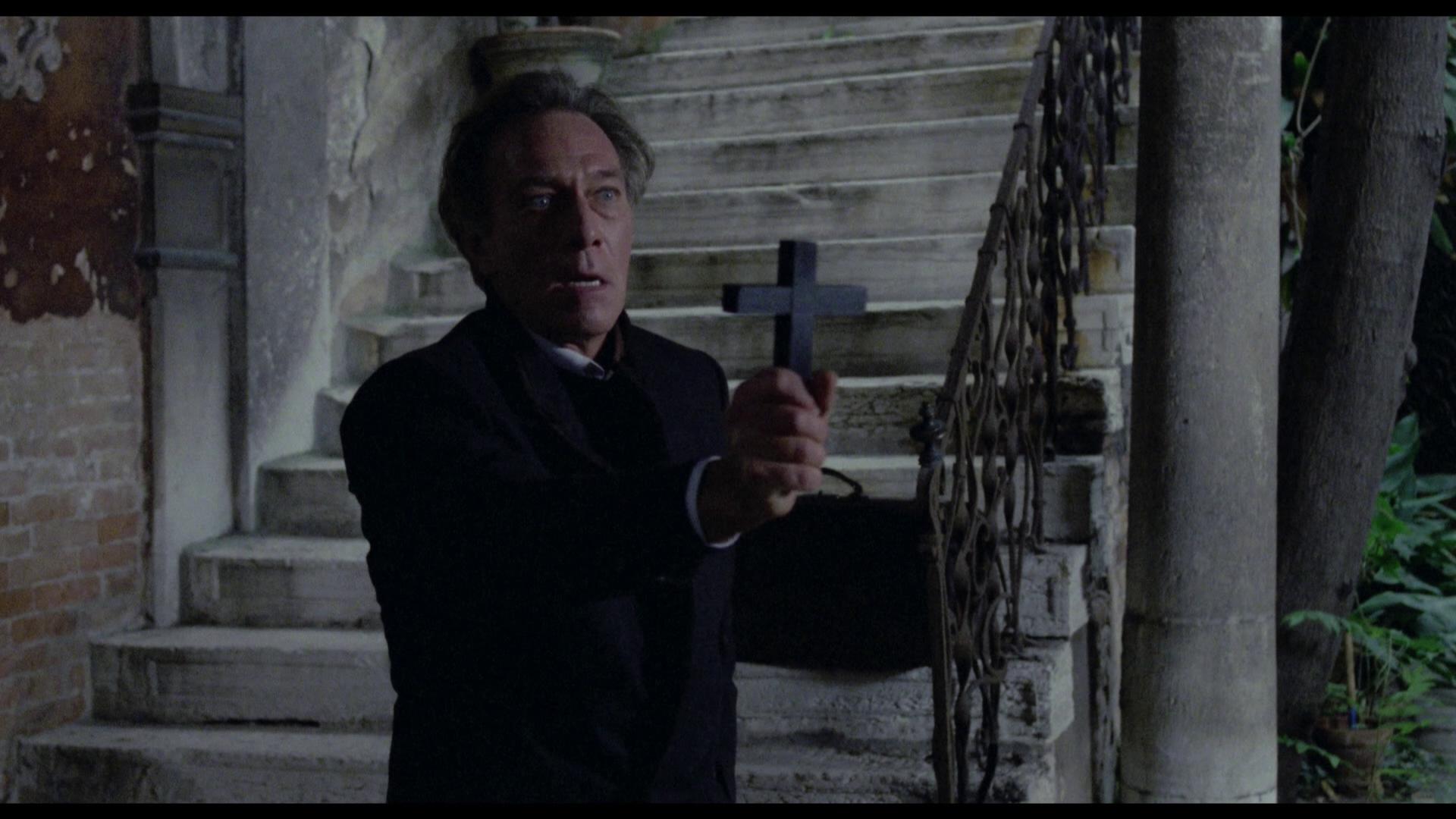
Klaus Kinski as Nosferatu in "Vampire in Venice."
"Vampire in Venice" is a real oddity.
This flick starts with Prof. Paris Catalano (Christopher Plummer) traveling from the U.K. to Venice, Italy in search of the infamous vampire Nosferatu (Klaus Kinski).
He believes the remains of the vampire is indeed in Venice. The last time anyone ever saw Nosferatu was back in 1786 at some carnival. This makes me wonder if this vampire has been out-of-sight all that time, why bother looking for him? 
I guess the answer lies in the fact that Princess Helietta Canins (Barbara De Rossi) asked Catalano to Venice because she thinks Nosferatu's tomb is in the basement of her family estate. 
For some reason, even though Nosferatu must still be in his tomb after all these decades, Helietta believes the old vampire wants to end his immortal life and enter into eternal life although he'll probably end up in Hell. 
When Catalano shows up, he can't help but notice how much Helietta looks like Nosferatu's old love interest, Letizia. That seems to be a running trope in a lot of these vampire movies. 
So, that night Helietta and her family, along with Catalano hold a séance for reasons that aren't explained. It's like they want Nosferatu to awaken after 200 years. Even the local Catholic priest, Don Alvise (Donald Pleasence) warns them how stupid such a demonic act is, and shouldn't be performed for the sake of their souls. 
The Catholic Church, represented by the priest, is the only figure of sanity and right mindedness. 
But obviously they're not a bright group considering they're tempting fate. So, they hold their little séance which causes Nosferatu to awaken and flea his tomb. 
Now Nosferatu is out prowling around Venice! 
In no time, he finds Helietta's mother, Princess Catalano (Maria Cumani Quasimodo) where he forces her onto a balcony and pushes her over. She lands on an iron fence and is impaled. 
During the funeral, Catalano tells Helietta that Nosferatu can actually be stopped by love, which seems like lazy and cliché writing to me. 
This movie appears to make up its story as it moves along. And why Catalano wants to kill Nosferatu before he kills himself is beyond me. 
If there's one thing this movie loves, its the image of Christopher Plummer standing in all his Christopher Plummer glory on a gondola with a look of power on his face. The movie has several shots of people floating down gondolas along the streets of Venice. Venice is a beautiful city but too much of a good thing can easily become mundane and repetitive. 
Still, I am eager to find out more about "Vampire in Venice." Why was it made? What was the motivation behind it? What was it like on set during filming, especially with Klaus Kinski on board? Movies with Klaus Kinski often have quite a
Christopher Plummer as Prof. Paris Catalano.
fireworks show of stories. Just check out my review of the 1986 horror movie "Crawlspace" which also stars Kinski. I wonder what Christopher Plummer thought about Klaus Kinski while working alongside him. 
Considering that Kinski stars in the lead role and has a reputation of having been a difficult and explosive actor to work with - notorious for not liking directors - my curiosity needs answers. His performance is nothing more than glaring with an evil glare, and that's about it. It's unimpressive. His presences is so egotistical in this movie. It spews right out of the screen with all the shots of himself standing in front of the camera over and over again as if he's reminding the audience, "I am Klaus Kinski, and you are not." 
This film tries to be a serious horror movie with depth and impact.  It's loaded with more air of artistry instead of the much needed trepidation and fear any audience would expect from a vampire movie. By the ends, it's just a pretentious and tawdry spectacle that takes itself way too seriously.
Still, the movie has some beautiful shots of Venice aside from all the characters floating down Venice streets. 
Any inclusion of haunting nightmarish scenes feels more like an after thought. And with its over extravagant soundtrack that makes me chuckle though it doesn't want me to, it takes the bite out of its horror (no pun intended). 
Anyways, the soundtrack is horrible! It starts off eerily enough, and then keeps going into an overly synthetized style that irritates my nerves. 
And the cutaways seem as though someone forgot to make the final edits to the movie. It's like the entire movie was released haphazardly. 
I get the impression the movie takes inspiration from Pope Benedict XIV's (1740 - 1758) statement that vampires are nothing but human fantasies. 
He's referenced in the movie. In one seen, Catalano is asked, "What's the Church's attitude towards vampires?"
Boy, that's got to be difficult question. Surely, there's more to it than the Church's official teaching that vampires suck. No pun intended. 
"Vampirism is one of the thousand ways in which evil manifests itself. It was Pope Benedict XIV who decreed that," Catalano replies. 
Going back to Klaus Kinski, everything I've ever seen him in, he always strikes me as insane. For Kinski, it's in the eyes. This movie is no exception. He's not frightening. He's just insane. In fact, it solidifies my impression. I can't help having the impression that he enjoyed all the worst scenes involving Nosferatu's female victims too much.
All in all, there's no real climax in this movie. It feebly fades in, and then as mysteriously as it arrived, it ends. If there's one thing I've learned about Kinski's acting style just by watching this one movie, its that he sure loves himself. 

Monday, October 21, 2024

203) The Legend of the 7 Golden Vampires; aka The 7 Brothers Meet Dracula (1974)

Son of Halloween 2024's spectacular and not random vampire movie review extravaganza! (Part Seven) 

"It's the darkness that brings them out." 

Directors
Roy Ward Baker
Chang Cheh

Cast
Peter Cushing - Prof. Van Helsing
John Forbes-Robertson - Count Dracula
David de Keyser - the voice of Count Dracula (uncredited)
Robin Stewart - Leyland Van Helsing
Julie Ege - Vanessa Buren
Robert Hanna - British Consul
David Chiang - Hsi Ching/Hsi Tien-en
Shih Szu - Mai Kwei
Chan Shen - The High Priest, Kah


It's East meets West in this last vampire movie in Hammer Productions' line-up of Dracula movies - "The Legend of the 7 Golden Vampires." It follows eight previous Dracula films I mentioned in my review of "The Brides of Dracula" - the second Dracula movie from Hammer Productions.  
I've already reviewed that movie, along with the first movie, "The Horror of Dracula" and skipped the rest to get to this unique gem of a flick. 
No doubt I'll come back to the previous movies I have yet to watch. 
"The Legend of the 7 Golden Vampires" is unique both in my lineup of this year's Halloween reviews as well as among vampire movies in general. 
This movie is difficult to find. And the version I was lucky enough to come across was the 1979 wide-release from Dynamite Entertainment re-titled "The 7 Brothers Meet Dracula." I found it on the fantastic streaming app "Cinema Box."
It has a 75-minute runtime, and I don't know how the 1979 version differs from the original cut. 
Unfortunately, it's the second Hammer Dracula movie that doesn't feature Christopher Lee as Dracula. As I mentioned in my last post, Lee doesn't appear in "Brides of Dracula" neither. 
John Forbes-Robertson bears the fangs and dawns the cape of Dracula in this movie, making him the only other actor aside from Lee to portray Dracula in Hammer Film Production's movies. 
In the plus-column, Peter Cushing returns as Van Helsing which ties this to the previous Dracula movies.  
In this film, a Taoist monk named Kah (Chan Shen) who is also a high priest within the Temple of Seven Golden Vampires in China, travels to Transylvania to summon Count Dracula. 
The Golden Vampires of his temple are growing weak. So, Kah wants Dracula to restore their power and give them the strength they need to be as powerful as they used to be.
Peter Cushing as Van Helsing.
Dracula agrees to help only if Kah will permit him to use his body to escape his castle which has become a sort of prison for Dracula. 
Kah is reluctant but allows Dracula to use his body and takes his form to escape his castle. Dracula then heads to China. 
A hundred years go by. Prof. Van Helsing (Peter Cushing) actually lives up to his title of professor as he lectures at Chungking University on the legend behind Chinese vampires. During his lecture, Van Helsing mentions a Chinese village that has been tormented by a cult that calls itself the "Seven Golden Vampires." 
As he explains, a local farmer had tried to take down the cult himself. During the fight, he managed to grab a gold medallion in the shape of a bat off the next of one of these vampire cult members. It turns out the vampires need the medallion to live. 
The farmer escaped with the medallion, and the cult's high priest sent the seven vampires after him. 
They caught up to the farmer and cornered him. The farmer placed the bat medallion around a statue of Buddha just before they killed him.
One of the vampires tried to take the medallion off the Buddha statue only to ignite into flames as soon as he touched it. So, the seven Golden Vampires are reduced to six. 
Van Helsing thinks this village still exists and that the six remaining Golden Vampires are still preying on the villagers. It's just a matter of finding where it's located. 
After his lecture, all the students and professors think it's just an urban legend, and don't take Van Helsing seriously. But one student named Hsi Ching (David Chiang) knows it's true because that farmer was his grandfather. To prove it, Ching has that same medallion his grandfather took. So, he's completely on board with Van Helsing in finding the village and killing off the vampires once and for all. 
So, Van Helsing and Ching, along with Van Helsing's son Leyland (Robin Stewart) as well as Ching's seven siblings who are masters in kung fu venture off to find that long lost village and take on the six Golden Vampires. 
The tagline reads, "the first kung-fu horror spectacular!" That's really all I liked about this movie. Well, Peter Cushing, too. I've never seen a Peter Cushing role I didn't like. 
John Forbes-Robertson as Count Dracula
And to think that just three years after starring in this movie, he would appear in "Star Wars." Within that time between "The Legend of the 7 Golden Vampires" and "Star Wars," Cushing appears in six movies. 
Anyways, this movie packs in three things I love into one film - vampires, Hammer horror, and kung fu. I don't really know much of anything about kung fu. I just know I love a good martial arts movie. In fact, while watching this, I could barely follow the story. I just wanted to see more fighting and vampires. It was a trip watching these fighting scenes as Peter Cushing stood off to the side also watching on screen. 
Everything else doesn't seem like it was thoroughly thought out. There's so much slow motion where it doesn't need to be. All that slow motion makes the movie feel like it's dragging.
The first twenty minutes contains a lot screaming and little to no dialogue. It opens with 23 minutes of gore and ghoulish blood sucking. 
Once Peter Cushing shows up, the film finally picks up and starts combining classic gothic style vampire with Chinese martial arts. 
I wish the final fight between Van Helsing and Dracula went on longer. It's the stuff of classics. Watching Dracula die marks the end of an era, or so it seems. 
A sequel called "Kali, Devil Bride of Dracula" was planned but was never executed. What a bummer! 
Otherwise, this movie has intense imagery that veers into a different mythos of vampires based in Eastern lore. And the scene with Cushing as Van Helsing explaining the differences between European vampire versus hunting Asian vampires, to Chinese vampire hunters is a real iconic vibe. If only the storyline had some stronger writing to support it, this would be a fantastic movie! 

Friday, October 18, 2024

202) Brides of Dracula (1960)

Son of Halloween 2024's spectacular and not random vampire movie review extravaganza! (Part Six)

"Count Dracula, monarch of all vampires, is dead, but his disciples live on, to spread the cult and corrupt the world."

Director
Terrance Fisher 

Cast
Peter Cushing - Dr. Van Helsing
Yvonne Monlaur - Marianne
David Peel - Baron Meinster
Martita Hunt - Baroness Meinster
Freda Jackson - Greta
Miles Malleson as Dr. Tobler
Henry Oscar - Herr Lang
Mona Washbourne - Frau Lang
Andrée Melly - Gina
Victor Brooks - Hans
Fred Johnson - the priest


The end of August is approaching as I write this, and I still have six more vampire movies to get through before Oct. 31. I got this! 
I couldn't post a thread of Dracula movies for the Halloween season without including at least one movie from Hammer Productions over in the U.K. 
Hammer horror movies are a pillar in the genre. They revived the classic Universal Monsters and gave them the finishing touch which the original films from Universal tried to accomplish within the boundaries of what they could and couldn't do. And these movies are in color, treating the subject matter with reverence and appreciation. They polish the appearance and atmosphere of Dracula, Frankenstein, the Wolfman, and all the rest, solidifying their place in horror pop culture. 
I've already reviewed Hammer Productions first Dracula movie, "Horror of Dracula" (1958) with Christopher Lee in the title role and Peter Cushing as Dr. Van Helsing. It makes sense to look at its sequel, "Brides of Dracula" from 1960. 
The movie starts as a young attractive French school teacher, Marianne Danielle (Yvonne Monlaur), is dropped off and left at a village inn while travelling to Transylvania. Her coach driver basically ditches her at the inn.
The local Baroness Meinster (Martita Hunt) invites her to stay at her castle for the night. But the locals warn her it's not safe. Her son, Baron Meinster (David Peel), is rumored to be crazy and kept locked in the castle. But Marianne accepts the invitation. 
David Peel and Yvonne Monlaur in "Brides of Dracula."

Once Marianne settles in, she snoops around the castle and happens to find, to her shock and horror, Baron Meinster locked in a room and chained to a wall just as she was told.
He begs for Marianne to release him, claiming his mother has taken his lands and keeps him jailed.
So, she sneaks into his mother's bedroom and steals the key to free him from his shackles. The jokes on her, though. the Baron is a vampire! 
Now that he's free, the Baron attacks his own mother and drinks her blood, as vampires are known to do. Marianne witnesses this evil and horrific deed and escapes the castle during the night. 
Now a vampire, the Baroness starts brining in young girls for her son to feed on. 
By morning, Marianne meets Van Helsing (Peter Cushing) but can't seem to remember what she witnessed the night before. 
So, Van Helsing takes her to the school where she'll be working. When he gets back to the village, Van Helsing comes across the funeral of a young girl found dead in the woods with bite marks on her neck. He knows exactly what that means and doesn't waste time investigating the presence and location of the vampire responsible.
The local priest, Fr. Stepnik (Fred Johnson), joins Van Helsing in his pursuit. He and Van Helsing try to encourage the deceased girl's father not to bury his daughter. Of course, it sounds like an outlandish request. Naturally, the father refuses and buries her. As expected, she rises from her grave as a vampire. 
Van Helsing and Fr. Stepnik go the cemetery and try to kill the vampire girl. When they get there, they find the Baroness's servant, Greta (Freda Jackson), who knows that both the Baron and her master are both vampires, calling out to the buried girl to rise from her grave.
The girl begins crawling out of her grave. Van Helsing and Fr. Stepnik try to stop her, but Greta keeps them back. And the living-dead girl escapes. 
Peter Cushing as Van Helsing.
When Van Helsing gets back to the castle, he runs into the Baroness and her son. Van Helsing attacks them, but the Baron runs off. 
Feeling pity for the Baroness as her son's attack on her was an act of revenge for locking him up, Van Helsing decides to drive a stake through her heart while she's asleep the next morning. 
The Baron goes straight to Marianne and asks to marry her, which she agrees to do. 
This makes Marianne's roommate, Gina (Andrée Melly) jealous. However, the Baron pays Gina a visit later that night and turns her into a vampire. 
Now, Van Helsing has his work cut out for him as he tries to fend off all these vampires and ultimately kill the Baron. 
It's thanks to British director Terence Fisher that Gothic horror such as this movie, and other Hammer horror films, gave audiences the classic yet revived (for the time) Universal monsters in color. 
His first major Gothic horror movie was 1957's "Curse of Frankenstein" which instantly solidified Hammer Production's place in the horror genre. Actors Christopher Lee and Peter Cushing took on leading roles in the majority of these movies. Peter Cushing nails the role as he gives Van Helsing a holy determination to destroy evil at the roots. 
Fisher also directed "Horror of Dracula" and "Dracula: Prince of Darkness." 
He often portrays evil as alluring and charming, only to lead to immorality, and then to death and destruction. Meanwhile goodness and Christian morals are portrayed as strong and determined. I can get behind that. 
"Brides of Dracula" is a worthy follow-up to "Horror of Dracula." While Dracula doesn't appear in this movie, though he's mentioned, his evil sickness carries on which Van Helsing must continue fighting. 
Sure, this movie is dated as far as horror goes. But it still has a classic charm about it. 
I love these gothic Victorian era horror movies! I tend to compare them with Roger Corman's Edgar Allan Poe films made in the same period. Comparing them side by side, it's clear Hammer had a bigger budget to work with, and it shows. But Corman still made some fantastic period horror movies with his Poe series that still hits the spot. 
"Brides of Dracula" keeps the same unsettling atmosphere and classic vampire tropes previously seen. It is formulaic in its story, and doesn't add much, if anything, to Dracula's lore. It tells a tale of Dracula's aftermath, and how Van Helsing has to clean up the mess he left behind. That's an original take, I think.
It has fine acting, a unique style of horror and atmosphere, and a story that pulls the audience in. 
There are seven more Dracula films in the Hammer series following "Brides of Dracula" - "Dracula: Prince of Darkness" (1966), "Dracula has Risen from the Grave" (1968), "Taste the Blood of Dracula" (1970), "Scars of Dracula" (1970), "Dracula A.D. 1972" (1972), "The Satanic Rites of Dracula" (1973), and the martial arts horror movie "The Legend of the 7 Golden Vampires" (1974). I'll get to that last one next! 

Tuesday, October 15, 2024

201) The Return of Dracula (1958)

Son of Halloween 2024's spectacular and not random vampire movie review extravaganza! (Part Five)

"I bring you a death- a living death."

Director
Pat Landes

Cast
Francis Lederer - Bellac Gordal
Norma Eberhardt - Rachel Mayberry
Ray Stricklyn - Tim Hansen
John Wengraf - John Meierman
Virginia Vincent - Jennie Blake
Gage Clarke - Reverend Whitfield
Jimmy Baird - Mickey Mayberry
Greta Granstedt - Cora Mayberry


I've skipped over a few vampire movies released between the 1940s and 1950s to get to this oddity - "The Return of Dracula."
The last movie I posted, "Son of Dracula" spawned the sequel "House of Dracula" in 1945 with John Carradine and Lon Chaney, Jr. 
"The Vampire's Ghost" was released in 1945 as well, from Republic Pictures. It's its own movie, though, and has nothing to do with the previous Dracula movies from Universal. 
The classic horror comedy, "Abbott and Costello Meet Frankenstein" came out in 1948 with Béla Lugosi reprising his role as Dracula. That deserves to be included in the Dracula-verse.  
"The Return of Dracula" is a United Artists production. It's not Universal so "Dracula" isn't the same at all to Lugosi's depiction. Plus, it was shadowed by U.K's Hammer Horror masterpiece, "Horror of Dracula" with Christopher Lee, Peter Cushing, and Michael Gough. I have a copy of "The Return of Dracula" as part of an MGM double-feature DVD set called "Midnite Movies." I found it on a free DVD shelf at a local library. 
There's several of these individual sets with different double-features, and this is one of a few I own in my library. It's packaged with the 1957 movie "The Vampire" also from United Artists. Both of these movies came out when horror movies were moving away from the shadowy and mysterious monsters, and moving towards the atomic age of the late 1950s and into the 1960s. 
"The Vampire" is a more sci-fi horror take on the vampire horror sub-genre. I was torn which one to post about in this slot.
However, they're both directed by Paul Landres. And as far as I know, the films are unrelated. 
In this movie, John Meierman (John Wengraf) is over in Central Europe investigating Count Dracula and attempting to capture him. 
Francis Lederer as Bellac Gordal, the vampire, in 
"The Return of Dracula."
He and some assistants are out at a cemetery planning on to corner Dracula inside his tomb and drive a steak through his heart. It's the best way to kill a vampire! 
When they open his casket, Dracula isn't inside. 
Little do they know that he's onboard a train heading out of town. 
On board the train. the vampire kills a Czech artist named Bellac Gordal who's heading to Carleton, California to visit some distant family members he hasn't seen since he was young. 
So, Dracula poses as Gordal once he steps off the train in sunny California. It doesn't sound like a safe place for vampires, but that's were he is.  
Gordal's widowed cousin, Cora Mayberry (Greta Granstedt) is fooled and is happy to see whom she thinks is Gordal after all these years. She invites him to stay inside her home with her son, Mickey (Jimmy Baird) and older teenage daughter, Rachel (Norma Eberhardt). 
Rachel is anxious to meet her distant cousin as she, too, has a love for art and is working on being a fashion designer. 
However, "Belloc's" behavior seems very strange. And he sleeps all day. 
Mickey's cat goes missing the day after he arrives, which is rather odd as well. 
Little do they know that he's really a vampire, and that he has taken up his resting place inside a nearby abandoned mineshaft. 
But the truth as a way of inserting itself, and before long Rachel and her boyfriend, Tim Hansen (Ray Stricklyn) begin to suspect Belloc isn't really whom he claims to be. 
"Return of Dracula" has a different setup to the customary Dracula movies, but the general idea remains the same. The vampire is looking to create a brood of vampires. Instead of taking up residence in the dark and sinister cold stone walls of a far-away castle nearly impossible to reach, this vampire takes up residence in Anytown, USA amidst an unwary typical suburban family. It could happen to anyone. 
Despite how much I found this to be a fun movie, I don't understand the title. First, where is Dracula returning from. I initially thought Dracula was returning from "The Vampire" which I mentioned. I actually haven't watched "The Vampire" yet, so I had to look up the synopsis. There is no Count Dracula in "The Vampire." I wonder if the writers of both these Landres movies are using the word "Dracula" as a noun instead of a proper noun. In other words, they think a vampire and Dracula mean the same thing as though Dracula isn't a proper noun. 
"A dracula snuck into my room last night and drank all my blood."
In one scene, Gordal turns Rachel's friend Jennie into a vampire. Later, Jennie is steaked through the heart. 
Norma Eberhardt and Ray Stricklyn.
Though the movie is in black and white, Jennie's quick death scene is colorized with the bright crimson red color of the stage blood grabbing the audiences attention.
The movie surpasses my expectations. I thought it was going to be the most vampiric B-movie so far. While it's certainly a product of its time, it's well executed and I found it satisfying and entertaining. This feels like a classic horror movie which may be why I enjoyed it. It has the feels of a B-horror movie or a long episode of "The Twilight Zone." Despite its obviously dated execution, it keeps it's classic premise sharp and maintains it's sense of horror, eeriness and dread. 
I wouldn't be surprised if Stephen King pulled some inspiration for his vampire tale, "Salem's Lot" from "The Return of Dracula" in that the audience doesn't need to travel off to Transylvania to be in the presence of a vampire. The vampire pops up in their own American neighborhood with all his mysterious foreign mannerisms. 
"The Return of Dracula" keeps a sense of fear and trepidation, perhaps tarnished with age...but it's still there and recognizable. 
It's not a perfect movie, especially considering whatever it has to do with the name of Dracula. In fact, the title would suggest it's a sequel which it's not. It's misleading. The movie is banking on the property of Count Dracula, and mentions the name Dracula only once as lore. But the vampire isn't Count Dracula. No relationship is referenced. It's its own movie. 
This movie might be confused with the 1943 movie "Return of the Vampire" which stars Bela Lugosi once again in the lead role.  
Though this movie comes across as a bit unnecessary, it still manages to leave a humble mark on the legacy of vampire movies. 
For a film from the late 1950s, it's borderline risque. It also utilizes jump scares, shadows and creeps. 
It keeps the suspense and trepidation lasting, and maintains a decent pace. 
Also, the sound track sounds like the theme from "The Shining." That's probably because it's the Dies Irae which can be heard at traditional Catholic funeral masses. 

Friday, October 11, 2024

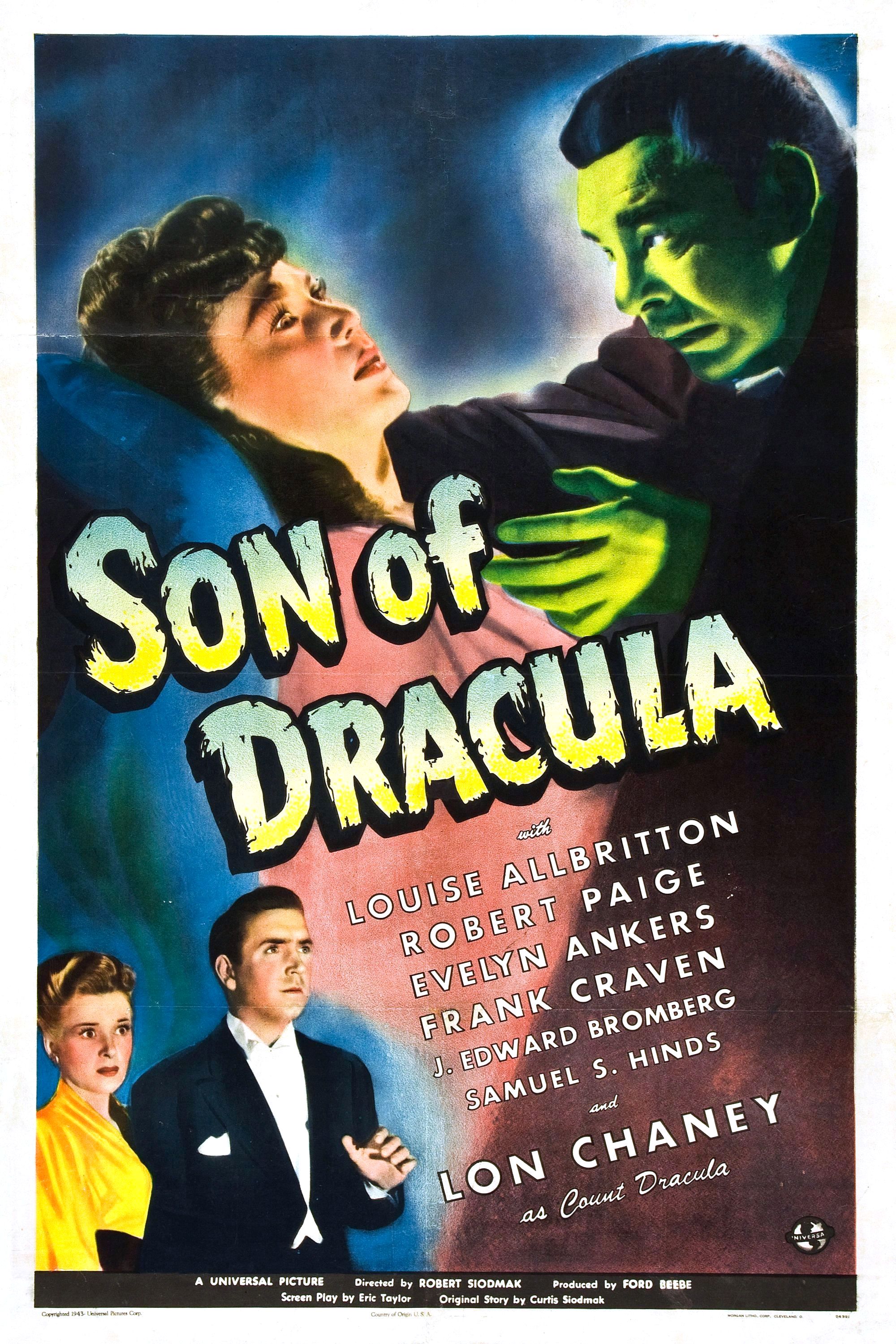
199) Son of Dracula (1943)

Son of Halloween 2024's spectacular and not random vampire movie review extravaganza! (Part Four)

"Alucard is not his name!"

Director
Robert Siodmak

Cast
Lon Chaney Jr. - Count Alucard
Louise Allbritton - Katherine Caldwell
Robert Paige - Frank Stanley
Evelyn Ankers - Claire Caldwell
Frank Craven - Dr. Harry Brewster
J. Edward Bromberg - Prof. Lazlo
Samuel S. Hinds - Judge Simmons


The 1943 horror flick "Son of Dracula" is the third installment in Universal's Dracula series. It follows the movie I previously reviewed, "Dracula's Daughter" which follows Tod Browning's famous movie, "Dracula." 
In this movie, the Wolfman himself, Lon Chaney, Jr., plays Count Alucard as he's invited to the United States by Katherine Caldwell (Louise Allbritton). She's the daughter of a New Orleans plantation owner, Col. Caldwell (George Irving).
Just as Alucard arrives, the colonel dies of a heart attack. He leaves all his money to Katherine and his other daughter, Claire (Evelyn Ankers).
Claire gets his cash while Katherine inherits his estate known as "Dark Oaks." 
Also, Katherine and Alucard start dating and want to jump into marriage pretty fast, much to the dismay and jealousy of Katherine's former boyfriend Frank Stanley (Robert Paige). 
He can't stand seeing his old fling engaged to someone else. So, he tries to shoot Alucard. But much to his surprise, his bullets don't hurt him. He doesn't even flinch. They pass through him and hit Katherine. 
Frank thinks he's accidentally killed his former girlfriend. He quickly fetches Dr. Brewster (Frank Craven) to try to save her life. 
When the doctor arrives, Katherine is up and well, as is Alucard. 
For some reason, they open up to the doctor telling him how they're going to devout themselves to scientific research. Also, they'll only permit visitors in the evenings. 
Meanwhile, Frank is still upset thinking he has killed Katherine. So, he turns himself into the police 
Louise Allbritton, Lon Chaney, Jr., and Robert Paige in
"Son of Dracula."
while the sheriff goes to investigate Dark Oaks. 
There, the sheriff finds Katherine dead. Brewster tries to convince the sheriff that he has just seen Katherine alive and roaming around. 
Still, the sheriff has her remains transferred to the local morgue. 
Brewster figures out Alucard is vampire and turned Katherine into a vampire, too. What other explanation could there be? He also realizes that "Alucard" is Dracula spelled backwards. 
Hungarian professor Lazlo (J. Edward Bromberg) comes to visit Brewster and confirms his suspicions of vampirism. 
An injured or dead young boy is brought to Brewster's home and has two bite marks on his neck which also confirms their collective fear that a vampire is among them.
Then who should show up? Alucard!
Brewster and Lazlo drive him away with a crucifix. 
Meanwhile, Katherine, who's up and about now, sneaks into Frank's jail cell to tell him she only wanted to marry Alucard in order to have immortal life. She also wants to share that immortality with Frank, whom she calls her "true love." 
At first, he doesn't want any part of what she's offering. But then he gives in, and she drinks his blood.
Afterwards, she instructs him to destroy Alucard. He agrees to do just that, breaks out of jail, and seeks out Alucard's coffin. 
When Frank finds the coffin, he sets it on fire. 
This leaves Alucard without a shelter from the sun's light which can destroy him. 
Lon Chaney, Jr., as Alucard.
When the sun rises, Alucard is destroyed. The sheriff, along with Brewster and Lazlo show up to find what's left of the vampire. 
Frank finds Katherine's coffin where she lies. He's torn as he has to kill her since she's now a vampire. But he loves her. He puts the ring that was on his finger onto Katherine's finger. And then he sets her coffin on fire. 
Rather than continue the story of Count Dracula, with more "exciting adventures" of the vampire, "Son of Dracula" continues the curse of Dracula. The story centers on how Dracula's aftermath continues turning other innocent victims into what he is- undead. It feels restrained in that it goes more for drama than frightening horror. 
Lon Chaney, Jr. is an iconic actor, and really established the infamous "Wolfman" into pop culture. However, as Dracula, he doesn't have the intimidating quality as Bela Lugosi has. Rather, he's more like a random guy dress as Count Dracula for Halloween, swirling his cape and giving off his best Dracula stare to scare all the kids. 
Chaney puts effort into his role and tries to give him a distinct personality all of his own. But despite his best efforts, he just doesn't quite pull off the fear factor Dracula needs to have, 
Regardless, I enjoyed this movie better than the previous "Dracula's Daughter." 
"Son of Dracula" has a little more horror movie feel to it when compared to the last movie I reviewed, while still carrying the noir vibe that "Dracula's Daughter" started. 
The camera work is great. There's a well worked shot of Dracula gliding supernaturally towards his victim in the woods. 
It's satisfying to see Dracula get sweet revenge. The movie presents an evil in such a way that the mere fact the characters know such an evil exists weighs heavily of their peace of mind.
Thankfully, underneath Chaney's performance, there still remains the taste of a classic Dracula flick.

Monday, October 7, 2024

198) Dracula's Daughter (1936)

Son of Halloween 2024's spectacular and not random vampire movie review extravaganza! (Part Three)


"Be thou exorcised oh Dracula, and thy body long undead find destruction throughout eternity in the name of thy dark unholy Master. In the name of the oh holiest and through this cross be the evil spirit cast out until the end of time."

Director
Lambert Hillyer

Cast
Gloria Holden - Countess Marya Zaleska
Otto Kruger - Dr. Jeffrey Garth
Marguerite Churchill - Janet Blake
Irving Pichel - Sandor
Halliwell Hobbes - Hawkins
Billy Bevan - Albert
Nan Grey - Lili
Hedda Hopper - Lady Esme Hammond
Edward Van Sloan - Prof. Van Helsing


Picking up right were Tod Browning's "Dracula" left off, "Dracula's Daughter" (1936) is a direct sequel to the 1931 horror classic which I last reviewed. 
In this movie, Van Helsing just steaked Dracula through his heart as seen in the last movie.
The police are called to Carfax Abbey where Van Helsing (played again by Edward Van Sloan) admits to killing Count Dracula. He's immediately arrested and taken to Scotland Yard.
There, he discusses his situation with Sir Basil Humphrey of Scotland Yard (Gilbert Emery) admitting that he did in fact kill Count Dracula. There's just one small snag. Dracula has been dead for 500 years. 
So, Van Helsing can't be charged with murder. 
That works in his favor, obviously. Van Helsing seeks the aid of a former student of his who's now a psychiatrist, Dr. Jeffrey Garth (Otto Kruger). 
Back in Whitby, the place where Van Helsing was initially arrested and booked by Scotland Yard, Constable Albert is left in charge at the prison where recovered bodies are being kept, while Sgt. Wilkes (E.E. Clive) goes out to meet an officer.
Countess Marya Zaleska (Gloria Holden) shows up in an attempt to steal Dracula's body. Why? Because she's Count Dracula's daughter!
Gloria Holden and Irving Pichel in "Dracula's Daughter."
Zaleska hypnotizes him with a dazzling ring she's wearing. 
She has her servant and muscle, Sandor (Irving Pichel), retrieve Dracula's body. 
She then makes a pyre to burn Dracula's body hoping it'll end her vampire curse. 
But Sandor discourages her from going through with it claiming all she has in her eyes is "death."
Zaleska is then left with nothing but her insatiable thirst for blood. She goes out into the night looking for a new victim. Deep down, she doesn't want to be a vampire. This is the curse of the situation. 
Later, she attends a fancy party where she meets Dr. Garth. She asks the doctor about overcoming some influences she's coping with that are coming from the afterlife - referring to her vampire curse thanks to Dracula. 
Garth thinks she needs to confront those urges. Zaleska feels confident that her will, and the doctor's advice, will help break her curse. 
However, she resorts to going back out looking for a victim. And in no time, Sandro finds an innocent young girl for Zaleska to feed on. He tells this young lady named Lili (Nan Grey) that Zaleska will offer her food, money and warmth if she'll pose for a painting his mistress is creating. 
Lili agrees and he takes her back to Zaleska's place. 
Zaleska tries to resist attacking her, but she can't and does what vampires are known for doing. 
Lili survives the attack - barely. 
Dr. Garth examines her under hypnosis. Lili squeals on Zaleska, revealing what she did. Soon after, Lili dies from heart failure. 
Dracula's daughter gives up on resisting those urges. As far as she's concerned, fighting them is futile. 
She kidnaps Dr. Garth's secretary, Janet Blake (Marguerite Churchill) in order to lure Dr. Garth to Count Dracula's Castle in Transylvania. 
Of course, he follows her there and offers himself in place of Janet. Just as she is about to attack him, Sandor intervenes. 
Lambert Hillyer directs with Edward Van Sloan returning to his role from the previous movie as Professor Van Helsing. 
One of the more iconic scenes in "Dracula's Daughter" with
Nan Grey (left) as Lili.
"Dracula's Daughter" a horror movie a bit ahead of its time, especially with its inclusion of psychiatry. I don't know of too many, if any, horror movies from this period that uses psychiatry as part of its story like "Dracula's Daughter." 
Overall, the movie strikes me as a serious movie and sequel. It's elaborate in its setting and premise, and tries to be frightening, but it feels heavier in drama. It has a stronger taste of film noir, rather than horror. 
That's not to say I was bored or not entertained by it. Rather, I was really intrigued by this movie considering its story and the era it was made. It's definitely a noteworthy film being foundational in the genre of psychological horror. 
The writers didn't simply make a girl version of Dracula. She's no chip off the ol' block. She's a separate entity. As "Dracula" is a story of the dark side of human nature, "Dracula's Daughter" is a story of struggle between reason and passion, or concupiscence. 
There seems to be a lesbian undertone in this movie, particularly in the scene with Zaleska preying on Lili. The seductive scene has strong lesbian implications. However, it's worth considering that, like Dracula, the vampire as a general character whether male or female, thirsts for blood. Dracula has been known to kill men to consumer their blood. I think the undertone in this movie is more in the way Countess Marya approaches her. The film's tagline, "she gives you that weird feeling" takes on a new meaning, doesn't it. It's pretty bold for a film from 1936. It continues that depiction of the flesh against the spirit. 
"Dracula's Daughter" has a sophisticated style to it rather than being some campy Dracula sequel. Maybe it tries to be too sophisticated. 
By the way, the 2024 movie "Abigail" is apparently a remake of "Dracula's Daughter." In fact, the original title for "Abigail" was "Dracula's Daughter." 

Thursday, October 3, 2024

197) Dracula (1931)

Son of Halloween 2024's spectacular and not random vampire movie review extravaganza! (Part Two)

"The spider spinning his web for the unwary fly. The blood is the life, Mr. Renfield."

Director
Tod Browning

Cast
Bela Lugosi - Count Dracula
Helen Chandler - Mina Seward
David Manners - John Harker
Dwight Frye - Renfield
Edward Van Sloan - Van Helsing
Herbert Bunston - Dr. Seward
Frances Dade - Lucy Weston


F. W. Murnau's German expressionist horror film "Nosferatu" portrayed the vampire for the first time so audiences could gaze upon the bloodsucking ghoul written about in Bram Stoker's novel, "Dracula." The movie laid an undying foundation for the horror genre. It was before all the modern tropes and depictions which Tod Browning's 1931 horror classic "Dracula" established. 
The character of Dracula, thanks in very large part to Browning's iconic film, has surely given horror cinema so much material and support unlike any other character in literary or cinematic history. There's so much that can and has been done with vampires, not to mention with Dracula's allegorical nature - the battle of the spirit against the flesh, good against evil, the devil versus God. 
Browning's film established the image of Count Dracula which has endured from decade to decade. Basically, Bela Lugosi is Dracula though the character has been depicted in various ways since 1931. Lugosi is Dracula, and Dracula is Lugosi. And if you say the name "Dracula" to practically anyone out there, images of Lugosi's character will come to mind. 
Like "Nosferatu" the plot of "Dracula" is based on Bram Stoker's book. Still, there are plenty of differences between both movies. To begin with, "Dracula" has sound. Not only do audiences see Count Dracula, they hear his soft but authoritative controlling voice and middle European/ Romanian accent. Perhaps sound is both a good quality as well as bad. With "Nosferatu" the silence gives the audiences' imagination more room to play. 
Lugosi's Count Dracula is an upscale wealthy aristocratic character with a bit of sex appeal compared to Max Schreck's Count Orlock who's more of an entity than an evil person. 
This movie begins as Renfield (Dwight Frye) travels to Count Dracula's castle in Transylvania on a matter regarding Dracula's leasing Carfax Abbey in England. 
When he arrives in Transylvania, the locals who fear Count Dracula warn Renfield not to visit his castle. 
Of course, he has business to tend to that can't simply be skirted based on the warnings of some superstitious locals. 
Bela Lugosi as Count Dracula in 'Dracula.'
When he boards the carriage to Dracula's castle, Renfield doesn't realize that Dracula himself is the carriage driver in disguise. During the trip, he looks out of the window and notices the driver is missing. Instead, he sees a bat guiding the horses. 
When Renfield arrives and enters the castle, he's greeted by the Count himself (Bela Lugosi). Little does Renfield know Dracula's true nature! 
After the two discuss the lease, Dracula hypnotizes Renfield and makes him open a window. 
A bat appears causing Renfield to faint. Dracula's three wives move in to attack Renfield, but Dracula forces them to get away and attacks him himself.
Later, we find Renfield onboard the Vesta sailing back to England. He's now become Dracula's slave. 
Dracula is onboard, too, hiding in his coffin. At night, he feeds on the boat's crew. 
By the time the ship reaches shore, the entire crew is dead. From the boat, Renfield is taken to Dr. Seward's (Herbert Bunston) sanatorium near Carfax Abbey. 
Now in London, Dracula meets up with Dr. Seward who introduces him to his daughter Mina (Helen Chandler), her fiancé John Harker (David Manners), and their friend, Lucy Weston (Frances Dade). Lucy is rather taken by Count Dracula's charm and appeal. 
Later that night, Dracula shows up in Lucy's room while she sleeps and drinks her blood. 
She dies the following day after a series of blood transfusions are administered. 
In the sanatorium, an out-of-his-mind Renfield has been eating flies and spiders, and whatever other insects cross his path. 
Another doctor pays him a visit - Dr. Van Helsing (Edward Van Sloan).
He tests Renfield's blood and discovers his bond to Dracula. Van Helsing knows an abundance of information on vampires. Renfield is agitated as Dracula calls him through telekinesis. Van Helsing presents Renfield with wolfsbane which agitates him even more. 
That night, Dracula intrudes into Mina's room while she's asleep and drinks her blood as well.
When the count visits again the night after that, both Van Helsing and Harker confront him. 
Van Helsing notices that Dracula doesn't cast a reflection in a mirror. 
Later, Mina sneaks out to the garden and meets Dracula there. This is Dracula's chance to finish her off, which he does. 
Fortunately, one of the maids finds Mina, and she's given Van Helsing's care.
He puts Wolfsbane around her neck as she sleeps to keep Dracula away. 
Back at the sanatorium, Renfield escapes but is caught and taken back to his cell.
Dracula drops into the parlor at Seward's house where Van Helsing is waiting for him. 
Edward Van Sloan as Dr. Van Helsing.
Dracula, pissed off, says Mina belongs to him and suggests Van Helsing better return to his home country or suffer serious consequences. 
Van Helsing calmly tells Dracula that he's planning on killing him by driving a steak through his heart.
This irks the Count even more. He tries to hypnotize Van Helsing, which seems to work until the doctor pulls a crucifix out of his pocket, which scares Dracula off. 
Harker finds Mina out on the terrace and goes to talk to her. She starts going on about the night, and the fog, and how she loves both. 
A bat starts fluttering above them. All Harker can hear is squeaking. But Mina can understand its commands. She attacks Harker but fortunately, Van Helsing and Seward come to his rescue. 
Mina knows what Dracula has done to her, and she tells Harker about it before ending their love. 
Van Helsing makes it his mission to kill Dracula. It's the only way to save Mina. 
"Dracula" is a movie that is rich in imagery and visuals right from the start of the film. 
This is early talking cinema. So, the presentation and style of "Dracula" feels like a recorded stage play. Hollywood was still learning the art of movie making back in 1931. 
The grandiose gothic sets, smoke, shadow, pacing, exposition, and general layout are haunting. It all conforms well with the camera work that seems to move through scenes like a creeping fantom floating through the rooms leading the audience to view the horror building up.  
Bela Lugosi brings a lot of mystery to the character. What is Count Dracula's backstory? What led him to become a blood thirsty creature? What pushed him towards demonic influences? 
In my eyes, Edward Van Sloan is just as quintessential in being Van Helsing as Lugosi is as Dracula. He's not impulsive or rash. Or, at least, he hides it well. 
Edward Van Sloan's Van Helsing knows exactly what he needs to do and doesn't let his guard down. He presents Van Helsing as a character with the duty to do what no one else can. Van Helsing takes on the duty because he has the mental stability.
Van Sloan returns as Van Helsing in the next Dracula movie I'll be review - a direct sequel to "Dracula" and released in 1936. 
Where "Nosferatu" is quite the ambitious undertaking, "Dracula" doesn't quite hit the same level of ambition. Instead, Dracula's presence turns menacing little by little through the movie. He starts off welcoming yet dark and deceitful. His true evil nature intensifies as the story progresses. Like the devil himself, Dracula works in secret - a quality of that evil nature of his. 
Browning's movie certainly made a major impression on audiences' decade after decade, nightmare after nightmare. 
The proof is found in every Halloween costume shop to this day. 
Browning uses both wide shots to really utilize the menacing and frightening atmosphere alongside close ups of Dracula's evil glare - windows to a soulless monster. Eyes can arouse the emotions their owner is expressing. In this case, fear and intimidation. These eyes are illuminated by an otherworldly light surrounded by shadow. They have the power to burn themselves into the minds of audiences where they can remain for years after. Audiences might forget the movie they saw years ago, but they won't forget Dracula's eyes.
This technique is used, funny enough, in the 1993 movie "The Addams Family" with the matriarchal Morticia Addams. It's more of a gag. A gleam of mysterious light is always across her eyes in each scene she's in.   
The darkness in "Dracula" is similar to "Nosferatu," and has a looming presence. 
Lugosi would nail this role so remarkably and memorably well but would only return as "Count Dracula" in "Abbott and Costello Meet Frankenstein." 
Though "Dracula" had no musical score upon its release, the inclusion of "Swan Lake" turns it into one of the best and most fitting scores in movie history. 

My Latest Review!

242) Obsession (2026) - New to horror