Showing posts with label *Roger Corman's Poe Series. Show all posts

Friday, July 18, 2025

219) Tomb of Ligeia (1964)


Director
Roger Corman

Cast
Vincent Price - Verden Fell
Elizabeth Shepherd - Rowena Trevanion/ Ligeia
John Westbrook - Christopher Gough
Derek Francis - Lord Trevanion
Oliver Johnston - Kenrick
Richard Vernon - Dr. Vivian
Frank Thornton - Peperel the butler
Ronald Adam - the Minister


I'm finishing up Roger Corman's Edgar Allan Poe series with this eighth movie in the series. Some consider "The Oblong Box" (1969) to be the final movie. It stars Vincent Price who stars in the previous Poe movies, and it also stars Christopher Lee. It's also based on a story by Poe. Plus it's produced through American International Pictures (AIP), which produced Corman's Poe movies except for "Premature Burial." AIP did eventually purchase the distribution rights for "Premature Burial." Anyways, Corman isn't involved in the production of "The Oblong Box" so it's not a part of his series. Still, I may review it at some point but I'm not including it in this thread. 
"The Tomb of Ligeia" deals with death, reincarnation, and love. Common themes in these Poe movies. Plus, there's also a big house, a coffin, and flames. The formula continues!
The story starts with a funeral at none other than Castle Acre Priory. I guess you can't start a horror movie without something centered on death. 
The funeral is for Ligeia (Elizabeth Shepherd) who's the wife of Verden Fell (Vincent Price). Being as young and beautiful as she was. Ligeia's casket comes with a window so her face can be seen even after she's dead. During the funeral, a black cat comes out of nowhere and jumps on her coffin. It looks as though this random cat is taking her soul. 
As expected, her death looms over Verden. He's especially troubled at the possibility of her soul being someplace that's hot and filled with all sorts of creative forms of torture. 
Ligeia made some blasphemous comments about God, and she was also an atheist. That would definitely land a soul in Hell. 
"Man need not kneel before the angels, not lie in death forever, save through the weakness of his feeble will," are Ligeia's words which Verden reads at the funeral.
"Blasphemy!" the minister says. 
So, she didn't believe in God's existence yet was still mad at God. So much so, she felt it necessary to hurl a few insults at God whom, again, she didn't believe existed. But now she's dead. She definitely believes there's a God now! 
Anyways, Verden's mourning and fear drives him to becomes reclusive in his mansion, which used to be a medieval monastery.
While wandering the cemetery on the grounds, he meets a woman named Rowena (also Elizabeth Shepherd) who's just passing through riding on horseback. The scene thus proves cemeteries really are a prime place to pick up girls.
Vincent Price as Verden Fell in "Tomb of Ligeia."
She happens to be engaged to Verden's friend, Christopher Gough (John Westbrook). However, that doesn't stop her from marrying Verden. 
This makes Ligeia's spirit pretty upset. Since she's dead, there's really little she can do accept haunt the place. So, she haunts the place. Ligeia manifests here and appears over there. And that black cat from the funeral starts showing up and freaking everyone out...as if the apparitions of Ligeia weren't freaky enough. 
In fact, Rowena thinks this cat is trying to kill her. It probably is! 
Well, Rowena is just not having any of it. Verden takes it upon himself to destroy this cat! 
Spoiler - the cat is actually Rowena in cat form. 
The duel between Verden and the cat culminates to Verden fighting the soul of Ligeia.
Like the rest of Corman's Poe movies (except for "Masque of the Red Death," their fight leads to the tomb burning down with Verden and Ligeia inside. It's not a Poe film by Corman unless something burns down. 
At least, he manages to strangle that damn cat! 
Now that he's dead, Rowena and Christopher hook back up and... the end. 
After coming off the previous "Masque of the Red Death, unfortunately "Tomb of Ligeia" comes across a little too weak and more of the same with tropes seen in Corman's previous Poe movies. 
The effort to make a gripping Gothic horror flick is ever present, but the story is too predictable. On the flip side, Corman has great care and respect for Poe. He clearly doesn't try to make a cheap spectacle. "Tomb of Ligeia" has a solemn tone that's respectable, and something I appreciate. 
In Ed Naha's book, "The Films of Roger Corman," Corman is quoted as saying, "I tried to make this last film as different from its predecessors as possible." 
It manages to feel like the rest. Despite the formula being on repeat for the eighth time, I find this entertaining enough.  
The creepy set designs, the unsettling camera angles, and Vincent Price's unsettling performance fit for Gothic horror make for truly classic horror.
Price still has that sinister vibe. His appearance reminds me of his role as Roderick Usher in the first of Corman's Poe movies, "House of Usher." 
Like Usher, his character is sensitive to light. However, in this movie he wears sunglasses throughout the story. It adds an otherworldly quality to Price as they make it difficult for the audience to read his face. Plus, it gives him a badass look! Maybe Price wanted to go full circle here by playing a similar role to his first movie in the series? 
As much as I love Vincent Price, especially in his Gothic horror roles, I enjoyed watching him more in the earlier Poe movies. It's business as usual for Price in this movie. In other words, he's played this kind of role again and again.
"Tomb of Ligeia" builds up suspense satisfyingly well. It's that Corman know-how at work!
I mentioned the possibility of reviewing the unofficial ninth movie "The Terror" but I've seen it before, found it boring, comically plotless, and I honestly don't feel like sitting through it again. At least, not right now. I have other movies I'm anxious to get to. Maybe that short mention just now will have to be my review of "The Terror."  
As for Roger Corman's Poe movies, they all have a real nightmarish quality to them. All of them. Even this last one. I love the Gothic style. The camera work. Vincent Price's performances. 
While some of the movies are better than others, and some certainly capture Poe's spirit better than the other adaptations, I found each one to be entertaining. I looked forward to each movie, and I mean that sincerely. The grand set designs in each one of these movies is fantastic and truly, truly the stuff of classic horror! 
I think these movies may have been even more entertaining and memorable had more of them been anthology movies like "Tales of Terror." Still, collectively, Roger Corman's Poe series really hit the spot for me as far as vintage horror goes. Each movie carries with it a remarkable cast. Some legendary faces in the horror genre show up along the way. It's fantastic. I think my favorite scenes throughout the entire series involved Peter Lorre and Boris Karloff going at it in "The Raven." Legendary! 
When it comes to the eeriest of these movies, I'd have to go with "The Haunted Palace." It's the most unsettling of the Poe movies. And it has Lon Chaney, Jr. - another horror legend! 
Vincent Price's performance in "Masque of the Red Death" is his most evil and intimidating one out of all these movies. It's the best of his performances in these Poe films. 
All in all, these movies have a well-deserved spot in horror. Roger Corman knew how to do a lot with a few gems! They're brilliant to watch, and deserve a lot of praise.

Wednesday, June 18, 2025

218) The Masque of the Red Death (1964)


Director
Roger Corman 

Cast
Vincent Price - Prince Prospero 
Hazel Court - Juliana
Jane Asher - Francesca
David Weston - Gino
Nigel Green - Ludovico
John Westbrook - Physical Red Death 
Patrick Magee - Alfredo
Paul Whitsun-Jones - Scarlatti

Director Roger Corman's 1964 movie, "The Masque of the Red Death" is the seventh film in his Edgar Allan Poe series, and the second to last of them. It's followed by "The Tomb of Ligeia" which was released the same year. 
I actually watched "The Tomb of Ligeia" before watching this but we got to keep these things in chronological order, right? 
Aside from the fourth movie in the series, "Tales of Terror" from 1962, "The Masque of the Red Death" pulls away from the usual formula of all these other Poe movies. And it's the darkest one yet. 
The movie begins as the disease referred to as "red death" spreads across medieval Italy. An old peasant woman wandering through the country comes face to face with the red death in the form of a hooded figure dawning red cloak. 
He presents this woman a white rose which turns blood red just before he hands it to her. He then tells her to take the rose back to her village and tell everyone there that, "the day of their deliverance is at hand." I guess fictional medieval plagues are notorious for being vague and nonsensical. 
That village is ruled by a pretty sadistic and evil prince named Prospero (Vincent Price). He pays that same village a visit with his entourage and is met with two poor villagers, Gino (David Weston) and Ludovico (Nigel Green). 
Meanwhile, that old lady from the beginning is found dead from... the red death! Her face is covered in blood oozing from her pores. Hence, the name "red death." 
So, Prospero orders his people to burn the entire village down. In the midst of the turmoil and cries of the villagers, he invites them to a feast at his palace in his usual condescending tone. This is where the audience is supposed to yell, "Don't do it! Don't go!" at the T.V.  
Gino doesn't take the mockery kindly, nor should he, and criticizes Prospero remarking he'll probably treat everyone like dogs and feed them nothing but table scraps. He then says that someday, Prospero's reign of terror will come to an end. 
This threat doesn't sit well with Prospero. Gino's father-in-law, Ludovico, backs him up as Prospero forces both men to their knees for his own amusement. 
Then he forces both of them, along with Gino's lover, Francesca (Jane Asher), to go with him back to his castle for his own amusement. 

Back at his castle, Prospero holds a bunch of parties with a ton of wealthy self-absorbed guests who are just as debauched as he is. 
He takes pleasure in humiliating his guests such as making them imitate as animals in front of everyone else.
Francesca is shocked to find out that Prospero is a Satanist. He certainly fits the part with his love of watching people humiliate themselves. For instance, he tricks a companion of his, Alfredo (Patrick Magee) to dress as a gorilla during a masquerade party. He then has his dwarf-jester, Hop-Toad (Skip Martin) to set Alfredo on fire, which he does for a laugh. 
But the red death comes uninvited to one of Prospero's parties. "The uninvited - there is much to fear." as Prospero observes earlier in the movie. 
He thinks the red-hooded figure is the devil. Well, it's not the devil but it's going to take Prospero to him. It doesn't take much time before Prospero realizes his time on Earth is at an end, and his fate is nothing but death. 
The story ends on a dark note as other plagues and diseases (tuberculosis dressed in a white hood, yellow fever in a yellow hood, scurvy in an orange hood, cholera in a blue hood, influenza in a purple hood, and the bubonic plague in a black hood) gather around the red death to discuss how many lives they've each given to death during that night. 
As I mentioned, this movie doesn't follow the same formulas and tropes that the previous Poe movies do. The story follows Prospero's complete surrender to evil and how that not only completely corrupts him, but it also corrupts those around him. Instead of ending with a huge estate burning down in flames which is common in these Poe movies, Instead, it all ends with Prospero begging to be spared from death which he brought upon himself, and shouting "no, no!" 
There's a contrast between the darkness of the subject matter and the colors which cover Prospero's evil world covered in the façade of vibrancy and care-free false security. 
The glamour of evil is precisely that. A façade. How else will the devil entice souls? With it's more serious and darker tone, I bet it takes inspiration from Ingmar Bergman's 1957 Swedish film, "The Seventh Seal." 
In one scene, one of Prospero's guests, Juliana (Hazel Court) wants to be in this cult of his. She gives herself over to the devil in a manner reminiscent of Lady MacBeth calling upon evil spirits to "unsex" her in Shakespeare's tragedy, "MacBeth." 
Vincent Price as 'Prospero' in 'The Masque of the Red Death.'
In fact, Corman claims he had some reluctance in actually releasing "The Masque of the Red Death" because of similarities to "The Seventh Seal." In an interview with Lawrence French, published in the introduction to "The Masque of the Red Death" novelization, Corman says, "I kept moving 'The Masque of the Red Death' back, because of the similarities, but it was really an artificial reason in my mind."
In his book, "Top 100 Horror Movies" writer Gary Gerani also quotes Corman from a 1970s interview.
"I had seen Igmar Bergman's 'The Seventh Seal' and thought there might be a horror movie application for it." (142) 
He definitely nailed it, especially as death appears in a red hood. And the final scene has six other hooded figures dawning a different color to symbolize their deathly touches. 
There's some depth to this picture that's sharply felt more than Corman's other movies. He takes on a different approach and it works well for a Gothic horror movie. 
It's worth mentioning that Jane Asher was dating former Beatle Paul McCartney at the time. I heard in various commentaries about this movie that McCartney visited the movie set. 
Anyways, I've considered myself a fan of Vincent Price, which is part of the reason why I wanted to watch all of Corman's Poe movies, all of which (except "Premature Burial" star Price. I think his performance here really solidified my fandom for Vincent Price. This performance of his is the most intimidating and frightening I've seen yet.
Gerani also points out that the set for "The Masque of the Red Death" is borrowed from the 1964 historical picture, "Becket" which is about the tumultuous friendship between St. Thomas Becket and King Henry II that ultimately led to Becket's martyrdom.
Corman definitely out does himself with this movie. It carries a timely moral.   
Evil is certainly not glorified in this movie. The villain is truly Prospero. The darkest of Roger Corman's Poe movies yet, with a real intimidating Vincent Price performance! One more to go after this one.
It's no revelation that pacts and dedication to the devil, whom Prospero always accurately refers to as the "Lord of the flies," end with screams and despair. As the movie claims, "thus passes the glory of the world." Prospero turned his back on God. So, God accommodated him. 
 

Sunday, March 9, 2025

214) The Haunted Palace (1963)

"One becomes accustomed to the darkness here." 

Director
Roger Corman 

Cast
Vincent Price - Joseph Curwen / Charles Dexter Ward
Debra Paget -Anne Ward
Cathie Merchant - Hester Tillinghast
Frank Maxwell - Priam Willet / Dr. Marinus Willet
Lon Chaney Jr. - Simon Orne
Milton Parsons - Jabez Hutchinson


Roger Corman's movie, "The Haunted Palace," is his sixth movie loosely based on the works of Edgar Allan Poe. This one is a sinister turn from Corman's previous off-the-wall Poe movie, "The Raven." 
As Frankenstein's monster himself, Boris Karloff, shows up in "The Raven," as does Peter Lorre, this time, Lon Chaney, Jr., famous for playing the Wolfman in the Universal Wolfman movies, stars in "The Haunted Palace."
As expected, Vincent Price returns in the lead role to carry this picture just as he has with the other Poe movies except for "The Premature Burial" where he's replaced by Ray Milland for the lead role. 
In this movie, strange things are afoot at the big house on the outskirts of Arkham, Massachusetts back in 1765. 
Residents know something's not right at the house. In fact, they all think that Joseph Curwen (Vincent Price), the master of the house, is a sorcerer or warlock. 
A young girl wanders up to the house, led in trance by Joseph and his mistress, Hester (Cathie Merchant). 
The couple take the girl down into the house's dungeon - all the big houses in Corman's Poe flicks have a dungeon. Anyways, she's forced to take part in some weird ceremonies and rituals. 
During these rituals, an evil entity is summoned and rises from a pit in the dungeon to possess this girl. 
Afterwards, some of the folks in town see this girl wander from the house clearly in a strange daze. They think she's cursed or under some kind of enchantment. 
So, they all march up to the house, grab Curwen, and take him to be burned alive. 
Just before he goes up in flames, Curwen curses the entire town and its inhabitants along with their descendants. 
Vincent Price in "The Haunted Palace."
The story jumps 110 years after these shenanigans. Curwen's great-great-grandson, Charles Dexter Ward (Vincent Price, again) has inherited the estate. So, he and his wife Anne (Debra Paget) move to Arkham to take over the house. 
However, the townspeople don't welcome them so warmly. 
They blame Charles's ancestor and his curse for all the locals suffering from deformities and other afflictions. It's all Joseph's fault as far as they're concerned. 
Charles and Anne are disturbed by all the disdain hurled at them that they consider leaving. 
However, the house's caretaker, Simon (Lon Chaney, Jr.) convinces the couple to forget about the crazy townspeople and all their personal issues, and to stick around. 
One thing that completely astounds Charles is the amazing and practically identical resemblance he has to his great-great grandfather, Joseph. His portrait hangs above a fireplace. He's taken by this portrait so much that he becomes obsessed with it. It's as though the portrait of his great-great-grandfather begins to possess Charles.
He and Anne meet a local doctor named Marinus Willet (Frank Maxwell) who catches them up to speed about Joseph and why everyone in town hates them so much. 
To add fuel to the fire, Marinus introduces them to the Necronomicon - the book of black magic. He tells Charles and Anne that the book belonged to Joseph, which he used to summon some nasty evil spirits, two in particular named Cthulhu and Yog-Sothoth. 
Joseph's diabolic plan was to conjure up these evil spirits to, uhhh... hook up with women and then create a race of superhumans. This is what led to all the deformed towns folk. 
Meanwhile, Charles eventually falls under the complete control of Joseph's painting. In fact, he's completely possessed by Joseph's spirit and begins conducting the same rituals Joseph did over 100 years ago. 
Corman brings his Poe line-up to a much darker and more serious tone with "The Haunted Palace." The story has an eviler sting to it. Eviler - that is a word, I believe. 
The story is based partly on the poem of the same title by Edgar Allan Poe, and partly on "The Case of Charles Dexter Ward" by H. P. Lovecraft. The
Lovecraftian elements are clearly seen in the presence of the Necronomicon and the inclusion of Yog-Sothoth and obviously Cthulhu.
Price's performance here is the best yet. Don't get me wrong, being a fan of Vincent Price, I haven't yet seen a performance of his I didn't like. But here, he brings such an unsettling tone that fits brilliantly well. Price seems to take each role of his seriously and meticulously puts details and specific tones into each of them. That's especially true here. 
If I had to pick a favorite Vincent Price role among these Poe movies, I'd think, thus far, this is it. He's playing dual roles and has the task to meld them together. 
Seeing Lon Chaney, Jr., is certainly a treat. I'm telling you, the casting choices within these last couple of movies is nothing short of classic. For me, being a fan of Universal monsters, it's a treat. This is the kind of stuff I geek out on. 
I'm loving Roger Corman's low budget but grand Poe movies, and "The Haunted Palace" certainly hits the spot.  
The movie has a generous and very welcomed portion of unsettling images that are off-putting, especially the deformed towns folk, some of whom have bare skin instead of eyes. In true Corman form, this Gothic film has an impressive set and showcases Corman's masterful talent in making a grandiose film despite a small budget. 
The age of the movie adds to the welcomed creepy factor acting like real cobwebs left untouched in a haunted house attraction. 
This movie is a return to something dark, in true Poe and Lovecraft fashion, and is more serious in tone than the previous film before it. 
Also. in true Corman/Poe fashion, the story ends with a large gothic looking home going up in flames. It's the signature on a priceless art piece. 

Thursday, December 5, 2024

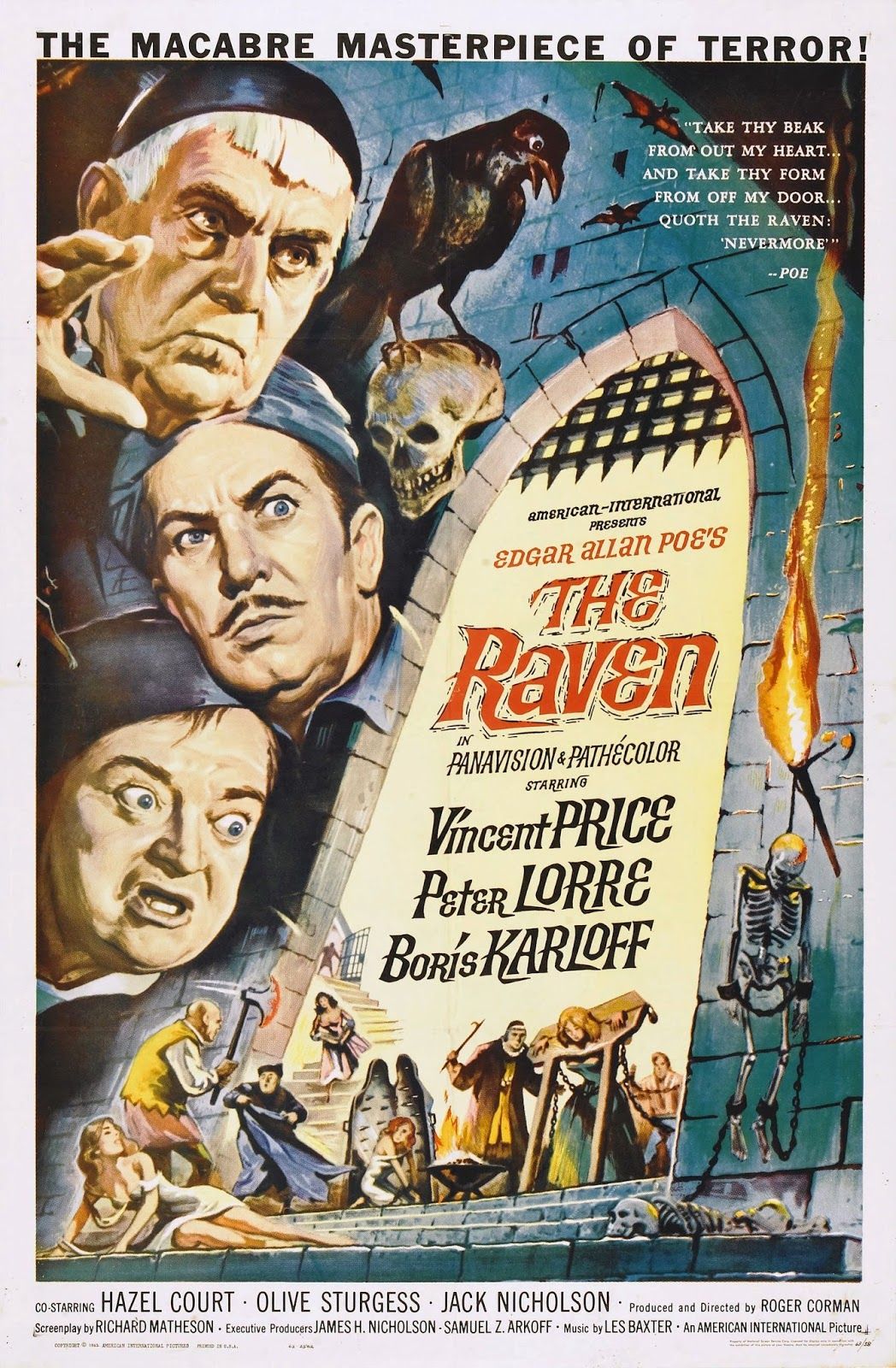
209) The Raven (1963)

"If I would have been sober, which I admit doesn't happen very often, but, it would have been an entirely different story! Entirely different."

Director
Roger Corman

Cast
Vincent Price - Dr. Erasmus Craven
Peter Lorre - Dr. Adolphus Bedlo
Boris Karloff - Dr. Scarabus
Hazel Court - Lenore Craven
Olive Sturgess - Estelle Craven
Jack Nicholson - Rexford Bedlo
Connie Wallace - Maid
William Baskin - Grimes
Aaron Saxon - Gort


If I walked up to any random person on the street and asked them what the first thing is that comes to their mind when I mention the macabre poet and storyteller, Edgar Allan Poe, chances are his 1845 poem "The Raven" is what they'd say. 
It's probably his most iconic and notable work. I mean, there's even an NFL football in Baltimore named after Poe's famous poem. What other writer has a sports team named after their work?
For me, it brings to mind my high school English class in which every month for all four years of high school, I and everyone else in my class had to memorize an assigned poem or sonnet, and then recite it in front of the class. One of those poems I had to memorize was, "The Raven." Too bad I don't remember the entire poem. 
Roger Corman's fifth Poe film happens to be (finally) "The Raven" - not to be confused with the 1935 movie, also called "The Raven," directed by Lew Landers. I happen to have that original movie in my film library and I'll get to it eventually.  
While Corman's previous Poe movie "Tales of Terror" felt the most Poe-like so far as it tells a trio of short stories, and Poe was a writer of short stories and poems, "The Raven" surprisingly feels the most un-Poe like. 
Honestly, I'm torn on this movie. I enjoyed it overall for its own sake. I'm also of the opinion that movies based on books and such don't have to completely follow the book. But I do think they need to respect their source material. They shouldn't convey an opposite message of what the author originally intended. Nor should it stray so far from the original source material were it becomes completely unrecognizable.
Vincent Price returns once again along with some other well-known and well-respected stars - Peter Lorre, Boris Karloff and a young Jack Nicholson. Lorre stars in the previous Poe movie, "Tales of Terror."
Nicholson and Karloff also appear in Corman's following movie "The Terror" which was filmed on the back of "The Raven." That's an interesting story for another time.
Nicholson also has a cameo in Corman's popular 1960 flick "Little Shop of Horrors." He's also in the 1958 film "The Baby Killers" produced by Corman. 
Anyways, "The Raven" starts off in a similar way as the poem as Vincent Price recites the opening of the poem before the movie goes in a completely different direction that's miles from Poe's original work. 
Vincent Price as Dr. Craven in "The Raven."
In this movie, matching in the Gothic horror style of the previous Poe movies, the poem's narrator - the one mourning over his lost Lenore - is a magician and sorcerer named Dr. Erasmus Craven (Vincent Price). Lenore has been dead for the prior two years. 
His daughter, Estelle (Olive Sturgess) is truly concerned about her father as she watches him exist in his morose state since the death of her mother.
One night, a raven lands on his window sill tapping on his window. He lets the bird fly into his study much to his amusement. 
I'll add here that this is the best dialogue in the entire movie.
Craven asks the bird, "Are you some dark-winged messenger from beyond?"
The bird doesn't respond. 
"Answer me, monster, tell me truly," he says.
But still, nothing.
"Shall I ever hold again that radiant maiden whom the angels call Lenore?"
Finally, the raven responds.
"How the hell should I know?" 
It brings to mind "The Simpsons" take on "The Raven" from the "Treehouse of Horror" episode in season two which aired back back in 1990. 
In their version, more faithful to the poem, Bart takes on the role of the raven, who initially quoths to Homer, mourning his lost Lenore (depicted as Marge), with "Eat my shorts." His sister, Lisa who's reciting the poem, reprimands him to take it seriously. 
Anyways, the raven is actually another sorcerer, Dr. Adolphus Bedlo (Peter Lorre). He was transformed into a raven during a duel with Dr. Scarabus (Boris Karloff). 
So, Bedlo asks Craven to help turn him back into his human form. And once he does, the two of them hunt down Scarabus to take revenge. 
Bedlo wants to get back at him for turning him into a raven. And Craven wants to get his hands on Scarabus because Bedlo swears he saw Craven's beloved Lenore inside Scarabus's castle. 
Estelle, along with Bedlo's son, Rexford (Jack Nicholson) join them in their mission to find and battle Scarabus. 
Peter Lorre and Jack Nicholson.
There's not really enough content in the source material to make an entertaining movie. If the film's writers just used the scenario as Poe wrote it, the movie would be nothing more that the narrator pondering, weak and weary, over many a quaint and curious volume of forgotten lore, brooding over his lost Lenore while arguing with a cheeky raven perched upon a bust of Pallas just above his chamber door. Perched, sitting, and nothing more. In other words, it would probably be painfully boring!
So, to prevent that, the movie takes a sharp right turn as soon as the raven utters his first line and takes a whimsical juvenile tone than previous Poe movies from Corman. 
Clearly, since "The Raven" is a poem, this movie takes some major liberties with it, turning it into something completely different. I both disliked and loved this movie. I'm torn. 
The story concludes with a duel of spells between Price and Karloff that must have been hilarious to watch on set sans the early special effects. 
I get the impression it's not supposed to be funny but the actors wouldn't mind at all if they saw audiences laughing at them through the whole scene. It feels heavier with comedy than the previous Poe movies in this series. 
While the previous movie had a Poe-like style and feel to it, though I don't know how accurate it is compared to the book, "The Raven" takes perhaps the most well known of Poe's works, gives it lip service in the beginning, and then deviates so far from the source material that it's not even recognizable. It's 99 percent Corman and one percent Poe. 
There is something very iconic of seeing Vincent Price with the raven perched on his arm. It's as though his tie in with such an iconic and well-known poem is meant to be. It's kind of like Sherlock Holmes investigating Jack the Ripper's murders. That has been depicted several times. The 1979 movie "Murder by Decree" comes to mind. 
With the final climax resembling something out of a live-action Disney movie, I'm a bit surprised that out of all of Corman's Poe movies, this one, based on Poe's most well known poem, is the most disappointing and laughable. But I like it for its absurdity, cast, performances, and laughs despite it deviating so far from Poe's genius. The story in and of itself is a trip to watch. For what it is, it's cheesiness is entertaining, and the cast is clearly enjoying it. 

Saturday, November 2, 2024

207) Tales of Terror (1962)


Director
Roger Corman

Cast
"Morella"
Vincent Price - Locke
Maggie Pierce - Lenora Locke
Leona Gage - Morella Locke
Ed Cobb - Coach Driver

"The Black Cat"
Vincent Price - Fortunato Luchresi
Peter Lorre - Montresor Herringbone
Joyce Jameson - Annabel Herringbone
Lennie Weinrib - Policeman
Wally Campo - The Barman

"The Case of M. Valdemar"
Vincent Price - Ernest Valdemar
Basil Rathbone - Mr. Carmichael
Debra Paget - Helene Valdemar
David Frankham - Dr. Elliot James

Halloween is over for another year, but thankfully the Fall season - my favorite time of year - carries on. If there was an ideal season for watching classic horror and thriller flicks, this is it. It's just how my imaginative mind works. 
Now that I've finished my string of Dracula/ Vampire movies for Halloween, I'm anxious to get back to other things, particularly Roger Corman's Edgar Allan Poe films. 
The last Poe film I reviewed was "Premature Burial" which follows a theme Poe seems to love. Namely, being buried alive.
"Tales of Terror" is an anthology movie that tells three different tales of the macabre. It's been a while since I reviewed a horror anthology movie. For a short period, I was reviewing a bunch of them and calling those reviews, "The more horror there is." They're fun to watch and comment on. I should get back to that anthology thread. 
The word "macabre" strongly comes to mind after watching this movie. And as expected, one of the stories involves being buried alive. 
As Poe is well known for writing short tales of terror, this movie has a true Poe feel to it. Thankfully, Vincent Price returns after being absent in "Premature Burial."
The Poe movies with Vincent Price were produced through American International Pictures (AIP). "Premature Burial" however was produced through Pathé Lab. While Corman wanted Price to appear in the last movie, Price was under contract with AIP. So, Ray Milland took on the lead role. But Vincent Price is back, and in three different and distinct roles! 


"Morella"
The first tale begins with a young lady (that's never a bad start) named Lenora (Maggie Pierce) as she's headed to Boston to see her estranged father, Locke (Vincent Price). He lives a reclusive life in his dark and dingy mansion. 
He's a big lush suffering from a stinging loneliness. Who wouldn't be if they lived alone for some many years in a huge house?
Locke holds a grudge against his daughter blaming her for the death of his late wife, Morella, who died while giving birth to her. 
While roaming his house, Lenora finds her mother's remains resting in a bedroom and treated as though she's only sleeping. 
Locke cannot accept Morella's death and has closed himself off from the outside world. He's waiting for death to take him, too. 
Lenora tells her father that she's sick and could die as a result. So, he begins to dissolve his grudge and allows her to stay. Despite having been estranged from his daughter, he doesn't want her die. 
That night, Morella's ghost returns to her decaying body since daughter is now in the house. She arises from her bed and restores her decaying corpse to her former beauty. But the catch is that her body is exchanged with Lenora's body as an act of revenge for being the cause of her death. Lenora's body then becomes the decaying corpse in Morella's spot.
Morella seeks out Locke and strangles him. His huge mansion catches fire, and Morella and Lenora switch places again. 
Lenore breaks a smile as she lies on the body of her dead father, while the bodies inside burn with the house. Burning houses, by the way, seem to be a reoccurring event in these Poe movies. 


Peter Lorre as Montresor Herringbone in the "Tales of Terror."
"The Black Cat"
In this segment, Peter Lorre plays Montresor Herringbone who has absolutely no love for his wife, Annabel (Joyce Jameson). 
He has even less affection for her black cat. 
He's also a huge lush like Locke in the previous story and wanders around town looking for a drink. 
After getting kicked out of a tavern, he stumbles upon a wine tasting party hosted by a widely respected wine connoisseur named Fortunato (Vincent Price). He decides to take on Fortunato in a wine identifying challenge. 
Herringbone impresses Fortunato by identifying each wine flawlessly. He chugs each glass while Fortunato sips and smells each glass like a well-trained connoisseur would. But Herringbone passes out before the challenge is over. Of course, Fortunato is just fine since getting plastered wasn't on his agenda for the night. Afterall, a connoisseur needs to stay respectable.  
At the end, he walks the drunk Herringbone home. There, Fortunato meets Herringbone's wife, Annabel (Joyce Jameson) while her husband remains passed out.  
After a while, Fortunato and Annabel become a little too familiar with each other. 
When Herringbone wakes up and realizes what happened between the two, he takes his revenge on both by sealing them up alive inside a wall in the cellar. 
However, after bricking up the wall, he doesn't realize that the black cat found its way inside as well and is now crying to get out. 
Police later show up to investigate Fortunato's disappearance. That's when they hear the crying cat which leads them to the sealed wall. 
When they break it open, they find the remains of Annabel and Fortunato. 


Vincent Price as Ernest Valdemar.
"The Case of M. Valdemar"
In the final segment, Vincent Price plays M. Ernest Valdemar who's suffering from a horrible illness that's slowly killing him.
So, he consults a hypnotist named Mr. Carmichael (Basil Rathbone) to hopefully ease his pain and maybe even cure him. 
Carmichael puts Valdemar into a trance. But then he keeps him a state between life and death as a kind of experiment.
While in this trance, Valdemar telepathically begs and pleads for Carmichael to end the trance or to kill him. But in the name of experimentation, Carmichael keeps him in this trance. In fact, he keeps him in this state for months. All the while, Valdemar's body starts to decay though he's still alive. 
Meanwhile, Carmichael starts to move in on Valdemar's wife, Helene (Debra Paget). She rejects his advances which infuriates him enough to attack her. This all happens in front of Valdemar's decaying lifeless body. 
However, he knows what's taking place. So much so that he slowly wakes up and kills Carmichael. 


 Vincent Price, David Frankham, and Debra Paget in
"The Case of M. Valdemar."
My thoughts...
I enjoyed "The Black Cat" the most. The late, great Peter Lorre launches this segment into grand heights. 
I really appreciate Corman casting Lorre in this film. His performance is fantastic, making "The Black Cat" among the most enjoyable stories in all the Poe films I've watched so far. Watching him work off of Vincent Price is the stuff of film legend. It's a real rarity to see these two on screen together. To my pleasure, they appear together in the next of Corman's Poe movies, "The Raven" which I will post commentary on later. 
Also, Basil Rathbone - Sherlock Holmes himself - is a welcomed sight as he plays a conceited character whose self-righteous style of cruelty effectively makes the audience want to dislike him. His performance lends Vincent Price a little more triumph when he awakens to kill him. 
I've heard "Tales of Terror" referred to as a throw-away horror flick, whatever that means. The talent is there with its big-name cast, and I'm partial to its gothic horror style just as I am with the other Poe films. 
The scare factor is in the scenarios, gothic sets, and situations. Like "House of Usher" in which the house is the monster, "Tales of Terror" relies on those three things. 
The first tale is decent enough, but more of the same as previously seen. It's a grim situation in a big creepy house just as the previous movies are. And the final tale is rather subtle. I think it's "The Black Cat" that really makes "Tales of Terror" worthwhile. 
Despite any problems this movie might have, I appreciate it for the variety that distinguishes it from Roger Corman's, especially with its off-putting tales. 
The subplot of being buried alive, seen in "The Black Cat" is depicted as an act of revenge rather than an act of despair as seen in "House of Usher." And that burial scene delivers one of the most chilling exchanges in the Poe series.
As Fortunato is being sealed up alive in the wall, he begs and pleads for Herringbone to let him go.
"For the love of God, Montresor," Fortunato pleads.
Montresor glares back and says coldly, "Yes...for the love of God." 
Vincent Price most impressively plays multiple characters, one for each story. Each character he portrays is depicted with completely different personalities. 
He's a depressed recluse in the first segment. That's followed by his performance as a conceited professional wine expert and scoundrel in the second segment. And in the third segment, he plays a sick man trapped in his own body. This movie alone shows how versatile an actor Vincent Price was. 
Out of all of Corman's Poe movies I've seen so far, this is the most Poe-like film. Of course, this and the previous movies takes various liberties with Poe's short-stories and poems. 
And it's an anthology movie which is right up my alley. I love horror anthologies. 
The movie really takes its time with its pace. Its runtime is two hours. 
Overall, "Tales of Terror" deserves appreciation. And it's a perfect segue for the next movie in Corman's Poe series which I can't wait to get to! 

Tuesday, July 30, 2024

193) The Premature Burial (1962)

"Can you possibly conceive it. The unendurable oppression of the lungs, the stifling fumes of the earth, the rigid embrace of the coffin, the blackness of absolute night and the silence, like an overwhelming sea."

Director
Roger Corman

Cast
Ray Milland - Guy Carrell
Heather Angel - Kate Carrell
Hazel Court - Emily Gault
Alan Napier - Dr. Gideon Gault
Richard Ney - Miles Archer
John Dierkes - Sweeney
Dick Miller - Mole


Roger Corman's third Edgar Allan Poe movie, "The Premature Burial," which follows "House of Usher" (1960) and "The Pit and the Pendulum" (1961), is the first of two Corman movies that star veteran actor Ray Milland.  
Milland also plays Dr. Xavier in Corman's popular sci-fi movie, "X: The Man with the X-ray Eyes" (1963). C'mon...who hasn't heard of it? 
"Premature Burial" is also the first and only one of these Poe movies not to star Vincent Price. Bummer!  
In this movie, Milland plays wealthy aristocrat, Guy Carrell who mopes around his huge estate worrying about being buried alive. It's a fear that consumes his mind like a worm. 
He and his fiancée Emily Gault (Hazel Court) are going to marry soon. Before they do, Guy tells Emily that he, like his father, has a rare disease that can make people appear dead. So, they're relationship is off to a good start as far as communication goes. 
He shows Emily the family crypt and tells her that when was a kid, he swore he could clearly hear his dad screaming from inside his tomb. 
Emily doesn't know what to think about all this. Guy's sister, Katie (Heather Angel), doesn't think he really heard their father from the tomb all those years ago. She thinks it was his all in his mind, fueled by his deep fear of being buried alive. 
Regardless, Emily is eager to marry Guy despite his inordinate fear. 
And so, they do. 
During the wedding reception, Emily plays the tune "Molly Malone" on the piano. For some reason, this drives Guy into some kind of panic, which makes him pass out. 
Afterwards, his fear of being buried alive worsens. Guy's fear pushes him to build his burial vault with various devices to ensure he won't be buried alive. It's even equipped with a poisonous mixture that he can use as a final resort in case the other safety measures fail. 
This fearful fixation has Emily worried. His colleague, Miles Archer (Richard Ney) is also worried about Guy. And Guy is worried about himself.
So, he takes a walk along the moors with Emily where he hears someone whistling "Molly Malone" off in a distance. Terrified, he passes out again.
While he's passed out, he has a nightmare where he's
buried alive in his vault, and none of his preventative measures are working, 
When Guy wakes up and asks Emily if she heard the whistling, Emily insists she didn't hear anything. 
Well, she can't take this incessant fear of his. It's getting out of hand. She gives Guy an ultimatum. Either he gets over this out-of-control fear or she's walking. 
Much to her surprise, it works. 
Guy takes his super safe burial vault apart and comes back down to earth. 
And then Miles has to chime in and encourages Guy to open his father's tomb to see for himself that he was not buried alive. 
It turns out that doing this was a terrible idea. Seeing his father's remains causes Guy to pass out again...and not wake up this time. Do you see where this is going?
Emily's father, Dr. Gideon Gault (Alan Napier) examines Guy, and believes he died from a heart attack.
He can't move or speak, but he isn't dead. They just think he is. The audience can hear his thoughts as he hopes and prays someone figures out he's alive. 
Emily chooses to have Guy buried in the cemetery outside of his estate. 
Guy now finds his worst nightmare coming true. He's able to move his eyes. Since his casket has a window over his face, Guy prays in his head that someone notices his eyes moving as they lower him into his grave. But they don't. 
Shortly after he's buried, grave robbers dig up his body just as he is able to regain mobility. 
Now, back from the dead (figuratively speaking), Guy takes revenge on those who buried him alive. 
Like the previous Poe movies, "The Premature Burial" maintains a grand impressive, elegant,
Ray Milland in "The Premature Burial."
yet low budget Victorian era style, seen in his previous Poe movies that I find entertaining and amusing to watch. Its atmosphere and style remind me of Hammer Horror movies from the U.K. 
This movie comes across drier than it does horrific compared to the Poe movies before it. However, the fear factor picks up midway. Ray Milland is a fantastic actor with a lot of respected titles under his belt. I still miss Vincent Price in this picture. 
Milland plays a sympathetic character wonderfully well. When the horror finally turns on, he doesn't quite hit the frightening mark. He tries, but his performance in the scary half of the movie leans into the side of awkward. He has to carry the horror on his shoulders with his characters consuming fear of being buried alive. Milland has to bring the audience the fear and terror they came to see through his own expressions. And he works it, but doesn't quite make it there for me. 
But I still enjoyed watching this and found it worthwhile and entertaining. 
There's one line that cracked me up. I don't know if it was intended to be funny, but it had me in hysterics. 
In that scene, Emily asks her dad if he's enjoying himself during the wedding reception. 
He replies, "I never enjoy myself. I merely experience greater and lesser degrees of tedium, that's all." 
If I were Emily, I'd be sorry for asking. 
It's worth pointing out that Alan Napier is the same Alan Napier who famously played Alfred Pennyworth, Bruce Wayne's butler, in the TV series "Batman."
Despite its mild weaknesses, and slight underperformance, Corman maintains his haunting style with Poe's continuing theme of being buried alive. It's a theme seen in the previous movies, and other Poe tales. Watching "The Premature Burial" makes me anxious to get to his next movie in the series - "Tales of Terror." 
 

Monday, June 17, 2024

191) The Pit and the Pendulum (1961)

"...the agony of my soul found vent in one loud, long and final scream of despair."

Director
Roger Corman

Cast
Vincent Price - Nicholas / Sebastian Medina
John Kerr - Francis Barnard
Barbara Steele - Elizabeth
Luana Anders - Catherine Medina
Antony Carbone - Doctor Leon
Patrick Westwood - Maximillian
Lynette Bernay - Maria
Larry Turner - Nicholas as child
Mary Menzies - Isabella
Charles Victor - Bartolome


Ever since I started this blog, I've developed an appreciation for the works of director, producer, and actor Roger Corman. 
Among all his work, he stands out in my head as the guy who created "Little Shop of Horrors." 
The more I read about Corman, particularly his Edgar Allan Poe films, the more I wanted to watch them in chronological order. Of course, there's a list of other movies he directed in his long reign as the "King of cult cinema" which I hope to get to in the future. 
I was sad to hear of Corman's passing last May. He certainly has an amazing legacy in horror/thriller cinema. 
In March, I started watching Corman's Edgar Allan Poe series starting with the first film, "House of Usher" (1960). As I mentioned in my review, Usher is followed by "The Pit and the Pendulum" (1961). And that's followed by "Premature Burial" (1962), "Tales of Terror" (1962), "The Raven" (1963), "The Haunted Palace" (1963), "Masque of the Red Death" (1964), and "The Tomb of Ligeia" (1964). All of these films except "Premature Burial" stars horror icon Vincent Price.
I'll also mention again that there's a few odd balls in this mix. To begin with "The Haunted Palace" is actually based on H.P. Lovecraft's novella, "The Case of Charles Dexter Ward." However, the title belongs to Poe.
The 1968 British horror film, "The Witchfinder General," directed by Michael Reeves and starring Vincent Price, is based on Ronald Bassett's 1966 novel. When it was released in the U.S. by American International Pictures, it was retitled "The Conqueror Worm" in order to connect it to Corman's Poe films.
"The Pit and the Pendulum" continues Poe's obsession with premature burial. Like the other Poe films, this is loosely based on his works.
The story takes place in Spain during the mid-1500s. Francis Barnard (John Kerr), an Englishman, drops in on his brother-in-law, Nicholas Medina (Vincent Price) who lives in a huge castle overlooking the sea. Barnard is looking into the disappearance of his sister, Elizabeth (Barbara Steele).
Nicholas, who lives with his sister Catherine (Luana Anders), tells Francis that his sister died from some sort of blood disorder three months ago. 
As Francis presses for more details, Nicholas and Catherine seem reluctant to give him any answers. But Francis is determined to know what exactly happened to his sister. And he refuses to leave the castle until he knows the facts. 
John Kerr and Vincent Price in "The Pit and the Pendulum."
During supper one evening with the family physician, Dr. Leon (Antony Carbone), Francis asks again about Elizabeth. 
Dr. Leon informs him that Elizabeth actually died from heart failure. As he puts it, she "died of fright." 
Things turn stranger from there. 
Francis demands to see where Elizabeth is buried. Nicholas obliges and takes him into a torture chamber. He also reveals to Francis that Elizabeth became obsessed with the torture devices housed within. So much so that she locked herself within the chamber's iron maiden where she died after whispering the name "Sebastian." 
Francis doesn't buy it. In fact, he picks up on what seems like guilt from Nicholas. He shares his thoughts with Catherine. And she tells him of Nicholas's traumatic childhood experiences as his father was a Spanish inquisitor named Sebastian Medina.
Once during his youth, Sebastian snuck into the torture chamber with his mother, Isabella, and Sebastian's brother, Bartolome. While hiding, he watched as his father tortured Bartolome with a hot poker while shouting "adulterer" at him. 
Bartolome didn't survive the ordeal. And after he died, Sebastian tortured Isabella in front of Nicholas. 
Then, Dr. Leon lets the morbid ugly cat out of the bag. 
He tells Francis and Catherine that Isabella was buried alive behind a stone wall in the castle. 
This news leads Francis to believe the same fate befell his sister Elizabeth. Dr. Leon says that if Elizabeth is roaming around the castle, chances are it's her ghost that's doing the roaming. 
The idea of premature burial is Nicholas's most dreaded and traumatizing fear. 
Soon, all kinds of noises start coming from within Elizabeth's room. 
Everyone goes to investigate these noises, and find her room demolished. And the portrait Nicholas painted of her is torn and slashed. 
Nicholas is now convinced his wife's angered soul is truly haunting the castle. He also starts hearing the harpsichord she loved so much play in the middle of the night. 
Shortly after, he insists her tomb be opened. 
Francis opens her grave and finds her corpse frozen in a terrified position with eyes wide open and her mouth wide open as she died screaming. Scratches mark the coffin lid. Clearly, she was buried alive.  And the sight of her makes Nicholas faint. 
That night, Nicholas is bombarded with mental anguish. He can hear Elizabeth calling him. 
He follows the sound of her voice until he reaches her gravesite. There, he witnesses his late wife crawl out of her grave and follow him as he tries to run. Scared out of his wits, Nicholas falls down a flight of stairs. 
Just then, Dr. Leon appears on scene and confirms to Elizabeth that Nicholas is gone. 
But it doesn't end there!
Like "House of Usher," the horror and apprehension grows and grows in  this movie. The excitement intensifies all the way through.
It's horror that doesn't rely on blood and guts, or jump scares, or gnarly hideous zombies and monsters. This fear is pure mental anguish and anxiety culminating in a superb twist ending. It's a fear of a real possibility. The only way out of that fear, as far as the story goes, cannot be met without inflicting a permanent scar. Horror writer Stephen King applies such a technique for the endings of some, if not many, of his stories. 
Once again, Vincent Price is well cast and maintains himself to be the master of horror and the macabre. 
He conveys the terror within the plot remarkably through his face and reactions. It's in his eyes. Through his defeated, lonesome, fear-filled eyes, Price insights those same emotions to the audience with no need for exposition. 
The performances are brilliant all around, but Price carries the entire thing on his shoulders as though it takes no effort. Yet, it's full of effort.
For a low-budget picture, Corman somehow manages to put the audience in a dreamlike atmosphere while the thought of being buried alive where no one can hear you is forced to stay within the audience's collective imagination for sometime.  
Perhaps the term "horror classic" is thrown out loosely for most of my posts, but that term needs to be applied to Corman's "The Pit and the Pendulum." 
As much as I found "House of Usher" to be a well-made horror flick, "The Pit and the Pendulum" manages to earn a few extra points for hitting the right fearful spots, and for Price's continued impressive performance. I have yet to see Vincent Price performance I didn't like. 

Friday, March 29, 2024

187) House of Usher (1960)


Director
Roger Corman

Cast
Vincent Price - Roderick Usher
Mark Damon - Philip Winthrop
Myrna Fahey - Madeline Usher
Harry Ellerbe - Bristol


Roger Corman, "The King of the Cult Film" and "The Pope of Pop Cinema," has a string of period movies based on the macabre works of Edgar Allen Poe.
The first is "House of Usher" (1960) based on Poe's "The Fall of the House of Usher." It's followed by "The Pit and the Pendulum" (1961), "Premature Burial" (1962), "Tales of Terror" (1962), "The Raven" (1963), "The Haunted Palace" (1963), "Masque of the Red Death" (1964), and "The Tomb of Ligeia" (1964). All of these films except "Premature Burial" stars horror icon Vincent Price. 
It's worth mentioning that there's a few odd balls in this mix. To begin with "The Haunted Palace" is actually based on H.P. Lovecraft's novella, "The Case of Charles Dexter Ward." The title belongs to Poe. 
The 1968 British horror film, "The Witchfinder General," directed by Michael Reeves and starring Vincent Price, is based on Ronald Bassett's 1966 novel. When it was released in the U.S. by American International Pictures, it was retitled "The Conqueror Worm" in order to connect it to Corman's Poe films. 
Also, Corman's 1963 movie "The Terror" staring Boris Karloff and a very young Jack Nicholson tends to be linked to his Poe films though it's not based on anything Poe has written. Corman himself explains the reason why this is so. In his memoirs, he says, "I was getting so familiar with the standard elements of Poe's material – or at least our adaptations – that I tried to out-Poe himself and create a Gothic tale from scratch." (Corman, 88). 
So, now I'm on another cinematic horror mission like my watching all the "Psycho" movies. I want to get through all these Poe films in chronological order. The challenge is finding them all. I've had them on my radar for a few years. And I happened to find a copy of "House of Usher" at the library. I'll likely include the oddball films as well because, why not. When I go for something, I want to go all in.
In this movie, Mark Damon plays Philip Winthrop who arrives unannounced to the isolated Usher mansion. He's there to visit his fiancé Madeline (Myrna Fahey). But her disappointed older brother Roderick (Vincent Price) doesn't great him very warmly. In fact, he doesn't want Philip there at all and would prefer he leave Madeline altogether. 
Vincent Price and Myrna Fahey in "House of Usher."
"For hundreds of years, foul thoughts and deeds have been committed within these halls," he tells Philip.
So, naturally Philip and Roderick take a disliking to each other. 
Philip's efforts are focused on trying to take Madeline away from the dreary and foreboding walls of the House of Usher. 
Despite Roderick's protests against the two marrying, Philip intends to marry her despite him. 
Roderick tries to convince Philip that he and Madeline both suffer from an inherited madness that's unique to the Usher lineage. As Madeline is very sick, he tells Philip she doesn't have long to live. But Philip refuses to leave and call off his engagement.
Strange noises echo throughout the halls at odd hours. 
Philip turns to the butler, Bristol (Harry Ellerbe), about these noises. He tells Philip that they're the result of a fissure that has existed in walls for decades. 
As the days carry on, and Philip refuses to leave, strange "accidents" begin occurring around him. He's almost killed as a result of some of these strange accidents. 
One of these accidents happen when Madeline is showing him the family crypt underneath the mansion. 
He's almost hit by a flying coffin, which causes Madeline to faint. 
Later, Philip goes to check on Madeline who has been resting in her room after fainting, and finds her sprawled across the bed, seemingly dead of a heart attack.
Roderick quickly has her placed in a coffin to be buried in a plot reserved for her in the family crypt. He wants her to be immediately buried. 
The following morning, Bristol tells Philip that Madeline used to have cataleptic fits. This means she's buried alive. He goes straight to Roderick about. And he admits to it. 
Roderick claims he allowed her to be buried out of love of his sister, and to ensure the tainted Usher blood won't spread to future generations. When he tries to go save her, Roderick assures him that by this time, she's surely dead. 
That night, Philip sneaks to the crypt only to find a trail of blood along the floor leading to a hidden passage. 
Madeline somehow managed to break out of her coffin and escape to somewhere inside the house. 
When Philip finds her, she has gone insane and attacks him. 
He gets the upper hand and tries to shake her back to some level of sanity. 
But she runs off to find her brother. 
Myrna Fahey and Mark Damon.
A violent storm erupts outside, causing the fissures to start splitting the house. 
Philip watches in helpless horror as Madeline attacks Roderick while the house crumbles to pieces. There's nothing Philip can do but watch as beams fall and kill Roderick and Madeline instantly.
Bristol finds Philip and drags him to safety outside before running back into the house which has now caught fire. 
Within minutes, the house burns and sinks into the ground until it's no more. 
Poe has some sort of interest in premature burial. His other stories "Premature Burial," "Berenice," "Black Cat," and "The Cask of Amontillado" have situations in which someone is buried alive. 
In this movie, the audience witnesses the scenario of being buried alive affect those around the victim. 
Everything from the atmosphere, mood, artwork, music direction and acting, especially from Price, fit so well together in this spectacle of a horror film. 
I don't like to quote other critics often, but "Variety" stated it best at the time when it wrote, "In having taken several liberties with the original, the release may aggravate Poe purists and scholars, but the shrewd alterations, since they pursue a romantic course, should prove popular with the bulk of modern audiences. It is a film that should attract mature tastes as well as those who come to cinema for sheer thrills." 
I have a soft spot for period horror pieces like "House of Usher." 
As Corman is known for producing low-budget movies, "House of Usher" doesn't feel like a low-budget picture. It's quite a spectacle despite having a small handful of performers, one being the legendary Vincent Price. 
In fact, it has a solid script, great performances from respectable actors, and a shooting schedule that took several weeks. 
This is such a lavish and well assembled movie. It reminds me a bit of the Hammer Horror productions such as the 1958 film "Dracula" starring Christopher Lee. 
Corman keeps the film truly rich and ornate yet simple with just four actors in the cast. Though he's resourceful, Corman takes everything he can get out of what he has. Every last little drop! 
And Vincent Price, as always, gives everything in his masterful performance. Price never seems to hold back in his films. "House of Usher" is certainly no exception. I love watching him as he delivers each line so meticulously and carefully, ensuring that his deliverance properly fits and supports the scene and the mood. 
Corman's film maintains a steady pace that doesn't drag nor speed up. There's no dull moment. 
It grows more and more suspenseful as trepidation slowly climbs until the final act. I honestly can't wait to get to the rest of Corman's Poe films. 
Death and despair fill the house. Only that which has life and hope can escape it. I can't say how close or loose the movie is compared with Poe's story. But the themes of family, madness, and isolation are certainly well maintained.
There's good reason why this movie was listed on the U.S. National Film Registry for being "culturally, historically, or aesthetically significant." 

My Latest Review!

Not a Review Necessarily - My 'Carrie' trailer reaction