Thursday, July 2, 2020

64) Awakening the Zodiac (2017)


Director
Jonathan Wright

Cast
Shane West - Mick Branson
Leslie Bibb - Zoe Branson
Matt Craven - Harvey
Stephen McHattie - Zodiac

There was a time when I took interest in the Zodiac murders that plagued my part of the world - the San Francisco Bay Area. 
I became interested in these murders for a short while after watching the 2007 movie Zodiac with Robert Downy, Jr., Jake Gyllenhaal, and Mark Ruffalo. How a murderer could be so hard to find after toying the law enforcement was absolutely intriguing.
I read the book Zodiac by Robert Graysmith who's the main character of the movie. After reading it, I had the impression that maybe the Zodiac Killer had some assistance. Perhaps not in murdering people, but at least in alluding authorities. 
Awakening the Zodiac starts in 1968 with the murder of two teenagers, David Arthur Faraday and Betty Lou Jensen, who are parked alone on Lake Herman Road in Benecia, Calif., just shortly after they have an encounter with a police officer. This, of course, is based on the true case involving the Zodiac. 
The officer disturbs their romantic privacy because they're not allowed to park there at night. 
And not even one minute goes by as the officer leaves the frame when another car pulls up. The driver gets out, approaches the car, and shoots both teens. 
And I'm left wondering where that cop went! He had to still be there. He couldn't have driven off that fast. 
Afterwards, the movie transitions to modern day Virginia where Mick Bradley (Shane West) and his wife, Zoe Branson (Leslie Bibb), are trying to turn their financial instability into something sturdy. 
Mick does so by purchasing an abandoned storage locker in the hopes of finding valuables and selling them for profit.
Mick goes halfsies on the storage unit with his pawnbroker buddy, Harvey (Matt Craven- Jacob's Ladder, X-Men: First Class). 
At first, it looks as though the contents from the locker are meager until Harvey discovers a few film reels. 
It turns out the films are of the Zodiac filming himself committing the murder depicted at the beginning of the movie. Another depicts what appears to be the murders of Bryan Hartnell and Cecelia Shepherd which took place in 1969 at Lake Berryessa in Napa, Calif. While Cecelia died from being repeatedly stabbed, Bryan did not. 
The trio find out that discovering this new evidence against the Zodiac could lead to a huge monetary reward. 
So, they break into the storage facility office in order to locate the owner of the locker. They find it's registered to a "Betty Ferguson." 
So, they drive to her home which appears uninhabited, and break in. But they find an old man inside who still lives there. 
It turns out the old man is Betty's son, Benjamin. He and his shotgun find the three intruders and is about to blow them away. They manage to talk their way out of it, however. 
Betty's husband, by the way, is Balthazar. I don't know if the fact all three of their names start with "B" means anything, or is some kind of Easter egg, but by the end of the movie I didn't even care. 
Those unfamiliar with the Zodiac murders, the killer sent coded messages to police and local Bay Area newspapers. While some codes have been deciphered, one particular code has yet to be decoded. And this code supposedly contains the Zodiac Killer's identity according to a letter he wrote to the press. . 
After reviewing more of the found footage, Harvey spots a code decipher briefly in one of the shots. It's a clue long sought after for 50 years.
He uses this brief clip to try and decipher the Zodiac's code that supposedly contains his identity. And he does. 
Off camera, somehow the Zodiac figures out what's happening and does what he can to stop them all. 
How the killer figures all of this out is beyond me. I understand it goes without depiction that the Zodiac knows his locker is sold off. And we catch glimpses of him, especially when he murders the manager of the locker facility. So, he could have gathered some information from her. Or, do we assume that since he's the elusive Zodiac, he's just really smart. After all, he's "elusive." It's not clear. Overall, this movie is predictable and is lacking substance. 
Anyone whose seen enough movies knows it's not going to end well when civilians take it upon themselves to investigate an infamous murderer, especially one as slippery as the Zodiac. 
But how did the Zodiac know Harvey was conducting his own private investigation and attempting to decipher the infamous coded letter authorities were unable to decode for so long? 
There's a lot of room for stronger writing in this movie. 
The purpose of this movie is to entertain and keep us suspense and trepidation until the resolution at the end. I suppose it fulfills that expectation. 
And I was intrigued to find out what was going to happen in the climatic third act. Still, despite that, if it wasn't for this blog and my writing about Awakening the Zodiac, I'd probably soon forget I ever watched this. There's some slight gore and gashing, but it's more of a thriller than a horror movie.
It's an interesting premise for a movie. But it's weak in writing. Its pace and energy is a bit listless. And its story is too predictable.

Shane West and Leslie Bibb in Awakening the Zodiac.

Monday, June 29, 2020

63) The Screaming Skull (1958)


Director
Alex Nicol

Cast
John Hudson - Eric Whitlock
Peggy Webber - Jenni Whitlock
Russ Conway - Rev. Edward Snow
Alex Nicol - Mickey
Tony Johnson - Mrs. Snow

Movies like The Screaming Skull are the reason why I created this blog in the first place. 
I'll start where the movie starts. The theme music at the beginning.
Well, to be honest, the movie starts with an open coffin as a narrator tells the audience what they're about to see will be the most terrifying movie they've ever experienced. 
"Its producers feel they must assure free burial services to anyone who dies of fright from seeing...the screaming skull!" the voice over says. Inside the coffin is a card that reads, "reserved for you." 
Blow me away, movie! 
When I sat and watched this flick, and the theme music started - typical eerie tuba music so common in 1950s and 60s B-horror movies - it sounded very familiar. I knew I heard it before, but I couldn't place it.
All I could determine was its resemblance to the Dies Irae. Being Catholic, I'm familiar with the tune of this Latin requiem chant.
The movie is about Jenni and Eric Whitlock (John Hudson and Peggy Webber), two newlyweds who are moving into Eric's huge summer home. 
The home happens to be where Eric's first wife, Marion, died when, according to Eric, she accidentally slipped and slammed her head against the edge of a decorative garden pond.
When the couple is settling into their home and new life, a pastor named Rev. Edward Snow (Russ Conway) and his wife (played by Tony Johnson) pay them a visit. 
In a moment of exposition, Eric tells them his new wife previously spent time inside a mental asylum after her parents suddenly died. Somehow, Mrs. Snow is aware that Jenni also has a lot of money. 
Mickey the groundskeeper (Alex Nicol, who's also the director), who's developmentally disabled, also lives at the estate. Mickey later tells Jenni that the ghost of Eric's first wife haunts the estate. That's just the last thing a former mental patient needs to hear. Especially as Jenni thinks the portrait of Marion inside the home happens to resemble her own dead mother. 
Soon, Jenni starts hearing screams and finding a skull in various places around the house. All of this starts to drive her mad to the point she feels like she's losing her sanity. 
There's even a moment where Jenni sees the skull and points in out to Eric, who claims there's no skull to be seen. 
John Hudson and Peggy Webber
At a running time of approximately one hour and eight minutes, this low-budget independent movie is a mess of bad acting, terrible film cuts, and some lack of continuity, and a misleading title. 
Well, o.k...there's a skull. And there's some screams. But I think the skull actually "screams" once or twice at most. 
There's one point in the movie where we see Jenni running to investigate a banging noise during the night. As she's running past the camera towards a window to close it, the film cuts to her jumping into her husband's arms in fright. I watched this movie on Amazon Prime, and thought I accidentally sat on the remote when this cut occurred. Normally when I accidentally sit on the remote, my butt generally seems to find the fast-forward button. But this wasn't the case here. In fact, this particular bad cut in the movie is even referenced in an episode of Mystery Science Theater 3000. 
There's another weird cut right in the middle of Jenni's dialogue. It's ridiculous! 
To the movie's credit, the ending is an unexpected twist. 
Otherwise, the pacing seems a little loose. And the story really needs more content, solidity and tightening up. By that. I mean a little more explanation as to the significance of the events taking place such as... 
*SPOILER*
If the husband is responsible for the skull, why does he see it move on its own?
And if his late wife is appearing as a transparent ghost, which she does at an earlier point in the movie, how does she appear in a solid form at the end. Eric even throws something at her, and knocks her down. 
It's too lackluster. There's not enough to really sink the horror-loving teeth into.
After watching the movie, I needed to find out more about the score because I knew it was used somewhere else. 
According to imdb.com, the opening theme played on a tuba is the Dies Irae portion of Hector Berlioz's Symphonie Fantastique. A different version of this piece was used for the opening theme of The Shining (1980). Now that I found this out, I urge readers to listen to the Dies Irae chant (a traditional hymn sung at Catholic funeral masses) on YouTube and compare it to theme song from The Shining. There's a clever similarity. The music for The Screaming Skull was composed by Ernest Gold whose notable work includes music for the movie Exodus.
The Screaming Skull is fun for its own sake. It's funny when it's not supposed to. And it has that nostalgic cheesy charm good for people who like that kind of stuff. Otherwise, it's just a weak, independent, low budget movie.

Saturday, June 27, 2020

62) Shin Godzilla (2016) - aka Godzilla Resurgence


Directors
Hideaki Anno, Shinji Higuchi

Cast
Hiroki Hasegawa - Rando Yaguchi
Ren Osugi - Prime Minister Seiji Okochi
Ken Mitsuishi - Governor of Tokyo
Satomi Ishihara - Kayoko Ann Patterson
Yutaka Takenouchi - Hideki Akasaka

There's a lot to say about Shin Godzilla. 
Its place in the Godzilla franchise is the reason I'm commenting about it on this blog. 
It's the first Godzilla movie from Toho Studios in 12 years - the last film being Godzilla: Final Wars (2004). The U.S. movie Godzilla was released in 2014, but that was from Warner Bros. I'm referring to films directly from Toho. 
It's also the first movie to exclusively feature Godzilla without any other monsters since Godzilla: 1985. 
And while Godzilla: 1985 was a direct sequel to the first movie that started it all, Gojira (1954), Shin Godzilla is a straight-up reboot of the franchise with a different origin story for the "King of the Monsters." 
When it comes to Godzilla movies in general, there's a lot of them. There's more than 20 Godzilla movies out there, including the Hollywood films. It's overwhelming. 
The Showa era of Godzilla flicks (1954 - 1975) starts with the original movie Gojira and ends with an epic monster showdown in the movie Terror of Mechagodzilla. After that, there wasn't a Godzilla movie until about ten years later. 
Incidentally, Gojira was released in the U.S. in 1956 under the title Godzilla: King of the Monsters. This version has some heavy re-edits, English dubbing of course, and stars Raymond Burr (Perry Mason). 
The Heisei era (1984-1995) kicks off with The Return of Godzilla (aka Godzilla 1984) which as I said is a direct sequel to the original 1954 movie. All other movies from the Showa era are pretty much ignored. Incidentally, don't you love it when movie studios just flush their work down the toilet and start over? 
Next is the Millennium era (1999 -2004). This is Toho's second franchise reboot, starting with Godzilla: 2000. The infamous American-made movie Godzilla with Matthew Brodrick (I call it the "Simpson's Godzilla" because of the number of cast-members from the Simpson's appearing in this movie) from 1998 falls into the Hollywood Godzilla movies which are carrying on to this day - the final one being 2019's Godzilla, King of the Monsters. 
Finally, Shin Godzilla starts the Reiwa era which is still wreaking havoc on us all!
Horror and Sci-Fi movies play a large role when it comes to audiences facing their fears. I think Godzilla is a perfect example.
While 1954's Gojira is a commentary on nuclear war and nuclear fallout which the Japan was all too familiar with after the bombings of Hiroshima and Nagasaki, Shin Godzilla pulls inspiration from the Fukushima Daiichi nuclear disaster in 2011 as well as the Tohoko earthquake and tsunami. 
The movie starts with the Japanese Coast Guard investigating an abandoned yacht out in the Tokyo Bay. During the investigation, the Coast Guard ship is destroyed and the Trans-Toyko Bay Expressway floods. 
Japanese officials look to viral videos online to see for themselves what transpired. 
While trying to determine the cause of all this turmoil, a Cabinet Member, Rando Yaguchi (thankfully, the names of officials are displayed along with the English subtitles) determines a living creature was the cause of it all after seeing a large tail come out of the water in one of the videos. 
It isn't long before a giant lizard with goofy looking eyes emerges from the waters and crawls through the streets of the city, tearing down buildings and destroying the infrastructure. 
The creature begins to turn into a bi-pedal red-skinned monster.  
When it returns to the waters to cool off from overheating thanks to its internal radiation levels, the government and military officials have a little time to strategize plans for public safety and defense. 
When the giant lizard returns, it begins to grow twice its size, and transforms into Godzilla. 
It's given the name "Godzilla" by anti-nuclear zoology professor, Goro Maki, who has been studying this creature for sometime. The name stems from Maki comparing the creature to God. 
It turns out the abandoned yacht actually belongs to Maki, and he left a lot of his research aboard the boat. 
Meanwhile, Godzilla ends up in Kamakura, where he remains stationary while his energy diminishes. But he returns stronger than ever. 
Both Japanese and American forces throw all they can at Godzilla to take him down. 
But as Godzilla grows more and more destructive (unlike any other Godzilla movie I've seen so far), armed forces do what they can, as fast as they can, to defeat him. They finally come up with an extraordinary plan to defeat Godzilla.
Shin Godzilla strives to be engaging with the chaos and turmoil, and "what are they gonna do?" depictions. It works at times. But too much of a good thing isn't always a good thing. It's slow and dragging the rest of the time, with all the talking officials and important heads in suits. Then again, it's basically a war movie - plan and attack, plan and attack. A small handful of surprises are thrown in to build intrigue and suspense. 
To the movie's credit, it does try to break this monotony with believable humor and random camera angles which make the actors stare directly into the camera as they stare at their computer screens or T.V.s. There's a lot of these angles, and I would love to find out why directors Hideaki Anno and Shinji Higuchi chose to use them so much. 
One scene in particular shows a room full of government officials and science nerds trying to figure out how to stop the monster. There's a lot of scenes like this in the movie, too, by the way. Anyways, while the camera is focused on two officials in the front of the frame, one random assistant bursts into shouts of shock as he evidently figured out something crucial. He runs around the room in the background to show supervisors his discovery, and then scampers to our main officials in the front of the frame to tell them what he found. It definitely breaks the monotony, and made me laugh.   
The dialogue gives the story a more realistic tone. In one department scene, the Deputy Chief Cabinet Secretary asks Rando "when was the last time you changed your shirt?" Others in the office comment that his shirt is pretty rank, so they leave a clean shirt on his desk. It's a subtle way of expressing just what these officials are going through as this unbelievable catastrophe is happening right before their eyes. This type of dialogue is peppered throughout the movie. 
But what really makes the movie are the special effects. Godzilla really goes to town on Tokyo - pun intended. There's plenty of destruction. There's bombs upon bombs, each being stronger than before. And Godzilla doesn't just trample on buildings and tear down high rises. Beams of radiation emanate from him, literally slicing through buildings like a hot knife through soft butter. And his atomic breath seems much more destructive than before. The King definitely doesn't hold back. You want to see Tokyo crumble and burn like paper? This movie doesn't short change the audience in that regard!
There's a lot of scientists, heads of state, and other leaders and geeks. But there's destruction, too. Lots and lots of destruction. And the effects are generally great, though many times the CGI Godzilla looks fake with movements clearly computerized.
I appreciate the use of the original soundtrack in this movie - the same that was used in the 1954 film. It helped give this movie the feeling and atmosphere of a Godzilla flick. And hearing it in a new film just hit the fandom spot for me! It's used in the trailer as well.
It's so evident the actors want to make a serious and believable movie. They really put their utmost emotion and spirited effort to make a great movie.
Shin Godzilla is a fun movie; a great Godzilla experience when all is said and done. Toho Studios still has what it takes! 

Thursday, June 11, 2020

61) The Pyx (1973)

Her business is pleasure...until her date with the pyx.

Director
Harvey Hart

Cast
Karen Black - Elizabeth Lucy
Christopher Plummer - Dt. Sgt. Jim Henderson
Yvette Brind'amour - Meg
Donald Pilon - Dt. Sgt. Pierre Paquette


Someone somewhere, a while ago, recommended this movie to me. It runs along the same vein of supernatural horror/thriller films like Rosemary's Baby, The Exorcist, The Omen, and maybe even The Wicker Man, or The Crimson Cult. 
The Pyx is classified as a supernatural horror film, but the "supernatural" is pretty subtle. Actually, it's a lot subtle. In fact, it's so subtle, I think I missed it entirely...until the end. There's a lot of Roman Catholic references and symbolism in the movie. Just the term "pyx" refers to a circular container, normally of gold, that's used by Catholic priests to carry the Eucharist to sick people, or those unable to attend mass. 
Also known as The Hooker Cult Murders, this movie is based on a 1959 novel of the same name by John Buell. 
As for the "horror" classification, well there's just a few scenes with dead people and some blood dripping from their lifeless bodies, and some random shots with blood on the floor or smeared on doors. And there's one scene with a dead cat stuck to a door with a knife. That's some horror-y stuff right there.
The movie, shot in Montreal, begins as a woman falls to her death from a high-rise building.
When police arrive, they discover a pyx and a small crucifix in her hand. 
This case is handed to Det. Sgt. Jim Henderson (Christopher Plummer) who identifies the woman as Elizabeth Lucy (Kristen Black) - a prostitute and heroin junky. 
He finds that the apartment she jumped from is being used as a cathouse. 
In turns out Lucy was a struggling Catholic who was trying to straighten her life out amidst being a prostitute. 
Henderson and his partner interview Meg who operates the brothel in the otherwise vacant apartment. She tells Henderson that Lucy was indeed an employee of hers, but often worked outside the brothel against Meg's wishes. 
Christopher Plummer (center) in The Pyx.
Needing further inquiry, Henderson goes back to the brothel the next day, but finds Meg and another girl with their throats sliced. 
Digging deeper into the investigation, he questions Lucy's roommate, Jimmy, who's also her close friend.
He reveals to Henderson that Lucy was acting strange the day she was killed noting one of her new clients was a strange rich guy whom he was bothered by. 
The audience is soon shown just who this mysterious client is, and his identity is completely unexpected. 
And that's when the movie takes a really dark, dark turn revealing something more evil than what Henderson anticipated is at hand.
A lot of elements are very much a product of the early 1970s. There's two conflicting themes - faith (Catholicism specifically) and sexual promiscuity. Though the novel was written in 1959, the movie was made at a time when sexual revolution was at a zenith, the Catholic Church was experiencing major changes stemming from the Second Vatican Council, and the world was a much different place morally speaking than it was in 1959. Souls were caught in the middle of it all. This is a movie for its day.
The sinister music in the final act is hilarious, though not intended to be. It's as though some tired Benedictine monks chanted a duet with Alvin and the Chipmunks. 
I was thrown off as the movie transitions from past events to present events. I didn't catch onto this until the end.  
At first I was confused as to what was happening, and wondering where the story was going. I kept thinking I missed a crucial plot point. And above all, I kept waiting and waiting for the "supernatural" aspect the movie claims to be, to kick in. The end really ties it all together. 
Karen Black.
The Pyx
 was a bit too underwhelming and lackluster, though it really tried to tell a thrilling story. The final act is what really makes the film. That's when my attention was really captivated. I needed to force myself to pay attention in the meantime. 
But strangely enough, I'm willing to give The Pyx another chance. Now that I, you know, "get it" I think the effort behind the story telling deserves one more viewing. After all, such efforts in starting and finishing a movie are much of the reason I started this horror blog for B-movies in the first place. 
The acting leans too close to dry. And for some reason, the opening shot is a mix of French dialogue along with English. I don't know why? 
There's little inflection in the dialogue, even with veteran actor Christopher Plummer. 
Horror movie legend, Karen Black (I talked about her in my review for Trilogy of Terror) does a good job as a broken prostitute. Her character is a conflicted soul, torn between the "profession" she's chosen for herself, and her Catholic life. I believe it's subtle, but it's there. The Catholic symbolism. The drug use. The guilt amidst the pleasure. It's there.
This movie, overall, makes for a somewhat decent psychological thriller. And for those that watch it...just keep watching. The supernatural element will come. 


Friday, June 5, 2020

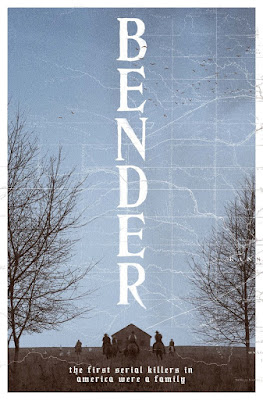
Little Apple Horror News: Independent horror movie on Kansas' Bender family re-releases in U.K. with new title


The U.K.'s Pinewood Studios has taken a keen interest in an independent movie about America's first serial killer family.
The 2016 independent horror film, Bender, was the directorial debut of independent film maker John Alexander. 
The movie centers on the Bender family (aka the "Bloody" Benders) who became historically infamous for murdering several travelers who crossed their threshold for a meal and an over-night stay. They lived in Labette County, Kansas, located in the southeast part of the state, from 1869 to 1873.
Bender has a notable cast including horror film legend James Karen (Poltergeist, Return of the Living Dead) as "Old Man Bender. It also stars Linda Purl (The Office), Bruce Davison (Willard, X-Men), and Buck Taylor (Cowboys & Aliens).
Filmed in Geary County, Kansas, and having its initial premier in Junction City, Bender has gotten an overseas release onto streaming services thanks to one of the U.K.'s leading independent film distributors High Fliers Films PLC at Pinewood Studios.
Pinewood is well known thanks to the number of famous movies filmed on its sets - several James Bond movies, Superman, Tim Burton's Batman, and Aliens. 
"With these films, both independent films and major studio films, people kind of expect a little spike of interest when a film comes out." Alexander said. "It tends to decline as it becomes older and older news. But this film is a little different."
Bender had an initial indy-film spike during its initial release. Alexander said people heard about it, read about it, and most importantly, watched it. And since then, his movie seems to have expanded year after year since. 
According to Alexander, his movie has played at more film festivals last year compared to 2016. 
"Which is totally strange," he said. "I assumed it was an American audience. I assumed also it was largely a Midwest audience. Maybe even a Kansas audience. Maybe, even, a Southeastern Kansas audience. I didn't know how far it would reach. It just kept expanding."
Thanks to the film's distinct unsettling, style not common in other horror/thriller movies, independent or otherwise, Bender continues to grab audience's attention and remain within conversations. With the story being true, the movie leaves the audience wondering if there's another family out there like the bloody Benders. Truth can certainly be scarier than fiction.
Alexander said he believes the movie caught the attention of High Fliers, PLC and Pinewood Studios in the U.K. through other sales he's made. 
That is, the movie was bought by a distributor in China for an Asian release. And it was also bought by some European distributors as well.
"Even some in Africa and South Africa," he said. "And much to my shock, I had no idea this unknown tale of the Old West would be relevant or of interest to people across many oceans." 
It was at this point that Pinewood Studios decided to snag the movie for British audiences.
There was just one small issue with the movie - the title.
The word "bender" refers to the act of binge drinking in the U.K. 
James Karen as 'Old Man Bender' in Bender.
"It never was on my radar to have a title that would work internationally," Alexander said.
So, agents, studio executives, and Alexander discussed possible alternative titles for the movie that would suit British audiences. They finally coming up with the alternative title The Family. 
"I'm totally happy with it. I think it works great," Alexander said.
Of course, it's still Bender in the U.S.
The movie was released earlier in May for U.K. streaming services such as Amazon and Video-on-Demand, 
Alexander said this release platform is fine as it would have been challenging to deal with a theatrical release given the current world-wide situation with the COVID-19 outbreak.   
Still, he considers himself fortunate as independent film sales are "grim and dire." 
"That was the greatest victory in these sales," he said "The fact that we've actually gone against the typical standard president of sub-par deals."

So, what else is going on?
In the meantime, Alexander has other horror up his sleeve.
His wife, JC Guest, who was a co-writer for Bender, is currently writing a movie which he calls "a feminist revenge horror film."
Alexander describes this horror work-in-progress as "topical and edgy. Another really bold, stylized, crazy horror film."
"The scripts being written right now," he said. "We do have our production company. And the producers who produced Bender are coming back on board for this." 
Alexander also released a satirical horror short film earlier this week which he says is "super fun and creepy."
The movie, Ur Gunna Get It, stars television writer Grace McKeaney (Roseanne), who also had a one scene in Bender as "the goat lady."
"I don't do a lot of shorts," Alexander said. 
The movie is fortunate to have McKeaney in its cast. As Alexander points out, she's a hilarious, brilliant, comedic mind, and horror mind. 
"People still talk to me about her performance [in Bender]," he said.
Ur Gunna Get It is streaming now on Vimeo. 
Click on the link to watch the trailer. 
 

Tuesday, May 26, 2020

60) The Black Sleep (1956)


Director
Reginald LeBorg

Cast
Basil Rathbone - Dr. Joel Cadman
Herbert Rudley - Dr. Gordon Ramsay
Akim Tamiroff - Udu
Patricia Blair - Laurie Monroe
Lon Chaney, Jr. - Mungo
Bela Lugosi - Casimir
Tor Johnson - Curry
John Carradine - Borg

This classic horror movie is too good to fall into the category of "shlock." 
After watching it, I think it's ahead of its time. 
It draws closer to what modern audiences consider the "horror genre" to be, more so than other horror films from this period. 
Normally in the golden age of horror, graphic scenes would be hidden or take place off camera. This movie casts off any typical period restraints and presents to audiences, 1956 audiences especially, imagery they likely weren't accustomed to. 
I wouldn't hesitate to call The Black Sleep a pioneer of modern horror that stands out over other movies of the day. And it was also Bela Lugosi's (Dracula) last film. Sadly, his character has no dialogue. 
The story is set in England in the later 1800s where renowned surgeon, Sir Joel Cadman (Basil Rathbone-Sherlock Holmes) whose young wife is in a coma due to a brain tumor, performs medical procedures in his large castle-like home. 
Cadman, though being an expert surgeon, cannot figure out how to reach the tumor without causing any brain damage. Medicine and techniques in 1876 were pretty limited. 
So, to figure it out, he performs practice brain surgeries on unwilling people. 
The doctor puts his victims under a powerful sedative called Nind Andhera, often used by Indians. Cadman calls this anesthetic, "black sleep." 
Once he's done with his surgeries, he places his victims in his cellar where they live out their days in mentally or physically damaged states. 
In the beginning of the story, Cadman visits his former student, Dr. Gordan Ramsay (Herbert Rudley). Ramsay is awaiting execution for the alleged murder of a moneylender named Curry (Tor Johnson - Plan 9 From Outer Space) - a crime Ramsay insists he's innocent of. 
To escape execution, Cadman encourages Ramsay to drink his "black sleep" as it will make it appear as if he died. 
Fooling the authorities, Ramsay's "dead" body is entrusted to the care of the doctor, who also has a gypsy assistant named Udu (Akim Tamiroff).
Phyllis Stanley, Basil Rathbone, and Herbert Rudley.
Udu gives Ramsay the antidote to the black sleep. 
Once he awakens in Cadman's office, Cadman wants Ramsay to be his medical assistant while he performs his brain surgeries. 
Ramsay agrees, but slowly discovers the purpose behind all these brain surgeries. 
One particularly memorable gore scene shows Cadman performing surgery of a male patient as Ramsay looks over his shoulder. 
The audience is treated to quite the special effect of an exposed brain. Cadman probes different portions of the exposed brain, showing how electric current will affect the nervous system of the patient. These small shocks cause motor reactions in different parts of the body. This was rather graphic for 1956. 
Ramsay finds different characters living inside Cadman's estate, including one damaged patient of Cadman's named Mungo (Lon Chaney, Jr. - The Wolf Man). 
He also encounters Cadman's mute servant, Casimir (Bela Lugosi). These are the kind of cameos that make watching the more obscure horror movies a lot of fun.
As Ramsay begins to see Cadman's work for what it really is, he tries a find a way to stop his former teacher while saving his damaged victims. 
The ending is classic. It reminded me of the ending from Wes Craven's The People Under the Stairs. I wouldn't be surprised if some inspiration for that came from The Black Sleep. 
Rathbone makes the perfect, quintessential mad doctor character. He speaks his emotions through his eyes. They can be intelligent, insane, and desperate. And though Cadman is sophisticated and intelligent, appearing to be in control, he's quite the opposite. I'm almost feeling presumptuous in daring to critique such a master actor as Rathbone. He's a surprising casting choice being more well known for portraying the world's most famous detective, but it's a fantastic choice, indeed. 
And the looming, unnerving presence of Tor Johnson is iconic to say the least. The blank eyes and mammoth presence of Johnson adds a monstrous queasiness to the film. His appearance is unforgettable. No doubt someone, at some point in history, who saw this movie had a nightmare with Tor Johnson from The Black Sleep. 
One shocking scene, the inclusion of which surprised me, shows one of Cadman's nurses accidentally catching fire and run screaming down a long corridor. Usually something that graphic would have been performed in a not-so-graphic manner. But thank God for independent films. That actress was on fire, or appeared to be set on fire. And we see her, flames and all, screaming down that corridor.   
Seeing all the patients of Cadman's locked in his basement was like walking through a well-made house of horrors, the likes of which will make a person cringe and heave. 
I enjoyed this movie. It really hit the horror-loving spot. 
I'm definitely putting The Black Sleep, which is an independent movie as I mentioned above, on my mental list of favorite horror flicks of all time.   

Tuesday, May 19, 2020

59) Motel Hell (1980)

It takes all kinds of critters to make Farmer Vincent Fritters

Director
Kevin Connor

Cast
Rory Calhoun - Farmer Vincent
Nancy Parsons - Ida
Paul Linke - Sheriff Bruce
Nina Axelrod - Terry
Wolfman Jack - Reverend Billy

The 80s horror flick Motel Hell is a mix of Psycho, The Texas Chainsaw Massacre, Silence of the Lambs (even before there was a Silence of the Lambs) and any movie that pokes fun at slasher horror films. By the way, I came up with that comparison on my own as it was my first time watching this. But the comparison is pretty easy to see. I just wasn't aware other critics beat me to it until after I finished writing this review.
It's a movie that may be obscure to many, but horror fans are surely aware of Motel Hell. 
Also, readers of Fangoria magazine may recognize the scene with the farmer dawning a pig's head over his own while yielding a chainsaw which appeared on the cover of issue #9. 
Farmer Vincent (Rory Calhoun) runs "Motel Hello" out in the country with his young sister, Ida (Nancy Parsons). Located on a farm, Vincent is also well known within 100 miles for his smoked meats.
But what all the residents who buy Vincent's smoked meats don't know is that not all of his inventory is made from beef and pork. No! All kinds of "critters" make up his selection - including humans. 
When Vincent goes hunting, he brings bear traps and such to puncture the tires of unsuspecting motorists zooming down the nearby highway. When they flip and crash, his meat supply is then replenished. 
But he doesn't just kill his inventory right away. Rather, he severs there vocal chords so they can't scream, plants them whole in his secret garden leaving their head above ground like a morbid Cabbage Patch doll, and covers them with a burlap sack.
He also feeds his "crop" with tubes to ensure they stay alive and are well fed when it's time to harvest.
During one particular night of hunting, Vincent shoots out a motorcycle tire causing it to loose control, and roll down the side of the highway.
He goes to investigate and finds a young couple, Terry and Bo, unconscious. He piles the two in the back of his pickup and brings them back to the hotel. 
He takes Terry (Nina Axelrod) to a motel room to rest while Bo is nowhere to be seen.  
Meanwhile, Sheriff Bruce (Paul Linke), Vincent and Ida's dopey brother, drops by. 
While he's visiting, Terry wakes up and wants to know what happened and where her boyfriend is. Vincent breaks it to her that he died in the crash, and admits he took the liberty of burying Bo himself.  
Distraught, bewildered and in a state of panic, she can't come to terms that her boyfriend is not only dead, he's been buried, too. Vincent even takes her to his grave in the local cemetery just to show her.
But she quickly comes to terms with her situation, and begins to love being at the Motel. However, she's unaware of Vincent and Ida's sick cannibalistic secrets.
Rory Calhoun and Nancy Parsons.
In fact she takes to Vincent so much that she begins to make advances on him.
He resists initially saying they have to marry first. So, she agrees to wed.
Meanwhile, Vincent and Ida continue to plant their victims and smoke their meats.
Even Sheriff Bruce is unaware of what's happening as he soon grows sweet on Terry and while becoming jealous of her love for Vincent.
Secrets can't be kept forever, and everything culminates to a battle of...chainsaws. 
The comedy is faint, but it's there. It's goofy in execution, and dry in the dialogue. Still, it's fun.
I picked up a faint taste of parody of slasher movies, especially when it came to Nina Axelrod's character who so nonchalantly becomes attached to the Motel, despite farmer Vincent and his sister's initial surreal company. Her love of the country life is all it takes for her to stay with the two just after her boyfriend dies, and Vincent takes it upon himself to bury him in the nearby cemetery.
In other areas, I picked up on the movie being a slight homage to the classic horror genre. When Sheriff Bruce takes Terry to a drive-in, they're watching the 1957 Sci-Fi horror movie The Monster that Challenged the World.
Director Tobe Hooper (Texas Chainsaw Massacre) was originally set to direct Motel Hell but backed out when the studio didn't put much confidence in the movie. So, the chainsaw motif makes sense, as does the pig masks.
Instead, Kevin Connor, known for At the Earth's Core (1976) and The Land the Time Forgot (1974), took the director's chair. Connor also directed Peter Cushing in From Beyond the Grave (1974).
The subtly over-the-top gore gives horror fans exactly what they're looking for. The humor is easy-to-swallow is it's not obnoxiously thrown in your face. Rather, the cornball humor is served in small. If it were layered on any heavier, Motel Hell would just be another "one of those kind of movies."
Rory Calhoun and Nancy Parsons are perfect pulling the movie along. They are fun to watch, and are clearly having fun in their roles. Harry Dean Stanton was a casting choice for the part of Vincent. I'm sure he would have been fantastic as well.
Rory Calhoun is so unassuming, likable, and innocent. He and Nancy Parsons should be remember much more among the many movie monsters stained in the fabric of cinema history. They work well off each other.
And Parsons is especially memorable as she creates a character that's funny, intimidating, unsettling, unnerving and warped.
The one question that kept me in front of the screen was how was it all going to end, and who was going to stop it all.
As soon as the first victims are captured and planted in the ground, this movie keeps the intrigue and morbid curiosity going and going.
This isn't the first time Rory Calhoun appeared in a comedy horror. He also starred in Night of the Lepus (aka Rabbits) from 1972. I got to get my hands on that one. Giant killer rabbits? Absolutely!
And gone is the horror trope of the useless sheriff.
Famous American DJ, Wolfman Jack, has a memorable and hilarious cameo as a T.V. preacher. He's hilarious.  
And keep an eye out for John Ratzenberger planted in the garden.
It's a movie that makes the genre carry on with very memorable scenes that a filmmaker could only get away with in a horror movie. It also takes subtle talent to add goofball comedy that's neither over-the-top nor distracting. Rather, it fits like a puzzle piece. That over-the-top quality is saved for the story and the carnage.
Movies like Motel Hell are the reason I started this blog in the first place. 

My Latest Review!

250) Ghost Train (2025)