Friday, May 13, 2022

112) Creepshow 2 (1987) - The More Horror There Is...

"Welcome, kiddies, to another edition of Creepshow."

Director
Michael Gornick

Cast
Prologue
Domenick John - Billy
Tom Savini - The Creep

Old Chief Wood'nhead
George Kennedy - Ray Spruce
Dorothy Lamour - Martha Spruce
Frank Salsedo - Benjamin Whitemoon
Holt McCallany - Sam Whitemoon

The Raft
Paul Satterfield - Deke
Jeremy Green - Laverne
Daniel Beer - Randy
Page Hannah - Rachel

The Hitchhiker
    Lois Chiles - Annie Lansing
    Tom Wright - The Hitchhiker

I'm bypassing the anthology horror movie "Creepshow" from 1982 and going straight for its sequel.
The first movie is directed by horror icon George Romero, with a screenplay written by the other horror icon, Stephen King. 
King even stars in part one, in the segment called "The Lonesome Death of Jordy Verrill" - one of my favorite stories. 
The movie has a cast of well-known actors such as Leslie Neilson, Ted Danson, Ed Harris, Hal Holbrook, Adrienne Barbeau, E. G. Marshall, and Tom Savini... to drop a few names. Even King's son, Joe King, has a role in "Creepshow."
The whole movie is presented in a comic book style very similar to EC anthology horror comics, "Tales from the Crypt", "The Vault of Horror", and "The Haunt of Fear." I have a stack of reprints sitting in the closet. Original copies cost some serious coin these days.
It's definitely a unique movie that's memorable either for the actual stories, the imagery, the style, the cast, or all of the above. Though "Creepshow" is a favorite guilty pleasure of mine, I don't have any plans to write anything up about it.
Part two continues the style of part one, though in its own unique way, with new stories that lean towards the campy but are just as unforgettable. Despite being weaker than the first and containing three stories instead of five like part one, I still find something to enjoy about it.
This time, we're treated to the "Creep" (Tom Savini, and voiced by Joe Silver) who acts as the storyteller similar to the Crypt Keeper, the Vault Keeper, and the Old Witch who tell the stories in the comics I just mentioned.
Two other stories were originally intended to be in this movie.
One is "Pinfall" and the other is "Cat from Hell."
Readers of my blog (both of them - mom and my buddy Ryan) may remember my mention of "Cat from Hell," written by Stephen King, in my review of the anthology movie "Tales from the Darkside." The story is told in that later anthology movie.


Old Chief Wood'nhead
"This hair's gonna get me paid 'n laid!"

"Old Chief Wood'nheadt" is the first segment to start things off. 
The story takes place in a dusty old general store that's barely hanging on within the nearly dead town aptly named Dead River, Ariz. 
Outside the general store stands a wooden tobacco store Indian which the store owner, Ray Spruce (George Kennedy) lovingly takes care of by reapplying its war paint as soon as it begins to fade.  
The store is long owned by Ray and his wife, Martha (Dorothy Lamour) - an old couple who are split between keeping the store or closing it down permanently.
Martha clearly sees the town's promising outlook is long behind it. Ray thinks there's still enough life left in Dead River to keep going a while longer. His store has been a welcoming part of the community for so many years. As Martha points out, he's given out more than he's put in. And once he has nothing left to give, everyone will just look for someone else to take from. 
He thinks the memories are too wonderful and numerous to just close the store for good. Thanks to the general store, they built their life together, and even managed to send their girls to college.
Among the "good things" the Spruces have done for the people of Dead River, they have financially helped a local Indian tribe.
An elder of the Indian tribe, Benjamin Whitemoon (Frank Salsedo) visits Bruce and Martha to give them a collection of the tribe's most valuable, sacred and cherished turquoise jewelry as payment for the debt the tribe incurred after all the financial helped they received. 
Ben tells them to keep the jewelry until they can pay their debt in full. If they can't pay back in full within a certain time, the jewelry is theirs.
At first Ray refuses to accept the offer, but Benjamin insists as refusing would be an insult to the tribe.
"It's a bad thing to borrow," Ben says. "It's a worse thing to beg."
So, Ray accepts it and promises to guard it with his life. 
And that's exactly what he does when Ben's nephew, Sam Whitemoon (Holt McCallany) and his gang shows up armed with a shot gun, moments after Ben leaves. 
Sam robs the couple, while his little gang - Andy "Rich Boy" Cavanaugh (Don Harvey) and Vince "Fatso" Gribbens (David Holbrook) - trash the store. 
After threatening to blow holes in the couple multiple times, and taking all the cash they have on them, Sam demands the jewelry Ben left with the couple. 
Ray refuses to just hand it over, and the two start arguing. In anger, Sam fatally shoots Martha. Shocked, Ray approaches his now dead wife. Sam points his gun at him and pulls the trigger. After Ray collapses, Sam snatches the tribe's jewelry and tells his buddies they're leaving for Hollywood that night. 
After they leave, the wooden Indian Chief (Dan Kamin), with fresh war paint on, comes to life to avenge the death of the couple. He pays each of the thugs a visit, the last being Sam. Needless to say, none of them make it to Hollywood. 
Incidentally, this is Lamour's last film before she passed away in 1996. Having been a well-known actress of the golden age of Hollywood, Lamour is especially known for starring in the "Road" movies with Bob Hope and Bing Crosby. 
Anyways, this is the best segment in the story thanks to its cast, acting, and story. 
McCallany plays his character as truly intimidating. He puts in a lot in this one role. 
McCallany's acting and presence on screen is truly daunting. He plays it so well that the audience wants to hate this egotistical, narcissistic, callous thug, and see him get what's coming to him. 
The segment left me with an admiration for McCallany as an actor thanks to this one particular role. He was a star in "All My Children" when he appeared in "Creepshow 2." According to IMDB this is his first film role. I didn't even realize until recently that he later stars in the film "Fight Club." 
The dialogue is a little campy but the story has originality to it. And it starts the movie off with something that's very unsettling. Having a "monster" as the good guy the audience is rooting for is a change of things. Still, the premise is still chilling none the less. This is a story I wish I thought of myself. It's a tale of vengeance towards the wrong-doer, similar to another segment in this movie.


The Raft
"It came when we came...like it could smell us." 

"The Raft" is based on a
short story by Stephen King, found in his story collection "Skeleton Crew." The story centers on two sets of college aged lovers- Deke (Paul Satterfield) and Rachel (Page Hannah), Randy (Daniel Beer) and Laverne (Jeremy Green) - as they take a trip to a secluded lake called Cascade Beach. It's the off season and they're there to have a good time, among other things. 
They plan to swim out to an old raft that sits in the middle of the lake and "hang out." 
When they reach the raft, it doesn't take long before Randy notices what looks like a huge oil slick following them in the water. 
He quickly becomes nervous about the oil slick as he sees it devour a duck on the water.
The others, however, think he's acting crazy. 
They quickly change their mind when the black oil slick grabs hold of Rachel, pulls her into the water, and digests her. 
Terrified, Deke thinks he can outswim it back to shore. Just before he attempts to do so, the blob grabs his foot through the wood planks of the raft and pulls him through the cracks. 
Randy and Laverne are now by themselves out in the lake with this thing underneath the raft trying to grab them through the wood. 
Soon, night falls and they take turns keeping watch as the other sleeps while trying to be careful not to step on any spaces where the blob can grab them, 
As morning comes, Laverne becomes the next victim of this blob, leaving Randy with no other choice than to try to swim back to shore. He makes it, but the blob capable of more than he thought.
The acting is bad but the segment's saving grace is the unsettling story that leaves the viewer feeling apprehensive and disturbed.
The look of the monster - greyish black, greasy, glossy, and viscous - is gross. It looks like something that would live just as well in some dank city alleyway.
The way the slime shoots up out of the water like tentacles eager for its prey is impressive. And kudos to the actors who immersed themselves in it.
"The Raft" is a classic creature feature story, but with a somewhat different setting. Rather than having otherwise innocent teens trapped in a cabin in the woods, or at a camp site, they're stuck on a raft surrounded by water within reach of the shore. Escape isn't necessarily impossible but don't count on it.


Tom Wright in "Creepshow 2."
The Hitchhiker 
"That'll cost ya, Mrs. Lansing." 

An adulterous businesswoman named Annie Lansing (Lois Chiles) heads back home late after sleeping with the guy she's having an affair with.
When she gets in her car and takes off, Annie realizes she only has 15 minutes to get back before her working husband returns home. 
So, she races back hoping to beat her husband. 
Annie lights up a cigarette after an otherwise fantastic night. But she drops her cigarette in her lap which causes her to lose control of the car.
In the chaos, she hits a hitchhiker (Tom Wright) holding a sign that reads "Dover."
At first she's shocked that she just hit someone. But as no one else is around, Annie takes off and doesn't look back. 
A truck driver (Stephen King) and some other drivers find the dead hitchhiker lying in the secluded street and report it to the police.
Meanwhile, as a shaken Annie tries to get home and not think about what just happened, she convinces herself that as no one was around to witness what she did, she's therefor in the clear. The only witness was the hitchhiker, and he's dead. 
She stops and starts convincing herself to go to the police. In that moment, sees the hitchhiker in her rearview mirror lumbering towards the car. 
Annie glances back, but he's gone. When she turns back around, he's right next to the driver's side window. 
"Thanks for the ride, lady," he says, his face covered in blood. 
He continues to appear, attempting to get in her car. And each time, Annie tries to kill him again. Every time Annie thinks she's killed him, or ditched him for good, he shows up again trying to get ride. 
Though this story seems the most cliche out of all the stories, it has the most horror comic book story style to it - the best horror story for a a buck or two. 
The makeup on Wright is rather gory. The blood covering his appearance increases throughout the story as Annie keeps trying to kill him again and again. It's a welcoming touch. 
Like "Old Chief Wood'nhead", it's a retaliatory kind of horror premise. Sinners only bring retribution upon themselves when it comes to horror movies. However, there is a psychological twist to the story that leaves the audience asking if she really saw the dead hitchhiker or not. Is her conscious simply running at full throttle? 
It's a shame "Creepshow 2" ends on this particular story. 
If only the movie included at least one more story. One of the originally planned tales that were ultimately left out would have been better to end on. Then perhaps "Creepshow 2" might have been appreciated a little more.  


Tom Savini as "The Creep" in "Creepshow 2."
The Interludes 

The animated transitional scenes are just as entertaining as the stories...for me, anyways. 
They give the movie its horror comic book feel, even more so than "Creepshow." The interluding story that transitions all the rest follows young Billy who initially waits eagerly for the delivery truck to drop off the first editions of the "Creepshow" comic hot off the presses. 
The delivery guy is none other than the Creep. 
After Billy gets the first copy, the Creep vanishes back to his lair, where he welcomes us "kiddies" and introduces us to the stories in this next "edition" of Creepshow.
"It's amazing that you bores and ghouls keep coming back for more," he says. "You must be gluttons for punishment, eh? Well I guess you bloodsuckers enjoy being repulsed? You're loyal to the gore." 
He's similar to the Crypt Keeper, or the Old Hag who take readers from one story to another in the pages of "Tales from the Crypt" and "Vault of Horror".
After the first tale, we find Billy picking up a package at the post office. It contains some Venus fly traps he ordered from his copy of "Creepshow." 
He pays the $9 c.o.d. charge, and heads out. The Creep opens a new service window at the Post Office to tell us the next anecdote.
On his way back home, Billy bumps into a gang of bullies. Rhino, their leader, snatches Billy's package and rips it open. He takes one of the plant bulbs and stomps on it.
Billy retaliates with a swift kick to the groin. 
He books it on his bike with the bullies in hot pursuit. 
In the meantime, the Creep tells us one last tale.
At the end, the bullies corner Billy in a vacant lot, ready to pound him. 
But what they don't notice is a group of towering, carnivorous Venus fly traps looming behind them.
The kids scream in absolute terror which is uncomfortable to hear. 
Billy, meanwhile, stands motionless with a sinister smirk on his face as he watches his bullies meet their end by becoming a meal for the plants. It's a bit uncomfortable to watch. The animators went as far as they could with this small animated segment.
The stories overall are what I like in this sequel. It's too bad there's less of them than part one. 
Like its predecessor, "Creepshow 2" has a notable cast of stars. 
It's worth noting that as actor Hal Holbrook stars in the segment called "The Crate" in the first "Creepshow," his son plays "Fatso" in "Old Chief Wood'nhead."
I first saw this movie at a rather young age - probably too young - thanks to my brothers renting it once way back in the day. Not only did my young self find the first and second story terrifying, but seeing an old innocent couple fall victim to a criminal with a shot gun surely scarred me for life. But having watched it multiple times since those days, I find the story just as much of a fun guilty pleasure than part one. It's the same sort of momentary thrill as reading a cheap horror comic. They're novel and classic, and you get your few bucks worth of momentary uneasiness and cringy horror which is why anyone would read such comics in the first place. 
It does nothing else for you other than give your eyes and the darkest part of your imagination something to play around with. Otherwise, that's all it's good for. Again, the best scares a few dollars can buy. Like such comics, the movie leaves its audience with the creeps as they imagine themselves in those same predicaments.
"Creepshow 2" definitely accomplishes the same thing, which is what it sets out to do with the same cheesy, pun-filled dialogue found in cheap horror comics. 
Holt McCallany as Sam Whitemoon.
After the segment "Old Chief Wood'nhead" the Creep tells the audience, "Well, kiddies, that was quite a price for young Sam Whitemoon to pay... toupée, eh?"
The overall stories are prone to sticking power. That is, they easily stay in the memory of audiences. Vengeful wooden Indians, and man-eating oil slicks somehow have that power. 
I came across "Creepshow 3" but that's another post for another time.
Anyways, as the Creep says, 'til next issue, try to stay scared.

Friday, April 29, 2022

111) Hitchcock (2012)


Director
Sacha Gervasi

Cast
Anthony Hopkins - Alfred Hitchcock
Helen Mirren - Alma Reville
Toni Collette - Peggy Robertson
Scarlett Johansson - Janet Leigh
Danny Huston - Whitfield Cook
James D'Arcy - Anthony Perkins
Michael Wincott - Ed Gein 


I don't know where I was or what I was doing in November of 2012 that made me completely miss the biopic "Hitchcock." How'd I miss this for so long? How did I not know about this in 2012? Or, is my memory failing me as I did know about it, and then simply forgot until recently. This movie's whole production and release is just a big mind trip for me, like one of those "Mandela effects" the kids are always talking about these days. 
Through some episode of pure and acute inattentiveness, I had it in my head that "Hitchcock" was released in 2020 or 2021. I was also under the impression that, like so many other movies released during this time, the pandemic had thrown it off the radar.
While "Hitchcock" isn't a horror flick in itself, it is a biographical movie about one of the most notable thriller movie directors, and one of the most iconic and respected horror movies ever made. So, I'm including it on this horror forum. 
The film begins just after director Alfred Hitchcock (Anthony Hopkins) releases his movie "North by Northwest" to high praise and acclaim. 
Being up there in age, a reporter asks him at the movie premier if he has plans to retire. 
This sparks in him a desire to make a movie that'll top and out-perform his previous works. 
There are two movie offers given to him - "Casino Royale" and "The Diary of Anne Frank" - which Hitchcock turns down. 
The idea for his next movie comes as he's reads Robert Bloch's novel "Psycho" which is loosely based on the horrific true life murders of Ed Gein. 
Hitchcock is determined to turn "Psycho" into a movie despite protests from studio executives, as well as the censors. 
Hitchcock puts his mind fully into the psychology of the story. He even tries to mentally picture what type of person Ed Gein (Michael Wincott) is, and what must have been going through his mind when committed his horrible crimes. 
Hitchcock tries to persuade his colleagues to be on-board with his plans to make this horror picture, as well as the hard-nosed executives at Paramount Studios. They refuse to finance this picture, so Hitchcock says he'll finance it himself, and get his television crew who shoot his program "Alfred Hitchcock Presents" to work on the movie. Paramount says they'll distribute "Psycho" under those circumstances. He also has to persuade censor Geoffrey Shurlock (Kurtwood Smith) of the Motion Picture Production Code to allow the distribution of "Psycho."
Even his wife, Alma (Helen Mirren), is not particularly enthusiastic about "Psycho" but she still stands by his side on it. 
Hitchcock casts his stars, Janet Leigh (Scarlett Johansson) and Anthony Perkins (James D'Arcy), in the lead roles. 
Anthony Hopkins as Alfred Hitchcock in "Hitchcock."
At this same time, Alma agrees to work with writer Whitfield Cook (Danny Huston) on a screenplay he's writing. It's clear that his intentions with Alma extend farther than his being a mere writing partner. 
This makes Hitchcock jealous to the point were he asks her if they're having an affair. 
After reconciling with each other, Alma works firmly beside her husband on his movie. 
When they finish, and the movie brings in the results Hitchcock aimed for, we're clued in on what his next picture is going to be. 
When it comes to biopics, I've often said on this blog that I prefer those that focus on one aspect of a subject's life rather than cover their entire lifespan in two-hours. It leaves the audience thinking about one particular event or aspect of that subject which makes them worth earning their own biographical motion picture. Often we hear about particular events that surround various notable people. Watching those events depicted helps put those stories into a clearer perspective. It's interesting in itself. An entire life span can be written well into a motion picture, but it then runs the risk of losing its focusing and being too long.
I appreciate "Hitchcock" doing just that. It tries to capture what kind of person Hitchcock was by taking this one period of time and turning it into a story. 
We're given Alfred Hitchcock the director, the husband, and the individual.
Still, "Hitchcock" doesn't impress me much with its depiction of the famous director making one of his most iconic films. His personal life is more interesting while the movie making part of the story is underwhelming. "Pyscho" was released in 1960. It was a period when some faint vestiges of  moral decency still existed in Hollywood. It wasn't much, but it was there. So, the only interesting part about watching this movie depict Hitchcock trying to make "Pyscho" is the amount of pushback he receives because of the boundaries he tries to cross. Regardless, he has his mind and heart set on this project so much that he's willing to put up the money himself. This means he and Alma has to make some sacrifices in their personal lives just to get a movie filmed. Outside of that, everything else is business as usual in the movie making process.
Like all other directors, Hitchcock has a unique style of movie making. He chose leading ladies who were pleasant on the eyes. In this case, he casts Janet Leigh played well by Scarlett Johansson. 
He would have his main characters mimic the audience reactions to create suspense. He also kept the stories simple and avoided clichĂ©s as best he could. 
While watching "Hitchcock" the depictions of his techniques didn't stand out. One scene shows him filming the famous shower scene in "Psycho." 
As he's directing Leigh to scream while she's being stabbed, she's not giving the performance he wants. So, he grabs the knife from the Norman Bates character, and starts swinging and thwarting it at her. This time, Leigh is truly terrified and starts screaming in true fear. Then Hitchcock stops and yells "cut." That was the highlight of the movie's portrayal of Hitchcock's directing techniques as far as "Psycho" is concerned.  
Scarlett Johansson, Anthony Hopkins, and Helen Mirren.
Helen Mirren helps hold the film together. She adds some true human warmth to the story as she's sandwiched between Hopkin's portrayal of Hitchcock's monotone voice and demeanor, and his indifferent persona. His passions are in his actions while his his voice and body language are drab and several notches below uninteresting. On the other side of him is business driven Hollywood, with its eccentric actors, and pervy screenplay writer, Whitfield Cook.
Hopkins captures Hitchcock's personality and passion as well as he can. Even then, I sense Hopkins channeling a bit of the personality of his former character, Hannibal Lecter from "Silence of the Lambs." Faint, but it's there.
His emotions come out when he suspects Alma is having an affair. It spills into his work, and explains his action in the scene were he directs Leigh in the shower scene.  
"Hitchcock" tries to be huge, and has a fantastic cast which includes Ralph Macchio and Toni Collette, but it ends up telling us very little. As a horror fan, I would have loved more story about "Psycho" and the reactions it led to. Otherwise, there's not a lot I learned about Hitchcock and the absolutely classic horror movie he made. I can't say the movie fully accomplished what I'm guessing it set out to do. What a shame.

Thursday, April 7, 2022

110) He Knows You're Alone (1980)


Director
Armand Mastroianni

Cast
Caitlin O' Heaney - Amy Jensen
Don Scardino - Marvin Travis
Elizabeth Kemp - Nancy
Patsy Pease - Joyce
Tom Rolfing - Ray Carlton
James Rebhorn - Prof. Carl Mason
Paul Gleason - Det. Frank Daley
Lewis Arlt -  Det. Len Gamble
Tom Hanks - Elliot


Did you, reader, ever stop and ask yourself, "Self, what was Tom Hanks's first movie role?" 
I asked myself that question a while ago. And wouldn't you know...his first movie appearance is in a slasher flick called "He Knows You're Alone" released in 1980. 
So, I looked for it, found it, and watched it.
Hanks doesn't play a big role in this first movie of his. And actually, his part is completely unnecessary. 
Figuring that out, I couldn't help but wonder if Hanks, back when he was working on this movie, pondered what direction his acting career would go from there. 
He went from a generally pointless side-character in "He Knows You're Alone" to a huge celebrity that has played notable people such as Fred Rogers, Jim Lovell, Capt. Richard Phillips, Chelsey "Sully" Sullenberger, and Walt Disney.
Incidentally, the next two movies Hanks stars in after this are "Splash" (1984) and "Bachelor Party" (1984). Large oaks from little acorns grow!
"He Knows You're Alone" centers on a young bride-to-be and a maniacal serial killer of brides-to-be. 
The movie begins as a bride is murdered hours before her wedding by her dejected and jealous ex-boyfriend, Ray Carlton (Tom Rolfing), whom she broke up with for her current fiancĂ©. 
Afterwards, he begins a string of murdering young women engaged to be married. 
The next victim is a young girl named Marie who's at a horror movie with her best friend. In the middle of the movie, she goes to use the bathroom. On her way there, Marie thinks someone is following her. 
Worried, she gets back to her seat and tells her friend who shrugs it off as the horror movie messing with her mind. 
A man sits right behind Marie, slowly pulls out a knife, and stabs her through the seat. She slumps over dead and into her friends lap. 
The killer happens to be Carlton, who escapes into the night.
He travels by bus to Staten Island where he overhears a university student named Amy Jensen (Caitlin O'Heaney) chattering about her upcoming wedding as she says goodbye to her fiancĂ© Phil (James Carroll) and his buddies as they leave for an extended bachelor party vacation.
Carlton gets off the bus and starts to stalk Jensen. 
He begins murdering people associating with her including her dressmaker, her best friend Joyce (Patsy Pease) and her university professor, Carl Mason (James Rebhorn), whom Joyce is having an affair with, a couple of pet goldfish, and her other friend, Nancy (Elizabeth Kemp). 
Tom Rolfing and Caitlin O' Heaney in "He Knows You're Alone"
Nancy recently started dating Elliot (Tom Hanks) - a jogger whom she often sees jogging along a forest trail. 
Meanwhile, Jensen's old boyfriend Marvin (Don Scardino) wants to hook back up with her, and tries to convince her not to marry Phil. Rather than grow angry and drive him off, Jensen feels bad for Marvin and treats him kindly despite his encouragement to call off the wedding.
The police are trailing Carlton, trying to figure out who specifically he's going after next. 
After investigating the dressmaker's murder scene, one of the investigators obtains a clue that points to Amy Jensen as his potential next target.
Jensen meanwhile sees Carlton in her backyard one evening, and quickly figures out she's being stalked. 
Pretty soon, the killer has her and Marvin trapped in the morgue where Marvin works. The police need to get to Carlton first before he gets to Jensen. 
"He Knows You're Alone" not only marks Hank's initial film role, it's also the directorial debut for director Armand Mastroianni. 
He went on to direct other under-the-radar horror films such as "The Clairvoyant" (1982), "The Supernaturals" (1986), and "Cameron's Terror" (1988). He also directed a few episodes of T.V.'s "Tales from the Darkside", "Friday the 13th: The Series" and one episode of "The Dead Zone."
"He Knows You're Alone" has decent enough production value, but the plot is substandard. 
The story feels like it was made by someone who watched a ton of horror movies but never wrote a story in their life, and then decided to write a movie using all the tropes they've seen in horror movies. It has a killer who moves quickly all over town and is always present in the shadows. There's the cop named Frank, at least one dumb character, a main character who stupidly puts herself in harm's way, and the bad guy doesn't die that easily. At least the phone works when its a matter of life and death, and the car is able to start.
Some of the shots, such as a scene with Jensen walking along a sidewalk with Carlton lurking nearby as well as some POV shots from the killer's perspective seem inspired by John Carpenter's successful 1978 slasher flick, "Halloween."   
The soundtrack as well seems a little similar to that from "Halloween."
But to the movie's credit, it doesn't attempt to be a "Halloween" rip-off. It works to be its own movie.  
The opening doesn't waste time building the uneasiness and apprehension. It turns out to be a scene from a movie. A twist done in horror films several other times before.
The horror factor comes and goes. The most horrific scene, outside of the dead goldfishes, is a scene where Jensen finds Nancy's severed head in the fish tank. 
What the movie does to keep the trepidation lingering from scene to scene is tacky and cheap - eerie music, predictable clues, blown out fuses, and someone hiding right off camera. Most of the horror content induces nothing more than eye-rolling.
"He Knows You're Alone" tries hard to be a horrific thriller, only to come out as an underwhelming, predictable (in the worst way) slasher flick. It's lucky enough to carry the claim of being the first movie with now superstar Tom Hanks.

Elizabeth Kemp as Nancy, and Tom Hanks as Elliot.


Tuesday, March 29, 2022

109) Dead of Night (1945) - The More Horror There Is...


Directors
Basil Dearden - The wraparound story at the farmhouse, and "The Hearse Driver."
Alberto Cavalcanti - "The Christmas Party" and "The Ventriloquist's Dummy"
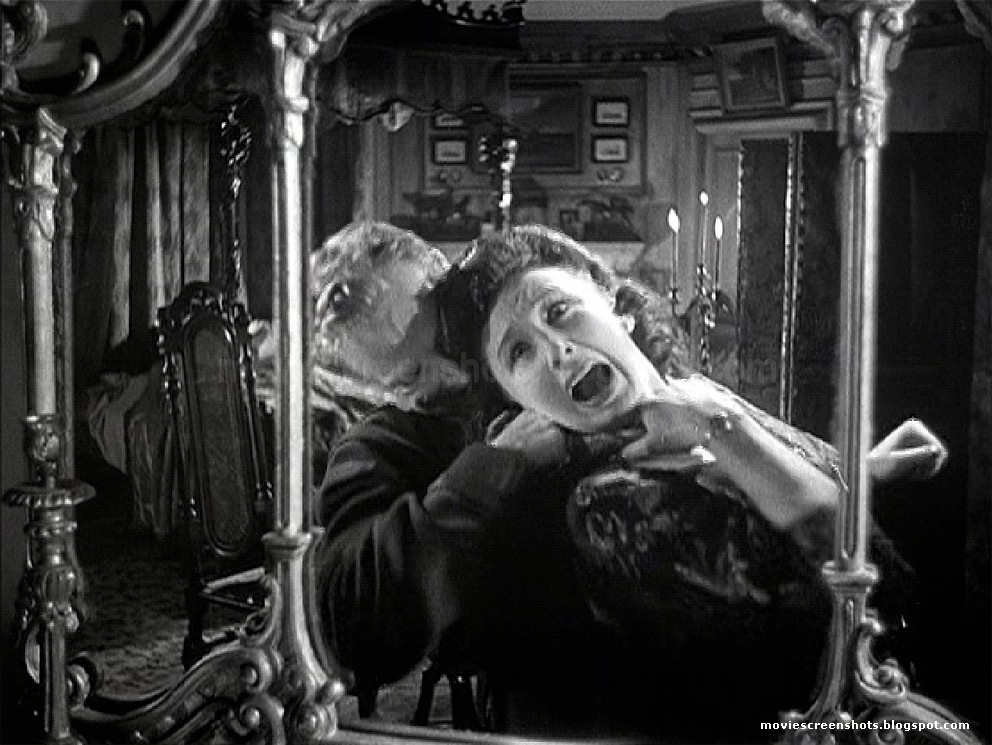
Robert Hamer - "The Haunted Mirror"
Charles Crichton - "The Golfer's Story"

Cast
Mervyn Jones - Walter Craig
Frederick Valk - Dr. van Straatan
Roland Culver - Eliot Foley

"The Hearse Driver"
Anthony Baird - Hugh Grainger 
Judy Kelly - Joyce Grainger
Miles Malleson - the hearse driver/ bus conductor

"The Christmas Party"
Sally Ann Howes - Sally O'Hara
Michael Allen - Jimmy Watson

"The Haunted Mirror"
Ralph Michael - Peter Cortland
Googie Withers - Joan Cortland
Esmé Percy - The antiques dealer

"The Golfer's Story"
Basil Radford - George Parratt
Naunton Wayne - Larry Potter
Peggy Bryan - Mary Lee

"The Ventriloquist's Dummy"
Hartley Power - Sylvester Kee
Michael Redgrave - Maxwell Frere


Gary Gerani writes about the importance of the anthology film "Dead of Night" within the horror genre in his book "Top 100 Horror Movies." 

"Anthology style movies have had an uneven history at the box office. Audiences tend to prefer a single plot, theme and set of characters into which they can invest their emotions for ninety some-odd minutes. But of all the popular film genres, horror seems best suited to the fractured, multi-tale format, with or without a unifying 'host.' And undoubtedly the best of these episodic fright films is one of the first ever made, Dead of Night." (p.148)

Incidentally, Gerani places "Dead of Night" at number 20 in his top 100 horror movies. I think that's fair. This British horror film from 1945 deserves recognition for not only being an early horror anthology, but for its unique overall unique story line that portrays the hazy line separating reality and delusion. 
The film opens as architect Walter Craig (Mervyn Johns) is driving out to a country house to discuss renovations with a guy named Elliot Foley (Roland Culver). 
When Craig arrives, a handful of guests are sitting in the living room. 
He's rather dumbfounded when he enters because even though he's never met the people inside, he knows them for a reoccurring dream. He's also so familiar with the situation, thanks to his dream, that he's able to predict events that will occur around the house. He then predicts something terrible is going to happen before he leaves. 
A psychologist named Dr. van Straatan is one of the guests present. He tries to convince Craig that his fears are only in his head. The others, however, take an interest in Craig's insight and start telling each other about strange experiences they've personally had. These are where the stories begin. 

The Hearse Driver
This segment is based on a story by E.F. Benson.  
Hugh Grainger (Antony Baird) races cars for a living. One particular racing accident lands him in the hospital. 
One sleepless night, as his health has vastly improved, he notices the clock in his room stops. 
He gets up and happens to look out of his hospital window. A horse-drawn hearse is sitting underneath his window on the street below. The driver (Miles Malleson) looks up at Grainer and says in a Cockney British accent, "just room for one inside, sir." 
This, of course, freaks out Grainger. Soon after the experience, he's discharged from the hospital. 
He waits to catch a bus. And when it arrives, the bus conductor is the same man he saw driving the hearse. 
"Just room for one, inside," he tells Grainger.
Dumbfounded, Grainger doesn't board. The bus pulls away. And what happens next leaves Grainger thankful he listened to his instinct. 

The Christmas Party
Based on a story by Angus MacPhail, "The Christmas Party" this segment centers on teenager, Sally O' Hara (Sally Ann Howes). Sally tells of her experience encountering the ghost of a child during a Christmas party held inside a huge mansion. 
All the young guests start a game of hide-and-seek.  
Sally runs up a few flight of stairs and hides behind window curtains. 
A boy named Jimmy finds her, and then hides with Sally. 
Jimmy tells her about a murder that happened in the mansion years ago. Sally doesn't let the tale scare her, though.
They decide to hide up near the attic. Sally finds a door that leads to a nursery. She walks in and finds a little boy crying all by himself. 
She tries to console him, and then tucks him into bed. He says his name is Francis Kent. 
Afterwards, she heads back downstairs with all the other party goers. 
She inquires about the little boy upstairs she claims to have seen. Sally tells one of the adults about him and says his name is Francis. When its explained who Francis is, she nearly collapses with dred. 


Ralph Michael and Googie Withers in 
the story "The Haunted Mirror."
The Haunted Mirror
After Sally tells her story, a wife named Joan Cartland (Googie Withers) talks about an antique mirror she gave her husband, Peter (Ralph Michael), as a birthday gift. 
At first Peter loves the mirror. It fits in their apartment well. 
But he starts seeing his reflection in an unfamiliar room whenever he looks in the mirror.
He thinks he's loosing his mind. Even when looking in the mirror with Joan, he can see the unfamiliar room, but can't see Joan's reflection. Joan says she doesn't see what her husband claims to be seeing.
Concerned, Joan looks into the mirror's history and who the previous owner was. 
The antique dealer who sold her the mirror tells Joan it belonged to a Francis Etherington who had murdered his wife after thinking she was having an affair. 
When Joan returns home after visiting the antique dealer, she finds Peter sitting alone in the dark facing the mirror. He's not himself at all, and accuses her of cheating on him. 
Things become violent fast, until Joan is forced to take care of the situation with her husband and the mirror herself. 


Golfer's Story
Based on the short story, "The Tale of the Inexperienced Ghost" by H.G. Wells, this segment is the comic relief of the movie. 
Golf buddies, George Parratt (Basil Radford) and Larry Potter (Naunton Wayne), fall in love with the same woman, Mary Lee (Peggy Bryan). 
To figure out which one of them will pursue Mary's affection, they agree to let a game of golf figure that out for them. The winner will have Mary's hand. The loser will not interfere in any way, and will disappear forever. 
Parratt ends up winning by cheating. Defeated, Potter walks into a nearby lake and drowns himself. 
Soon, his ghost appears to Parratt demanding he gives Mary up. If he doesn't he has to haunt him for the rest of his life. 
Of course, he doesn't. Potter's ghost, meanwhile, forgets how to make himself disappear. 
This becomes a major problem on Parratt's wedding night.


Michael Redgrave (right) and Hugo in
the story "The Ventriloquist's Dummy."
The Ventriloquist's Dummy
Dr. van Straaten tells his own tale about an interview he conducted with a ventriloquist named Maxwell Frere (Michael Redgrave). 
Frere is famous for his performances with his dummy, Hugo. He appears at various nightclubs and other venues. Frere is an English gentleman while Hugo is insulting and quick with his biting remarks.
An American ventriloquist, Sylvester Kee (Hartley Power) travels to England to meet Frere and his dummy. 
Hugo, who seems cognizant and tends to speak for himself, evidently wants to leave the act with Frere and join with Kee. 
During an act, Hugo seems to get out of hand, and Frere tries to silence him. Hugo then bites his hand which draws blood. 
After that show, Kee meets with Frere and Hugo in Frere's hotel room to talk business. 
The next morning, Frere finds Hugo in Kees' room, and accuses him of trying to steal his dummy. He ends up shooting Kees and is, of course, arrested. 
This is where Dr. van Straaten gets involved. He meets with Frere in his jail cell, and then has Hugo brought to the cell.
He watches as Frere has an argument with Hugo, and attempts to suffocate the dummy with a pillow before smashing its head in with his foot.  
When Kee, who survives being shot, visits Frere in the hospital, he finds that Frere isn't himself anymore.
This is the creepiest story, thanks in large part to Hugo. It's also a story that obscures what's real and what's pure delusion, which is done really well. Nothing is obvious in this segment.
In the final act back inside the house, Craig's horrific prediction comes true. He murders Dr. van Straaten. During this tragic event, he starts seeing himself within each of the stories he has heard throughout the course of the movie. 
Soon, he wakes up at the sound of the phone ringing, and tells his wife he had a terrible nightmare. The caller is Eliot Foley, inviting him to his country home to discuss renovations.
As the credits start rolling, we see Craig driving down the same country road from the beginning of the movie. He then stops at the same country house and is greeted by Eliot Foley. 
"Dead of Night" is a well-made psychological film with a theme (or so it seems to me) of human reaction to death and eternity. 
The first story seems to portray the looming reality of death. This leads to other stories surrounding individuals facing or confronting death in various manners. 
The reality of death is told in various unique ways. The movie doesn't completely rely on grotesque images and monsters to frighten the audience. Reality and mental delusion are obscure. 
It ends with Craig in an eternal loop. Is he in some kind of hell for his deed? Insanity is doing the same thing over and over again, and expecting a different result. 
"Dead of Night" feels a little ahead of its time as a psychological thriller and an anthology. Or, perhaps its more better to say the movie is foundational in the horror genre. 
I may have to re-watch this movie to gain some clarity about the entire premise.  
I thought I had "Dead of Night" figured out within the first 30 minutes. I anticipated that all the people in the room were dead and it would later be revealed they were all living some sort of hell. That's not quite the case. 
The movie slows down right before the last act. There's a slight but distinct foreboding feeling that wafts from story to story. It's interrupted in "The Golfer's Story."
That segment is intentionally silly, and ends with an uncomfortable situation. On Mary and Parratt's wedding night, Mary obviously wants Parratt to take her to the bedroom so they can consummate their marriage. 
Mervyn Jones as Walter Craig in "Dead of Night."
But Potter is forced to haunt him as he forgot how to make himself vanish. So, when they go into the bedroom, the idea is that Potter is going to be forced to watch them. 
Of course, it doesn't get that far as Parratt accidentally makes himself vanish leaving the ghost of Potter to...umm...fill in for him. No pun intended.
It would have been so much better if this story were depicted with the same trepidatious tone as the other stories. I haven't read Wells' story this is based on. I don't know if his short story is meant to be comedic or not. Either way, the comedy feels out of place in this movie. 
In "The Golfer's Story", Basil Radford, who plays George Parratt, and Naunton Wayne, who plays Larry Potter both starred as a double act in Alfred Hitchcock's 1938 movie "The Lady Vanishes" where they played Caldicott and Charters. They were popular enough that their characters in "Dead of Night" are derived from Caldicott and Charters.   
Though the movie doesn't rely on hideous creepy things that generally scare audiences (or did in 1945), it packs in a lot of frightful elements surrounding premonitions of death, spirits, cognizant (maybe?) ventriloquist dummies, unrequited love, and insanity. 
After the credits rolled, I couldn't wait to start writing. The story has been lingering in my head since I watched it.
I recognize Welsh actor Mervyn Johns from his later role as Bob Cratchit in the 1951 British film "Scrooge." English actor Miles Malleson, who plays the hearse driver in this movie, also appears as "Old Joe" in "Scrooge." 
But most recognizable of all is the young Sally Ann Howes who is well known for playing "Truly Scrumptious" in the 1968 film "Chitty Chitty Bang Bang."
I previously reviewed another horror movie that stars Howes - 1980's "Death Ship."
"Dead of Night" is like a long episode of "The Twilight Zone." It if were a Twilight Zone tale, it would surely be a classic episode worth remembering. 
I have yet to find another horror anthology film so well structured with a story well told in a multi-tale format without a singular host to tell it. It's a beautiful foundation to anthology horror films. "Dead of Night" doesn't begin inside a haunted house, or with a hideous monster telling us how we're going to be scared. It begins with a bad dream and a group of ordinary people sitting in a living room telling each other what weird experiences they've had. The uneasy grows from there. Well done! 

Monday, March 21, 2022

108) Drive-In Massacre (1976)

Stu Segall

Cast
John Goff - Det. Mike Leary
Bruce Kimball - Det. John Koch
Robert E. Pearson - Austin Johnson
Douglas Gudbye - Germy
Norman Sheridan - Orville Ingleson


I'm back in deep schlock territory with the 1976 B-slasher flick "Drive-In Massacre." 
This movie was made in, and is intended for, the era of drive-in movies. That's clear not just from the title. This was before drive-ins became seemingly antiquated Americana pieces that you might still find in random towns few and far between for mostly nostalgic purposes.
I've always wanted to watch a movie at a drive-in. I have yet to experience what that's like.
This movie tries relatively hard to turn the experience of watching a movie in your car into a potential life or death situation. Of course, at drive-ins, there's more going on than eating junk food and watching movies like "Drive-in Massacre."
The movie starts with a title card indicating that on "August 10th, at a rural California drive-in, the horror began."
We then see a young attractive couple sitting in their car as couples at drive-ins generally do. 
The horror wastes no time as the story starts off. Just as they're getting warm and cozy, the dude decides he actually wants to listen to the movie. He struggles (of course) reaching out the car window to grab the speaker. 
An unseen killer comes out of nowhere and slices the guy's head off with a single swipe of a sword. The girl also "gets it" through her neck. 
Detectives Mike Leary (John F. Goff) and John Koch (Bruce Kimball) investigate the murders. One of their fellow investigators advises them to speak with the theater's manager, Austin Johnson (Robert E. Pearson).
"I talked to the manager of the drive in," this other officer says. "His name is Austin Johnson, and you're really gonna like him. He's what you'd call your perfect asshole." There's really no clearer way to describe Johnson.
When they go to question Johnson, he's more upset that the theater owner disappeared and left him the undesirable task of running the place than he is over the fact two people were brutally murdered the night before. 
"So, a couple horny kids got themselves chopped up by some kook! So, what?" Johnson says. 
They also speak with the theater's custodian, Germy (Douglas Gudbye), who's much more helpful than Johnson. He tells the cops that a guy comes in every night to peep on the couples making out in their cars. They instruct him to write his license plate down next time he sees him at the drive-in.  
Johnson, by the way, treats Germy terribly and refers to him as a "miserable piece of vomit."
During the next night's show, the killer murders two other young lovers while they're...*ahem...making memories during the movie. 
This time, the killer leaves his sword behind. 
Previously, Germy told investigators the missing owner has a collection of swords. So, they bring Germy to the station to see if he can identify it as part of the owners private collection. Unfortunately, it's not. But Germy gives police the peeping tom's license plate number.
It belongs to a loner named Orville who admits upon questioning why he goes to the drive-in each night. 
Robert E. Pearson (Center) playing "the perfect asshole"
in "Drive-In Massacre."
During the investigation, police search Orville's car where they find clothing stained with blood. 
He tries to escape on foot, but they catch up and place him under arrest. 
But they have to let him go soon after because Orville insists the blood is from a dog he accidentally ran over with his car. The police confirm this claim with an analysis of the blood.
Orville insists his innocence, and also promises never to go back to the drive-in. 
The next night, Leary and Koch are at the drive-in disguised as a couple. 
They see Orville at the drive-in, despite his promise to never return. 
During the movie, a young guy tries to make out with the girl he's with. However, she's more interested in actually watching the movie. Frustrated, he storms off for a bit while she stays in the car.
When he returns, he finds his girlfriend without her head. 
Right away, the investigators think Orville is the killer. But when they approach his car, he's throat is slit. 
They were three cars away from the killings. And they were supposed to be looking out. How they completely missed everything happening is simply thanks to lousy story execution. 
The investigators take Austin and Germy in for more questioning. 
Austin is being his usual dick-headed self. Police want to close the theater down, but Austin refuses unless they obtain a court order. He then fires Germy. 
The next night, police get a call about a lunatic with a machete who just killed two people, fled to a warehouse, and is holding a young girl hostage.
Leary and Koch chase this guy down, and think this is their drive-in killer. Spoiler - it's not their guy.
Later, Germy goes to collect his things at the theater and have a word with Austin. 
The investigators see Germy walk into the projection booth. Then, a silhouette of Austin getting beheaded is visible on the movie screen.
The investigators rush in. What they find isn't what they expected. The movie ends abruptly with a disclaimer. 
The overall film reminds me of a homemade movie made by rather knowledgeable student filmmakers for their final project. It would earn them a solid "B+" for sure. I'd have to take points off for moments of poor writing and one or two instances of bad direction. Still, I would commend them for the amount of effort that went into their production. 
The horror element comes in strong in the opening, and then tapers off as the movie becomes a crime thriller rather than a slasher. 
The killer using a sword as his weapon makes the scenario seem that much more maniacal and insane. 
There's little happening after the gore in the beginning, except for investigating on top of investigating. 
The story seems to remember at times that it's supposed to be a slasher horror film, and tries to live up to slasher movie expectations with a horror scene here and there. 
The entire scene with Leary and Koch chasing the killer in the warehouse with the young hostage is one of the most awkward scenes in a B-film I've seen. 
The girl escapes his grasp, and never says a thing other than pleading for him not to kill her. 
When the investigators arrive, there's a cat and mouse chase through the warehouse before they finally shoot him.
The girl runs into frame, with hardly any emotion. 
"Did you have to kill him? He's my father," she says nonchalantly. 
I wonder why she couldn't have run out or shouted "Please don't shoot him. He's my dad."
The entire scene is awkward and terribly executed. I understand what the writers are trying to do with it. They're trying to set up a false conclusion to bolster up the audience's sense of dread. It's hilarious - unintentionally, no doubt. 
The trepidatious soundtrack reminds me of something you'd hear on a video game from an Atari, or whatever video game console people played in 1976. 
The ending is a cheap attempt to give the audience a lasting sense of uneasiness after the credits roll.
When the investigators break into the projection booth, they find the mutilated bodies of Johnson and Germy. 
Rather than show the audience who the killer is, a voice booms over the speakers at the theater.
"Ladies and gentlemen, this is the manager. Do not panic. There is a murderer loose in the theater. I repeat, do not panic. The police are on the way."
The movie then ends with a disclaimer on another title card.
"The killer could strike again. Anywhere...Anytime...Who will be next?" 
The beginning is enough to pull audiences in. But once they're in, it's like being tricked into listening to an insurance seminar or a time share sales pitch. Disappointing! There's something to build up to, but we're left with no satisfying conclusion. 
"Drive-In Massacre" wants audiences who probably first saw this movie at a drive-in to keep that uncomfortable "what if" feeling in the back of their minds as they drive back home.
I admit I had a little fun watching "Drive-In Massacre" primarily because of its B-Horror cult status, and the nostalgia of it all. 
The highlight of this movie is its writer, George Buck Flower. Flower is best known as "the bum" in "Back to the Future" and "Back to the Future II." 
He also stars in other well known films such as "They Live", "Escape from New York" and "Pumpkinhead" to name a few titles. I didn't realize it at the time, but he plays the maniac in the warehouse in this movie. Crazy drunk pedestrian! 
Though the movie starts off strong as a horror picture, if fizzles out to an underwhelming, haphazard story. But oddly enough, this one is kind of growing on me, all things considered.

Monday, February 21, 2022

107) Tales from the Darkside: The Movie (1990) - The More Horror There Is...

Director
John Harrison

Cast
Deborah Harry - Betty
Matthew Lawrence - Timmy

Lot 249
Christian Slater - Andy
Steve Buscemi - Bellingham
Julianne Moore - Susan

Cat from Hell
William Hickey - Drogan
David Johansen - Halston

Lover's Vow
James Remar - Preston
Rae Dawn Chong - Carola
Robert Klein - Wyatt

The television anthology series "Tales from the Darkside" is worth remembering. The show comes from the mind of horror legend George Romero and aired some campy but otherwise good episodes during its run.
I've mentioned the series before when I wrote about obscure movies and shows based on the works of Stephen King.
"Tales from the Darkside" ran from 1984 to 1988 on CBS. After the weekly horror series ended, the show's producer, Richard Rubinstein, went on to produce another horror anthology show called "Monsters." I've also mentioned this series in my list of Stephen King movies. "Monsters" ran from 1988 to 1991 and is a series I'd like to look into more. The only episode I've seen of "Monsters" is titled "The Moving Finger," based on a short story by King.
Both shows featured celebrity appearances similar to another horror series of tales I just wrote about that aired on HBO.
"Tales from the Darkside" somehow managed to earn itself a movie in 1990 called "Tales from the Darkside: The Movie." How original. And, like its source material, it has quite a list of celebrity actors in its three tales of terror. The stories come from the minds of Michael McDowell, Sir Arthur Conan Doyle, and... surprise... Stephen King.
The film begins with a wraparound segment starring rock singer Deborah Harry as a modern ghoulish witch named Betty, who's keeping a young boy, Timmy (Matthew Lawrence, "Mrs. Doubtfire"), locked in a cell. She feeds him cookies in the hopes of fattening him up because she's planning a dinner party, and Timmy is the main course.
Timmy tries to stall the witch by reading tales from a book she left in the cell with him—her favorite book when she was a child.

Lot 249
Screenwriter Michael McDowell starts the storytelling off with Sir Arthur Conan Doyle's short story "Lot No. 249."
In this tale, Steve Buscemi plays graduate student Edward Bellingham, who's a lover of antiquities and has been framed by two fellow students, Susan (Julianne Moore) and her boyfriend, Lee (Robert Sedgwick).
They stole a valuable museum piece and planted it in Bellingham's dorm room.
With the university breathing down his neck, as they think he's guilty of the theft, this betrayal will ruin his opportunity to obtain a scholarship.
Bellingham obtains an ancient mummy that he is able to reanimate by reciting words found on a parchment buried with the mummy.
As the mummy is under his control, he uses the corpse to murder both Lee and Susan in the same ancient Egyptian way it was preserved centuries ago. Back then, according to the film, Egyptians would extract the deceased's brains through its nose with a metal hook. Its insides were then removed and replaced with flowers and spices.
Susan's brother, Andy (Christian Slater), quickly figures out what is taking place behind Susan and Lee's murders.
He knocks Bellingham out and ties him up in a chair. Andy's plan is to get Bellingham to summon the mummy so he can destroy it. After that, he'll set Bellingham on fire.
Andy is able to destroy the mummy. But when he gets to the killing part of his plan, he can't bring himself to do it.
Later, Bellingham brings Susan and Lee back to life to obtain revenge on Andy.
McDowell's screenwriting credits include work on the TV series as well as on "Monsters," "Tales from the Crypt," "Amazing Stories," and "Beetlejuice." He's also a novelist and an all-around talented writer.
The story itself is a bit bland, and I say that with all respect to Arthur Conan Doyle. Though the premise certainly has the feel of classic horror, it's the lackluster performances in this segment that make it lackluster.
As the students are all upper-class, preppy '90s kids, they're all played without much personality or emotion. Julianne Moore screaming is the only time anyone in the story emotes.
This segment feels like a palate cleanser.
The horror is grotesque right away and continues through the film. The horrific imagery is what stands out most about "Tales from the Darkside: The Movie."

David Johansen in Tales from the Darkside: The Movie
Cat From Hell
George Romero takes this short story from Stephen King and includes it as the second tale.
It's both the most humorous story and the most disturbing as far as disgusting imagery is concerned. Spoilers ahead... because I have to mention the ending.
A wealthy old businessman named Drogan (William Hickey) hires a killer, Halston (David Johansen), to take out a simple house cat.
Drogan informs Halston that he owned a pharmaceutical company that used cats as test subjects for new drugs. This testing resulted in the deaths of thousands of felines. So, Drogan believes this cat, which suddenly appeared on the doorstep one day, intends to gain revenge on the entire household.
Drogan relates how the cat is responsible for killing his two sisters, Amanda (Dolores Sutton) and Carolyn (Alice Drummond, "Ghostbusters"). It also took out their family butler, Richard (Mark Margolis). Now, Drogan is next.
Halston, of course, thinks Drogan is out of his mind. But since he's paying big money, he accepts the job to simply kill a cat.
Drogan leaves him while Halston gets to work.
As he tries to take the cat out, Halston discovers it's his most difficult job yet.
When Drogan returns, he finds Halston's dead body on the floor.
The cat had leapt onto his face, forced its way into his mouth, crawled down his throat, and into his body. And the audience sees the entire thing happen.
As Drogan stares at Halston's body, the cat comes back out of Halston's mouth and leaps onto Drogan's lap. The shock leads to Drogan having a heart attack.
It's a predictable story, but Johansen certainly has fun with the role. He gives a lot of energy, infuriatingly yelling at this cat that's getting the better of him.
Evidently, this story was intended to appear in the 1987 horror anthology movie "Creepshow 2" but was ultimately scrapped.
The segment has the feel of a tale to be told in the "Creepshow" franchise, with its awkward angles, many of which are from the cat's point of view, and comic-book-esque flashback sequences shot with a blue filter.
Seeing a cat crawl in and crawl out of Johansen through his mouth is a well-done effect and a truly unforgettable scene.

James Remar as "Preston" in the story Lover's Vow.
Lover's Vow
Michael McDowell writes the final story in the film. And this is the most terrifying one. More spoilers are ahead.
A struggling artist, Preston (James Remar), lives alone in a studio apartment. A stone gargoyle on an adjacent building happens to face into his apartment through the skylight. His agent, Wyatt (Robert Klein), calls, asking to meet at a bar near Preston's apartment.
When Preston finally arrives, Wyatt doesn't beat around the bush. He tells Preston that his artwork isn't selling and that he's dropping him as a client.
Feeling demoralized, Preston stays at the bar and drinks a few more.
Before he knows it, it's closing time. The bartender offers to get him home, as he's too plastered to take himself home.
As the two exit into the alley, Preston takes a moment to relieve himself. Meanwhile, the bartender sees a winged gargoyle standing right there in the alley. So, he starts shooting.
The creature tears the bartender's hand off and then rips off his head.
It then turns its attention to Preston, who begs the creature to spare his life.
"Your life in exchange for a promise," the creature says.
Of course, Preston agrees.
"If I let you go, you must swear you'll never say you saw me, never say you heard me speak, never tell anyone how I look, never repeat what I've said. A promise... forever," it says.
He hesitates a bit, until the gargoyle raises its hand to strike. Then he promises.
"Cross your heart," the gargoyle says as it claws Preston's chest with three long slashes. And then it flies off.
Later in the night, trying to sober up while comprehending what he just witnessed, Preston runs into a young woman named Carola (Rae Dawn Chong) while she's trying to get home.
He stops her, warning her that it's dangerous on the streets.
Carola claims to be lost and wants to get a taxi. Preston encourages her to call a taxi from his apartment, promising she'll be safe.
After a while, the two fall in love, get married, and have a couple of kids.
In the ten years proceeding, Preston is burdened by the events he witnessed the same night he met Carola. He's never been able to forget. But his life as an artist has improved considerably, thanks in large part to connections Carola has in the art world.
That promise, though, chews at his mind incessantly. Holding in this experience has been difficult.
On their 10th anniversary, Preston decides to tell Carola about the gargoyle he saw the night he met her and how it killed the bartender.
He thought after ten years that his promise would have been forgotten. But it wasn't. And he broke it.
I find this story the scariest segment, with its depiction of a man's burden of being forced to hold onto a secret. How would someone cope with witnessing the existence of gargoyles but being forced to never tell? In Preston's case, demon-like gargoyles exist and kill people. And when he does tell someone, he's forced to watch all he holds dear succumb to that otherworldly reality.

Matthew Lawrence as "Timmy."
"Tales from the Darkside: The Movie" relies more on its horror and imagery, which, to the movie's credit, is unforgettable. The stories get better as they progress.
I recall seeing this in my younger days. Scenes from each story stuck with me for 30 years.
Too much of it initially comes across as flat and, at times, rushed.
After the third tale is told, young Timmy makes a quick getaway. He kills the witch and makes a cute remark to the camera, breaking the fourth wall, saying, "Don't you just love happy endings?" And then the credits roll.
This horror movie is a fun scare but doesn't exceed beyond that.
Still, it's a movie that has received a bit of a following and hasn't been lost to obscurity. With names such as Sir Arthur Conan Doyle, George Romero, and Stephen King, that's certainly no surprise.

Tuesday, February 15, 2022

106) NEW HORROR RELEASES - Shut In (2022)


Director
D.J. Caruso

Cast
Rainey Qualley - Jessica Nash
Luciana VanDette - Lainey Nash
Jake Horowitz - Rob
Vincent Gallo - Sammy


I've sat through probably too much of the mindless, tasteless drivel the horror genre has produced over the decades. But I've also watched, and re-watched, some of the most sublime and magnificent horror films made. "Frankenstein" (1931) remains one of my favorite movies in the genre.
On February 10, the conservative news site, The Daily Wire, released its first original horror movie "Shut In." I was taken in by the fact a relatively new news agency is producing its own horror film. I had to see what this would be like. So, I managed to catch the premier.
Often horror movies elevate the monster into a hero of sorts. Torture and murder become the homeruns audiences cheer for. Often do horror fans prefer to see the monster slaughter the innocent young girls. The more kills, the better. That's where schlock comes from. Sure, a lot of it is freaky and frightening.   Freaky and frightening is what attracts audiences and horror fans. But with such schlocky horror movies, that's all there is to take away at the end.
In an episode of "Siskel and Ebert at the Movies," film critics Gene Siskel and Roger Ebert narrowed in on this aspect of horror films which they claimed is often mixed with misogyny.
In that episode, Ebert says, "I think a lot of people have the wrong idea. They identify these films with earlier thrillers like 'Psycho' or even a more recent film like 'Halloween', which we both liked. These films aren’t in the same category. These films hate women, and, unfortunately, the audiences that go to them don’t seem to like women much either. To sit there [in a theater] surrounded by people who are identifying, not with the victim but with the attacker, the killer – cheering these killers on, it’s a very scary experience.” 
"Shut In" offers a relatable, frightening tale about a woman. Jessica Nash (Rainey Qualley) is a former meth addict who's now focused on keeping her life clean as she raises two young children. 
She lives in an inherited old farm house that belonged to her grandmother. Her plan is to sell the house, which is surrounded by apple trees, so she can move to a new location and start a fresh life.
While packing up belongings, Jessica accidentally gets locked in the kitchen pantry. While she's in there, her drug addicted violent ex-husband Rob (Jake Horowitz) shows up to the house with his drug addict buddy, Sammy (Vincent Gallo). Jessica is weary of Sammy as he's been previously accused of pedophilia. 
Rob lets her out of the pantry. As the two guys are clearly high and looking for cash, Rob locks Jessica back in the pantry in a fit of anger. He nails it shut as a form of "punishment" stemming from his own jealousy towards her undergoing drug rehabilitation. He also intentionally kicks a small bag of cocaine under the pantry door so she can fall back into her old habit. Rob insists she's not better than he is.
The two guys leave. Jessica now has to make sure her daughter, Lainey, is able to help take care of her son, Mason, while she's lock in the pantry. Mason is still a toddler, and Lainey is about four-years old. Sammy returns to the house alone several hours later. Jessica quickly has to find a way to stop him from harming her children. 
And she must quickly find a way to get out of the pantry. 
Amidst all her worries and fears, Jessica's period of darkness in the pantry forces her to face her urges to fall back into her cocaine habit, think about her relationship with God, and come to terms about being a mother despite feelings of inadequacy to be a good mom.
How will she come out of this darkness? 
Qualley's performance is magnificent as she so easily conveys Jessica's emotions and turmoil through simple inflections and body language. It's almost flawless. 
Rainey Qualley as Jessica Nash in "Shut In."

For a thriller, Shut In focuses a lot more on the moral of the story rather than the trepidation and sense of danger within the scenario. 
Initially, I anticipated the movie would focus more on the kids being in a place of danger while their mother is locked in the pantry and wicked men take advantage of the situation. 
As the film progresses, this isn't quite the case.
While some moments build up tension, they're quickly relieved. That doesn't necessarily make it a bad film. It simply wasn't as thrilling as I anticipated after watching the trailers. 
Monsters looming over us in dark places don't necessarily have to be evil demons, or machete yielding killers in hockey masks. They can simply be those small things we fight every day that bring us down, such as a small bag of cocaine, our own sense of failure, or bad company. Those worst case scenarios can be truly frightening to watch. 
Daily Wire co-founder Jeremy Boreing endorses this film as an artistic one.  
In his "Letter to Artists" Pope John Paul II writes, "Even when they explore the darkest depths of the soul or the most unsettling aspects of evil, artists give voice in a way to the universal desire for redemption." 
Suffering, inner-turmoil, and the desire to be rescued are themes running throughout the movie. "Shut In" accomplishes what it sets out to do without being preachy or hammering its themes over the heads of the audiences. 
The audience can easily put themselves in the main characters place. And not only are they in the pantry with her, they can reflect on their own struggles while she struggles with her own situation. They can realize the same truths as she does. There's always a way out. We just have to be willing to get a few scrapes and scars in the process.
I've always been of the opinion that horror should act as a sort of "how to" guide when it comes to facing our fears. Horror movies like this one can encourage us to overcome, rather than succumb. 
Though a bit underwhelming in its thrills, "Shut In" is truly one of the best thriller films I have seen in a while. The horror is certainly more psychological than bloody.
The simple, relatable, yet frightening scenario reminds me of something Stephen King would produce where the protagonist finds themselves stuck in some agonizing situation that could happen to anyone. Donna Trenton finds herself stuck in her Ford Pinto with her son Tad, fighting against the threat of dehydration and heat stroke as the ravenous St. Bernard dog, Cujo, waits to attack them outside their car. 
The only way out will require some sort of sacrifice, perhaps for the better. The protagonist will find their freedom. That much is certainly obvious. The cost of freedom isn't so obvious. 
Their exit from the darkness will leave a scar. And that scar will always be there. For Jessica, the freedom and the life waiting for her on the other end of the darkness within the pantry is much more sweeter. She's a mother, and that's worth any sacrifice.  
In his book "Danse Macabre", King says, "Horror movies do not love death, as some have suggested; they love life. They do not celebrate deformity, but by dwelling on deformity they sing of health and energy. By showing us the miseries of the damned they help us rediscover the smaller joys of our own lives. They are the barber’s leeches of the psyche, drawing not bad blood but anxiety … for a little while anyway." 
It's certainly not a ground-breaking film in the horror genre. It's a story similar to films such as "Panic Room" (2002) and "Don't Breath" (2016) but with a bit more emphasis on its themes. Still, I'm glad I saw it.

My Latest Review!

247) The Lodgers (2017)